The Google site reputation abuse policy update was a clarification published on 19 November 2024 that made third-party content hosted to exploit a site’s…
The Google explicit fake content update was a ranking change announced on 31 July 2024 that demotes non-consensual explicit deepfake imagery in Search and…
The Google December 2022 helpful content update started on 5 December 2022 and finished on 12 January 2023, 38 days against Google’s two-week estimate.…
The Google September 2022 product reviews update started on 20 September 2022 and finished on 26 September 2022, a six-day rollout that again rewarded…
The Google page experience update for desktop extended the page experience ranking signal from mobile to desktop search. It started on 22 February 2022…
Google’s featured snippet deduplication was a change confirmed on 22 January 2020 that stopped a URL shown in the featured snippet from also appearing…
The Google Mobile-Friendly update, nicknamed “Mobilegeddon”, began on 21 April 2015 and expanded mobile-friendliness as a ranking signal in mobile search results, worldwide and…
The Google HTTPS ranking signal was announced on 6 August 2014, when Google started using secure, encrypted connections as a lightweight ranking signal that…
The Google Pirate Update, announced on 10 August 2012, added a ranking signal based on how many valid copyright removal (DMCA) notices Google receives…
The Google Freshness Update, announced on 3 November 2011, changed how Google decides when a searcher wants recent results, and Google said it affected…
The Google Negative Reviews Update, announced on 1 December 2010, was Google’s response to the DecorMyEyes story: an online merchant that mistreated customers yet…
The Google Allegra update arrived in early February 2005 (Wikipedia gives 2 February) and was the most discussed Google update since Florida, even though…
The Google Brandy update rolled out in February 2004 (Wikipedia gives 17 to 20 February) and shifted rankings towards topical relevance: better handling of…
The Google Dominic update was the May 2003 index refresh during which webmasters saw backlink counts and rankings swing, and noticed unusual crawler activity.…
Short answer: Google says its systems look at many factors and signals, weighted differently for each query, but it has never published a list…
Read the guide →
Google algorithm updates are changes to the systems Google uses to rank search results. This page lists every notable Google update from the first named update, Boston in February 2003, to the latest confirmed update in 2026: 108 updates in total, each with its start and finish dates, what it changed, and a full article on how to recover if it hit your site.
Google confirms broad core updates and spam updates on its Search Status Dashboard. Older updates, before Google confirmed them publicly, are dated from the best-documented industry sources and marked as such in each article. I update this page whenever Google announces a new update.
A core update is a broad change to how Google assesses content overall. It does not target one site or one tactic. Pages can rise or fall because Google has become better at judging which results are most helpful, not because something on your site broke. Core updates usually take one to three weeks to roll out.
Spam updates
Spam updates improve the systems that detect pages breaking Google’s spam policies, such as link schemes, cloaking, scaled content abuse and site reputation abuse. If a spam update hits a site, the fix is to remove the violation, not to wait for the next update.
Helpful content and reviews
Google ran separate helpful content and reviews updates between 2021 and 2023. With the March 2024 core update, the helpful content system became part of Google’s core ranking systems, so its signals now move with core updates rather than on their own schedule.
Discover and other surface updates
Some updates affect a single surface, such as the February 2026 Discover update. If traffic changes only in Discover or only in Images, check that report in Search Console on its own before assuming a sitewide problem.
The landmark updates that shaped modern SEO
Panda (2011): demoted thin, low-quality and duplicated content. It is the reason content quality became a ranking conversation.
Penguin (2012): targeted manipulative link building. It is why link quality matters far more than link count.
Hummingbird (2013): rebuilt how Google interprets queries, moving from matching keywords to understanding meaning.
Mobile-friendly update (2015): made mobile usability a ranking factor, and Google later moved to mobile-first indexing.
RankBrain (2015): Google’s first widely discussed machine learning system for understanding queries it had never seen before.
BERT (2019): improved how Google reads the context of words in a sentence, especially in longer, conversational queries.
Page experience (2021): brought Core Web Vitals into ranking signals alongside HTTPS and mobile usability.
Helpful content system (2022): rewarded content written for people over content written to rank, and was folded into core ranking in March 2024.
March 2024 core and spam updates: introduced the scaled content abuse, site reputation abuse and expired domain abuse policies that still shape what is safe to publish.
How to tell if an update affected your site
Wait for the rollout to finish. Rankings move around during a rollout. Check the end date on the Search Status Dashboard first.
Compare like with like. Google suggests waiting at least a full week after an update finishes, then comparing that week in Search Console with the week before it started.
Separate the surfaces. Look at Web, Images, Video, News and Discover separately. A drop in one does not mean a drop in all.
Find the pattern. Sort pages and queries by the change in clicks. Small drops of a few positions rarely need action. Large, sustained drops across a section of the site do.
Rule out other causes. Tracking changes, a migration, a robots.txt mistake or a seasonal dip can look exactly like an algorithm hit. My diagnostic checklist for sudden traffic drops walks through them in order.
What to do after a drop
Google’s advice is to avoid quick fixes. Review the pages that lost the most visibility and ask honestly whether they are the most helpful, reliable and people-first answer to the query. Improve or restructure what can be improved. Deleting content is a last resort. Some changes are recognised within days, but it can take months, and sometimes the next core update, for improvements to show. If you would like a second pair of eyes, an SEO audit separates algorithm effects from technical problems quickly.
Questions about Google algorithm updates
What is the latest Google algorithm update?
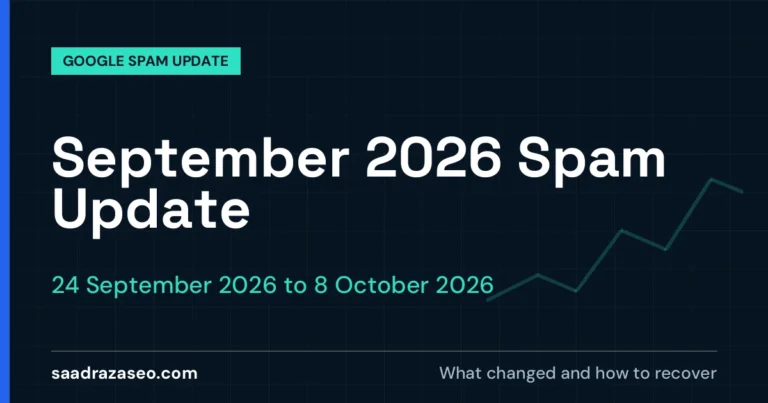
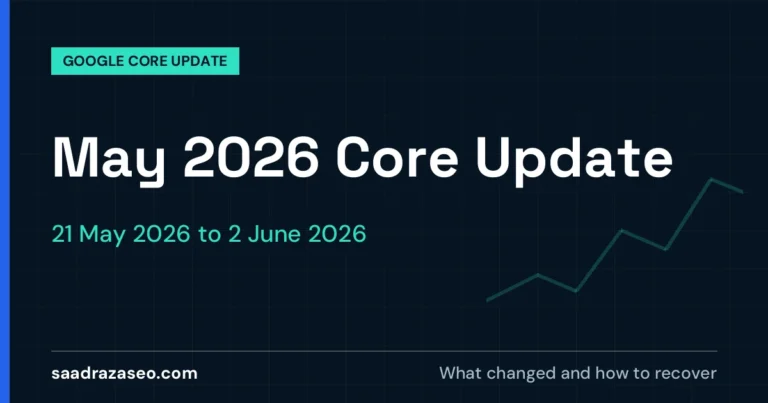
The most recent confirmed update is the September 2026 Spam Update, which started on 24 September 2026 and finished on 8 October 2026. The latest core update is the May 2026 Core Update (21 May to 2 June 2026).
How often does Google update its algorithm?
Google changes its ranking systems thousands of times a year, but most changes are small and unannounced. In recent years it has confirmed two to four broad core updates and several spam updates each year.
How long does a Google core update take to roll out?
Most recent core updates have taken between one and three weeks. The March 2024 core update was unusually long and took about six weeks.
What was the first Google algorithm update?
The first named update was the Boston update in February 2003, announced at the SES Boston conference. Before that, Google refreshed its index roughly monthly in what SEOs called the Google Dance.
Can I recover from a Google update?
Yes, but not with a quick fix. For core updates, recovery comes from making affected pages genuinely more helpful and trustworthy, and often shows at the next core update. For spam updates, remove the violation; algorithmic recovery can take months. Each update article on this page has its own recovery steps.
Does a ranking drop after an update mean I have a penalty?
Usually not. A core update reassesses all sites, so others may simply have been judged more helpful. A manual action is different and is shown in the Manual actions report in Search Console.
If an update has hit your traffic and you want a clear plan, request a free audit and I will tell you what changed and what to fix first.
Request received
Thank you! Saad will contact you within the next 24 hours.