
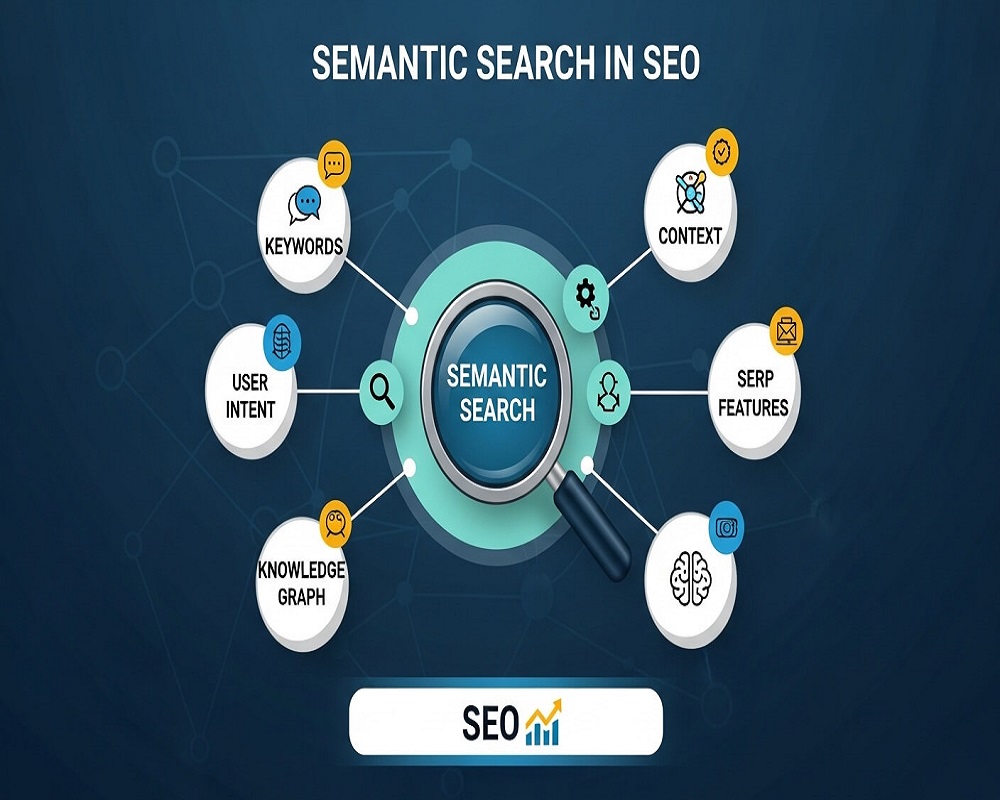
Short answer: Semantic search is when a search engine works out what a query means, including the intent, the entities involved and the context, instead of only matching the exact words typed. For SEO, that means pages rank for what they help with, not for how often they repeat a phrase. To use it, match search intent, cover the topic and its related questions fully, name entities clearly, link related pages and add structured data.
This guide is for business owners, writers and new SEOs who want to know what semantic search actually changes about how they plan and write pages. It explains how Google interprets meaning, which of its systems do what, and the practical steps I use to make content easier for both Google and AI assistants to understand, with a quick self-check at the end.
What is semantic search?
“Semantic” means relating to meaning. A semantic search engine tries to understand what the searcher wants, not just which words they used. Compare two approaches to the query “best place to get kebabs near Gulshan late at night”:
- Lexical (keyword) search looks for pages containing “best”, “place”, “kebabs”, “Gulshan” and “late at night”.
- Semantic search recognises that this is a local, commercial query; that “kebabs” relates to restaurants and BBQ; that Gulshan is a Karachi neighbourhood (Gulshan-e-Iqbal) rather than Gulshan in Dhaka, based on location; and that “late at night” points to opening hours. It might show a map of BBQ places open now, even if none of them uses the word “best”.
Semantic search also handles ambiguity. “Apple” in “apple pie recipe” and “apple share price” refers to different entities, and Google uses the surrounding words, the searcher’s location and past patterns to pick the right one.
How Google’s semantic search works
Semantic search is not one algorithm. It is several systems working together, and Google documents most of them in its guide to Search ranking systems. The table below summarises what each does in plain terms.
| System | Introduced | What it does | What it means for your content |
|---|---|---|---|
| Knowledge Graph | 2012 | Stores entities and the relationships between them | Name people, brands, places and products clearly and consistently |
| Hummingbird | 2013 | Rebuilt the core algorithm to interpret whole queries | Write for the full question, not a fragment of it |
| RankBrain | 2015 | Relates words to concepts so pages can rank without the exact terms | No need for separate pages for every synonym |
| Neural matching | 2018 | Matches concepts in queries to concepts in pages | Clear explanations of a concept are matched even to vague queries |
| BERT | 2019 | Understands how word order and small words change meaning | Natural, precise sentences beat keyword strings |
| Passage ranking | 2020 (announced) | Judges relevance of individual sections of a page | A clear section on a sub-question can rank even within a long page |
| MUM | 2021 | Understands and generates language across languages and formats | Google says it is not used for general ranking, only specific applications |
Google’s own example of BERT shows why this matters. Before BERT, the query “2019 brazil traveler to usa need a visa” returned results about US citizens travelling to Brazil, because the word “to” was largely ignored. After BERT, Google understood the direction of travel (Google, 2019). Small words carry meaning, and so does your phrasing.
Entities, intent and context
Underneath these systems sit three ideas you can act on:
- Entities: the distinct things a query and a page are about. I cover how to make yours clear in how to do entity-based SEO.
- Intent: the job the searcher wants done, whether to learn, compare, buy or find a specific site. See my guide to search intent.
- Context: location, language, device, time and earlier searches. A query for “SEO services” from Lahore and from London should not return the same page.
Vectors and embeddings, briefly
Modern retrieval turns queries and passages into lists of numbers (embeddings) so that texts with similar meanings sit close together, even when they share no words. “Dripping tap” and “leaky faucet” end up near each other. You do not need to compute embeddings to do good SEO, but the idea explains why covering a topic in natural, varied language works better than repeating one phrase.
Rather have an expert do this for you?
Hand it over and get back to running your business.
Semantic search vs keyword search
| Keyword-matching mindset | Semantic mindset | |
|---|---|---|
| Planning | One page per keyword variant | One page per intent, covering its variants |
| Writing | Hit a target density | Answer the question fully in natural language |
| Structure | Keyword in every heading | Headings that mirror the questions people ask |
| Linking | Exact-match anchors | Descriptive anchors that connect related topics |
| Success measure | Rank for one phrase | Impressions across many related queries |
Keywords still matter. They tell you how people phrase a need and which topics have demand. What changed is that matching the words is no longer enough; the page has to satisfy the meaning. My older guide to keyword density explains why repetition stopped working.
How to optimise for semantic search
1. Start from intent, not the phrase
Before writing, search the query and look at what ranks. Are the top results guides, product pages, comparisons or local listings? If Google shows a map pack and service pages, a 3,000-word blog post will struggle however good it is. Match the format first.
2. Cover the topic the way an expert would
List the sub-questions a knowledgeable person would expect to see answered. Sources I use: Google’s “People also ask” and related searches, Search Console queries the page already gets impressions for, sales and support questions from the client, and gaps in the current top results. A page on “semantic search” that never explains intent or entities feels incomplete to readers and to Google. My guide to semantic SEO goes deeper on planning topic coverage.
3. Write clear, self-contained sections
Because of passage ranking and AI Overviews, individual sections can be pulled out and shown on their own. Give each H2 or H3 a question-style or descriptive heading, answer it in the first sentence or two, then add detail. Define terms the first time you use them. This is also what makes content quotable in AI Overviews.
4. Use natural variation and related terms
Use synonyms, related concepts and the terms your audience uses. For Pakistani audiences, that often includes Roman Urdu and local terms (“ac mistri”, “plot for sale DHA”, “online rishta”). Do not force in lists of so-called “LSI keywords”; lists of related terms are only useful as a prompt for subtopics you may have missed, not as words to paste in. I explain this in how to use related keywords.
5. Make entities explicit
Name the main entity in the title, H1 and opening. Google says it uses structured data both to understand a page and to gather information about the world, such as people, books and companies (Google Search Central). Add structured data that matches the page: Article with an author, Organization on the About page, Product on product pages, LocalBusiness for physical locations, FAQPage only where the page genuinely contains FAQs. My schema markup generator helps with the common types.
6. Link related pages into topic clusters
Internal links show how your pages relate. A pillar page on a broad topic links to detailed pages on each subtopic, and they link back. This helps Google understand that your site covers a subject in depth, which is how topical authority is built in practice. See topic clustering for a step-by-step method.
7. Measure query breadth, not just one ranking
In Search Console, open the page and look at the Queries tab. A page that Google understands well usually appears for many related queries, including ones you never targeted. If impressions are concentrated on one phrase, or the page appears for unrelated queries, the topic or intent is unclear.
Worked example: rewriting a keyword-led paragraph for semantic search
Before: “Our semantic SEO services in Karachi are the best semantic SEO services. Contact us for semantic SEO in Karachi.” This repeats one phrase and tells the reader nothing.
After: “I plan content around the questions your customers ask, group related pages into topic hubs and add the structured data Google uses to recognise your business. For a Karachi clinic, that might mean one page per treatment, a guide answering common patient questions, and Organization and LocalBusiness markup that match the Google Business Profile.” The second version names entities (clinic, treatments, Google Business Profile), covers related concepts and describes real work, so it matches far more queries than the phrase it dropped.
Common mistakes I see
- Several thin pages for one intent: “SEO company Karachi”, “SEO agency Karachi” and “SEO firm Karachi” as three near-identical pages. They compete with each other; see keyword cannibalisation.
- Stuffing related-term lists: pasting tool-suggested terms into a paragraph at the end of an article.
- Vague headings: “Overview” and “More information” give Google no clue what a section answers.
- Schema that does not match the page: FAQ or review markup with no visible FAQs or reviews.
- Ignoring the searcher’s language: writing only in formal English when customers search in Roman Urdu or local shorthand.
Check your understanding
A searcher types “2019 brazil traveler to usa need a visa”. What did BERT change about Google’s answer?
- It ranked pages with the highest keyword density
- It understood the word “to” meant a Brazilian travelling to the US
- It showed results only from government websites
BERT reads words in context, so small words like “to” that change meaning are no longer ignored. That was Google’s own launch example.
You sell AC repair in Karachi. Which plan suits semantic search best?
- Separate pages for “AC repair”, “AC repairing” and “AC mistri”
- One page repeating “AC repair Karachi” in every paragraph
- One strong service page that covers the common problems, prices and areas, using the terms customers use
The three phrases share one intent, so one page should cover them. Semantic systems connect the variants without separate pages.
Which Google system does Google say is not used for general ranking?
- MUM
- BERT
- RankBrain
Google’s ranking systems guide says MUM is not currently used for general ranking, only for specific applications such as improving COVID-19 vaccine searches.
What is the best sign in Search Console that Google understands a page’s topic?
- It ranks first for one exact phrase
- It gets impressions for a wide set of closely related queries
- It has the highest word count on the site
Broad, relevant query coverage shows Google connects the page to the whole topic, not just a string of words.
Frequently asked questions
What is semantic search in simple words?
It is search that understands meaning. Instead of matching the exact words you type, the search engine works out what you want, which things you are talking about and the context, then shows results that answer that, even if they use different words.
Is semantic search the same as semantic SEO?
No. Semantic search is what the search engine does. Semantic SEO is what you do in response: planning and writing content around topics, entities and intent so the engine can understand and match it.
Does Google still use keywords?
Yes. Words in the query and on the page still matter, and the title, headings and opening paragraph should use the language people search with. Google simply interprets those words in context instead of counting them.
Does structured data help semantic search?
It helps Google identify entities and page types with less guesswork and makes some rich results possible. It does not replace clear content, and markup must match what is visible on the page.
How does semantic search affect AI Overviews and AI assistants?
AI answers are built from passages that clearly answer a question. Pages with well-defined sections, named entities and direct answers are easier to extract and cite, so the same practices help in both classic results and AI features.
Sources
- Google, “Understanding searches better than ever before” (BERT announcement, October 2019).
- Google, “How AI powers great search results” (February 2022).
- Google Search Central, “A guide to Google Search ranking systems” (updated 2025).
- Google Search Central, “Introduction to structured data markup in Google Search” (updated 2025).
If you would like me to review whether your key pages match intent and cover their topics properly, my on-page optimisation service starts with exactly that, or you can send me your site.
Request received
Thank you! Saad will contact you within the next 24 hours.
Keep an eye on your phone and inbox.