
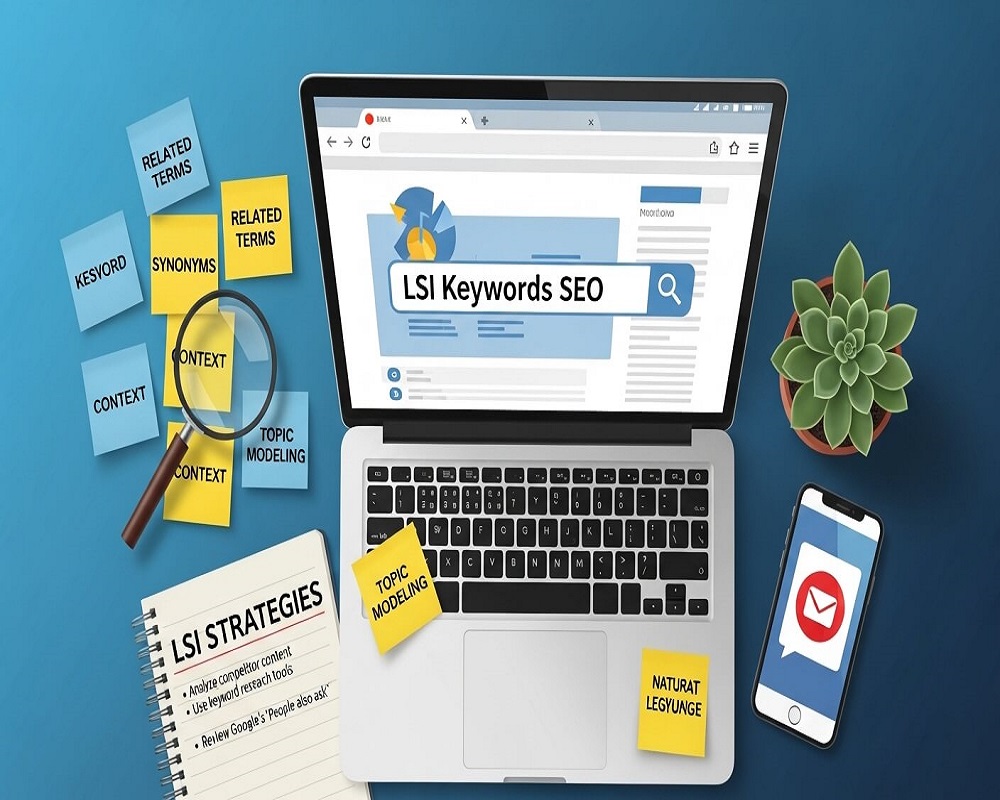
Short answer: “LSI keywords” is an SEO label for related words and phrases, but Google does not use latent semantic indexing and has said LSI keywords do not exist as a ranking concept. What people mean by the term still matters: cover the related subtopics, entities, questions and wording your searchers expect, so the page fully answers the query. Find them in the results page and your own data, then write naturally.
This guide is for writers, site owners and SEOs who have been told to “add LSI keywords” by a plugin, a brief or a course. I will explain honestly what the term means, why Google rejects it, and the method I actually use to cover related terms, entities and questions so a page answers its query fully, without stuffing in a list of words.
What people mean by “LSI keywords”
In everyday SEO talk, “LSI keywords” means words and phrases that are closely related to your main keyword. For a page about “home loan”, people would list terms like “mortgage rate”, “down payment”, “tenure”, “EMI”, “credit score” and “processing fee”. The idea is that a page which uses these terms looks more clearly about home loans than a page that repeats “home loan” twenty times.
That idea is broadly sensible. The name is not. The term borrows the label of a 1980s information retrieval technique and attaches it to something much simpler: writing about a topic the way a knowledgeable person would, using the vocabulary that naturally comes with it.
What latent semantic indexing actually is
Latent semantic indexing (LSI), also called latent semantic analysis, is a mathematical method for finding patterns in which words appear together across a fixed set of documents. It builds a large table of terms and documents, then compresses that table so that documents sharing related vocabulary end up close together, even if they do not share the exact search word. According to Search Engine Journal, the patent application for it was filed in September 1988. It was designed for small, relatively static collections, not a web index of billions of pages that changes every minute.
Does Google use LSI keywords?
No. In July 2019 Google’s John Mueller wrote: “There’s no such thing as LSI keywords — anyone who’s telling you otherwise is mistaken, sorry” (Search Engine Roundtable). He has also said Google has “no concept of LSI keywords” and that it is something you can completely ignore. There is no public evidence that Google has ever ranked pages with latent semantic indexing.
What Google does describe is far more capable. Its guide to ranking systems says RankBrain helps it “understand how words are related to concepts”, neural matching helps it understand representations of concepts in queries and pages, and BERT helps it understand how combinations of words express different meanings and intent. When Google announced BERT, it said the system would help Search better understand one in 10 searches in US English (Google, 2019).
The practical consequence: Google does not need you to sprinkle “related keywords” for it to understand your topic. It needs the page to genuinely cover what searchers want to know. This shift to semantic search is why I treat the “LSI” checklist as a research prompt, not a target.
So why does the term survive?
- It points at something real. Pages that cover the full topic often do rank better, and they naturally contain related vocabulary. People mistake the side effect for the cause.
- Tools sell it. “LSI keyword generators” give a neat list, which feels more actionable than “understand your reader”.
- Briefs repeat it. Many content briefs still include an “LSI keywords” field, so writers keep hearing it.
Rather have an expert do this for you?
Hand it over and get back to running your business.
LSI keywords vs what actually helps
When I review a brief that lists “LSI keywords”, the list is usually a mix of five quite different things. Separating them makes it clear which ones help and how to use each.
| What the list contains | Example for “home loan” | Does it help? | How to use it |
|---|---|---|---|
| Subtopics | eligibility, documents required, interest rates, prepayment | Yes, most of all | Give each real subtopic a section or a clear paragraph |
| Entities | State Bank of Pakistan, KIBOR, banks that offer the product | Yes, they add precision | Name them where they are relevant and explain them; see entity-based SEO |
| Questions | “how much home loan can I get on my salary” | Yes, they reveal intent | Answer directly, often as an H3 or FAQ |
| Query variants and synonyms | mortgage, house finance, ghar ke liye loan | Sometimes | Use the wording your market uses, once or twice, naturally |
| Generic co-occurring words | money, bank, month, apply | No | Ignore; they appear anyway if you write well |
The first three rows are where the value is. This is the core of semantic SEO: covering the meaning of a topic, not repeating its words.
How to find related terms, entities and questions
You do not need a paid “LSI” tool. This is the order I work in for a new article.
- Read the results page first. Search the main query in a private window. Note the type of pages ranking, the headings they share, and what the top results have in common. That tells you the intent before any word list does. My guide to search intent explains how to read it.
- Collect questions. “People also ask” boxes, autocomplete and related searches show the follow-up questions real people have. Write them down word for word.
- Check your own Search Console data. For an existing page, the Performance report shows queries you already appear for but barely answer. These are the best related terms you will ever get, because they are your searchers’ words.
- List the entities. Which organisations, products, laws, places, people or standards does an expert naturally mention on this topic? Wikipedia, official sites and regulator pages help here.
- Use keyword tools for gaps, not quotas. Keyword tools and content editors (Ahrefs, Semrush, Surfer and similar) show terms common across top pages. Use them to spot a subtopic you missed, then decide whether your reader needs it. Proper keyword research groups these into topics.
- Group by subtopic. Sort everything into sections. Anything that deserves its own page belongs in a separate article, linked from this one, as part of a topic cluster.
A local angle: Pakistani and mixed-language searches
On Pakistani sites, the most useful “related terms” are often not in any English tool. People search “home loan”, “house finance”, “ghar ka qarza” and “Meezan easy home” for overlapping needs, and they type “AC repair” alongside “AC mistri” or “AC service near me”. When I audit sites here, the gap is rarely a missing English synonym. It is that the page ignores the words customers actually use. Search Console and your sales team’s call notes are better sources than any generator for this.
How to use related terms in your content
Once you have the subtopics, entities and questions, use them where they help the reader:
- Headings: turn real subtopics and questions into H2s and H3s so readers and Google can see the structure. My guide to header tags covers this.
- Opening paragraph: answer the main query in plain words, using the main keyword once.
- Body: explain each entity or term when you first use it. A related term that is mentioned but never explained adds nothing.
- Title and meta description: write for the click, with the main keyword and the payoff. Do not cram related terms in.
- Image alt text: describe the image accurately; never use it as a place to list terms.
- Internal links: link to your deeper pages on related subtopics with descriptive anchors.
Google’s SEO Starter Guide puts it simply: think about the words a user might search for, and avoid excessively repeating the same words, even in variations, because that is tiring for readers. A list of 40 related terms dropped into a 1,000-word article is still keyword stuffing, just spread wider. If you are worried about this, see avoiding over-optimisation.
Worked example: rewriting an “LSI-stuffed” paragraph
Before (written from a generator list): “Our home loan offers the best mortgage rate. A home loan with a low mortgage interest rate, flexible loan tenure and easy EMI makes home financing simple. Apply for home finance and housing loan today.”
It contains six “related keywords” and tells the reader nothing.
After (written from questions and entities): “Most banks in Pakistan price home finance against KIBOR, the benchmark rate, plus a fixed margin, so your monthly instalment can change when the benchmark moves. Before applying, check three things: the maximum tenure the bank allows, the prepayment charge if you want to repay early, and the salary or income documents they require.”
The rewrite uses fewer “keywords” but answers real questions, names an entity (KIBOR) and explains it, and covers subtopics (tenure, prepayment, documents). That is what related-term coverage should look like.
Common mistakes I find
- Pasting a generator list into the brief as mandatory words. Writers then force terms in where they do not belong.
- Chasing a “related keyword density”. Rules like “1 to 2%” or “one per 200 words” have no basis in anything Google publishes, and keyword density itself is a weak measure. Use the keyword density checker only to catch overuse.
- Treating synonyms as coverage. Swapping “car” for “automobile” does not answer a single extra question.
- Creating separate pages for each variant. “LSI” variants of the same intent belong on one page; separate pages compete with each other, which I explain in keyword cannibalisation.
- Ignoring entities. A guide to VAT that never names the tax authority, or a recipe that never names a cooking method, looks thin to readers whatever words it contains. Making the main entity clear is covered in my guide to entity salience.
Check your understanding
LSI keywords: quick self-check
Does Google use latent semantic indexing to rank pages?
- Yes, it is a core ranking factor
- No, Google has said LSI keywords are not a thing
- Only for long articles
John Mueller said in 2019 that there is no such thing as LSI keywords. Google uses systems such as RankBrain, neural matching and BERT to understand language.
Which item from an “LSI keyword” list usually adds the most value?
- Generic words like “bank” or “month”
- Exact synonyms of the main keyword
- Subtopics and questions searchers actually have
Subtopics and questions show what the reader needs answered. Covering them is what makes a page useful, and related vocabulary follows naturally.
What is the best source of related terms for an existing page?
- Search Console queries the page already appears for
- An LSI keyword generator
- The keywords meta tag
Search Console shows the exact words real searchers used to find you. Google’s Starter Guide also confirms it does not use the keywords meta tag.
A brief asks for 40 related terms in a 1,000-word article. What should you do?
- Fit all 40 in somewhere
- Use the ones that match real subtopics and drop the rest
- Put them in the image alt text
Forcing terms in creates repetitive copy, which Google’s guidance calls tiring for users. Coverage of the topic matters, not the count of words.
Frequently asked questions
Are LSI keywords real?
Not in the way the name suggests. Latent semantic indexing is a real 1980s technique, but Google has said there is no such thing as LSI keywords in its ranking. Related terms, entities and subtopics are real and useful; the “LSI” label is just inaccurate.
What is the difference between LSI keywords and semantic keywords?
In practice people use both phrases for the same thing: terms related to your topic. “Semantic keywords” is the more accurate name, because Google’s systems model meaning and concepts, not latent semantic indexing. The useful work is the same: cover subtopics, entities and questions.
Are LSI keywords the same as synonyms?
No. Synonyms are words with the same meaning, such as “lawyer” and “advocate”. Related terms are words that belong to the topic, such as “bail”, “court fee” and “Bar Council” for a page about hiring a criminal lawyer. Related terms add more coverage than synonyms do.
How many related keywords should I use?
There is no number. Cover the subtopics and questions a reader needs, explain any entity you name, and stop. If a sentence only exists to fit a word in, delete it.
Are LSI keyword generator tools worth using?
They can prompt ideas, but they produce lists without context. I get better results from the live results page, “People also ask”, Search Console queries and the entities an expert would mention. Use any tool as a checklist for gaps, never as a quota.
Sources
- Search Engine Roundtable, “Google: There Is No Such Thing As LSI Keywords” (2019).
- Search Engine Journal, “Latent Semantic Indexing (LSI): Is It A Google Ranking Factor?” (2022).
- Google Search Central, “A guide to Google Search ranking systems” (last updated 2025).
- Google, “Understanding searches better than ever before” (BERT announcement, 2019).
- Google Search Central, “SEO Starter Guide” (last updated 2025).
If your content plan still runs on keyword lists and you want it rebuilt around topics, intent and entities, my on-page optimisation service covers it, or you can ask me a question about a specific page.
Request received
Thank you! Saad will contact you within the next 24 hours.
Keep an eye on your phone and inbox.