
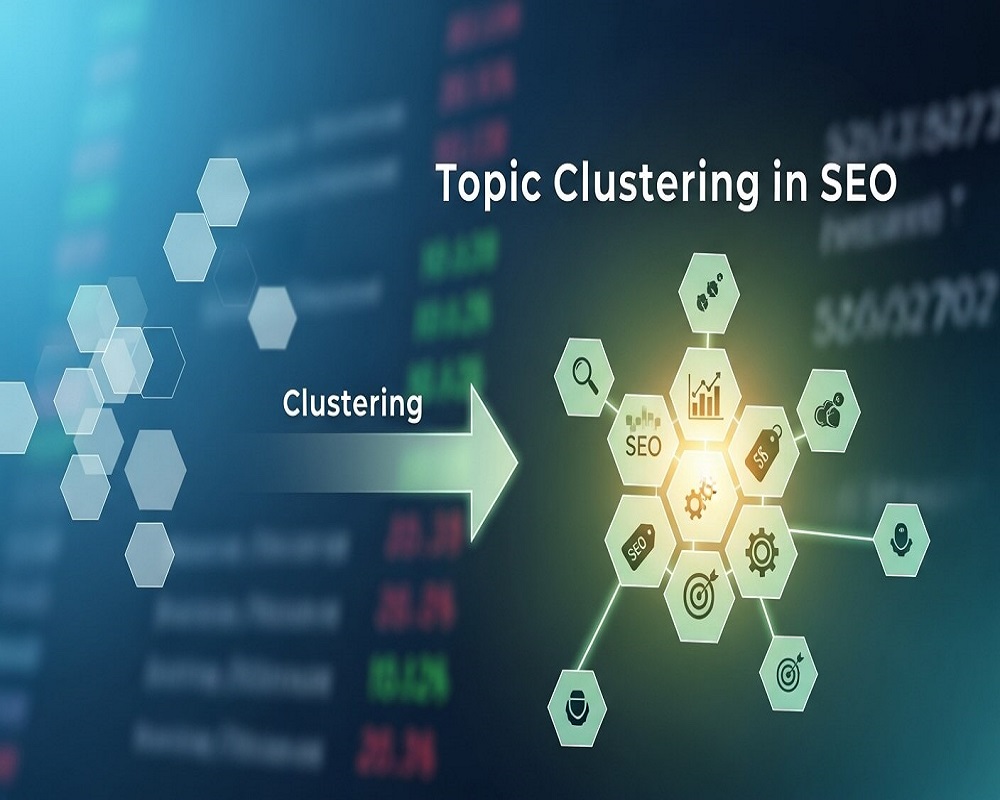
Short answer: To do topic clustering in SEO, choose a broad topic your business should be known for, collect the keywords around it, and group them by search intent so each group becomes one page. Make one pillar page that covers the topic as a whole, create cluster pages for each subtopic, then link every cluster page to the pillar and to closely related siblings with descriptive anchor text. Review the cluster in Search Console every quarter.
This guide is for business owners, content leads and SEOs who have a blog full of unconnected posts, or who are planning a new site and want structure from day one. I walk through the method I use to plan clusters for clients, with a worked example for a Karachi solar installer, a cluster map table and a checklist you can follow.
What is a topic cluster?
A topic cluster is a group of pages on one subject, organised so that readers and search engines can see how they relate. It has three parts:
- Pillar page: a broad page that covers the main topic as a whole and points readers to the detail. For example, “Solar panels for homes in Pakistan”.
- Cluster pages: pages that each answer one subtopic in depth, such as “Net metering in Pakistan”, “On-grid vs hybrid solar systems” or “Solar panel cleaning”.
- Internal links: every cluster page links to the pillar, the pillar links to every cluster page, and closely related cluster pages link to each other.
You will also see the terms content hub, hub and spoke, and pillar page used for the same idea. A silo is related but stricter: it restricts links to within a section, while clusters link wherever it helps the reader. My guide to site architecture for SEO covers how clusters fit into a site’s overall structure.
Why topic clusters help SEO
Google has never said it ranks “topic clusters” as such, and I would not claim it does. What clusters do is make several things Google does care about easier:
- Discovery and crawling: Google’s link guidance says every page you care about should be linked from at least one other page, with anchor text that is descriptive, concise and relevant (Google Search Central). A cluster guarantees that for every page in it.
- Clear relevance: one page per intent means Google does not have to choose between near-duplicate posts. That avoids keyword cannibalisation.
- Topical depth: covering the questions an expert would expect shows the site knows the subject. This is the practical side of topical authority.
- AI search: Google says AI Overviews and AI Mode may use “query fan-out”, running related searches across subtopics (Google Search Central). A site with a good page for each subtopic has more chances to be one of the pages those searches find.
- Readers: someone who lands on a cluster page can move to the next question without going back to Google.
Rather have an expert do this for you?
Hand it over and get back to running your business.
How to do topic clustering: step by step
Step 1: Pick topics that match what you sell
Start from the business, not a keyword tool. List the three to five subjects your customers need to understand before they buy. A solar installer’s list might be home solar systems, net metering, batteries and maintenance. A pillar topic should be broad enough to have at least five to ten distinct subtopics, and narrow enough that one page can introduce it properly.
Step 2: Collect every keyword and question around the topic
Pull keywords from several places, because each misses things:
- Keyword tools (Ahrefs, Semrush or Google Keyword Planner) with the topic as a seed.
- Google autocomplete, “People also ask” and related searches.
- Search Console queries your site already appears for.
- Customer questions from WhatsApp, calls, email and sales meetings. For Pakistani businesses this is often the richest source, and it surfaces Roman Urdu and local terms tools miss.
- Subtopics on the topic’s Wikipedia page and in competitors’ guides.
My guide to keyword research covers this stage in detail.
Step 3: Group keywords by intent, using the results page
This is the step that makes or breaks a cluster. Two keywords belong on the same page if Google shows mostly the same results for both. Search them side by side: if the top results overlap heavily, they share an intent and should be one page; if they differ, they need separate pages. Tools that cluster by SERP overlap automate this, but a manual check of the top ten is enough for small sets. For background on intent types, see what search intent is and search intent segmentation.
Step 4: Map each group to one page
Give each keyword group one URL, either an existing page or a new one. Mark the broadest group as the pillar. Record the plan in a sheet with the primary keyword, secondary keywords, intent, page type, URL and status. This is the same discipline as keyword mapping.
| Page | Role | Main query | Intent | Page type |
|---|---|---|---|---|
| Solar panels for homes in Pakistan | Pillar | home solar system Pakistan | Informational and commercial | Guide |
| Net metering in Pakistan explained | Cluster | net metering Pakistan | Informational | Explainer |
| On-grid vs hybrid vs off-grid solar | Cluster | on grid vs hybrid solar | Commercial | Comparison |
| How many solar panels for a 10 kW system | Cluster | 10kw solar system panels | Informational | Calculator or guide |
| Solar panel cleaning and maintenance | Cluster | solar panel cleaning | Informational | How-to |
| Solar installation in Karachi | Money page | solar installation Karachi | Transactional and local | Service page |
The table is an illustrative plan, not a client’s site. Notice the last row: a cluster should feed a page that converts. Each cluster page links to the service page where it makes sense, and the service page links back to the guides that answer pre-sale questions.
Step 5: Write the pillar, then the cluster pages
The pillar should answer the broad question on its own, with a short section on each subtopic and a link to the cluster page for detail. Avoid pasting whole cluster pages into the pillar; that recreates the duplication you are trying to remove. Each cluster page should fully answer its one question, with the main answer near the top. Length should follow the question: “how often should I clean solar panels” may need 800 words, a comparison of system types may need 2,000.
Step 6: Link the cluster properly
- Pillar links to every cluster page, in context where each subtopic is introduced.
- Every cluster page links back to the pillar, early in the content where it is natural.
- Cluster pages link to siblings only where a reader would genuinely want to go next.
- Anchors describe the destination (“how net metering works”, not “click here”), and vary naturally.
- Add the pillar to your main navigation or a hub page so it is close to the home page.
My guide to internal linking goes further on anchor text and link placement.
Step 7: Measure at cluster level and fill gaps
In Search Console, filter the Performance report by a URL pattern or a list of the cluster’s pages and track clicks, impressions and the number of queries across the group over time. Look for queries where a cluster page gets impressions but sits on page two: these often reveal a missing subtopic that deserves its own page or a section. Most clusters I build show clearer movement in 3 to 6 months, depending on competition and how much of the cluster already existed.
Worked example: retrofitting an existing blog into a cluster
Imagine a Lahore interior design studio with 40 blog posts written over three years, five of which cover kitchen design: “Modern kitchen ideas”, “Kitchen design ideas 2023”, “Small kitchen design”, “Kitchen cabinet colours” and “Best kitchen layouts”. A SERP check shows “modern kitchen ideas” and “kitchen design ideas 2023” return almost the same results, so those two posts compete. The plan: merge them into one up-to-date pillar, “Kitchen design ideas for Pakistani homes”, and 301 redirect the weaker URL to it. Keep “Small kitchen design”, “Kitchen cabinet colours” and “Best kitchen layouts” as cluster pages, each linking to the pillar and to the studio’s kitchen design service page. Then add the missing subtopic that customers keep asking about on WhatsApp: “Kitchen renovation cost in Lahore”. This example is illustrative.
Topic cluster checklist
- Topic chosen: tied to something you sell, with at least five real subtopics.
- Keywords collected: from tools, Search Console, “People also ask” and customer questions.
- Grouped by SERP overlap: keywords with the same results share one page.
- One page per group: each group mapped to a single URL in a sheet.
- Pillar defined: the broadest group, covering the topic as a whole.
- Existing content audited: overlapping posts merged and redirected, not left competing.
- Cluster pages written: each fully answers one question with the answer near the top.
- Pillar to cluster links: every cluster page linked from the pillar in context.
- Cluster to pillar links: every cluster page links back to the pillar.
- Sibling links: only where a reader would naturally go next.
- Money page connected: the cluster links to the relevant service or product page.
- Pillar easy to reach: linked from navigation or a hub page.
- Tracking set up: cluster pages grouped in Search Console and reviewed quarterly.
Ticks are saved in your browser.
Common topic clustering mistakes
- Clustering by keyword similarity alone: “solar panel price” and “solar panel price list” look different but usually share one intent, while “solar inverter” and “solar inverter repair” look similar but do not.
- A pillar that tries to rank for everything: if it copies every cluster page, the pillar and clusters compete.
- Thin cluster pages written to fill a map: a 300-word page on a question that needs a real answer helps nobody.
- Clusters with no commercial link: traffic that never reaches a service or product page.
- Links only in a “related posts” widget: contextual links in the body carry more meaning for readers and Google.
- Never revisiting: new questions, products and regulations (for example, changes to net metering policy) need new or updated pages.
Frequently asked questions
How many pages should a topic cluster have?
There is no fixed number. It depends on how many distinct questions the topic really has. Small businesses often start with a pillar and five to eight cluster pages, then add more as Search Console reveals new questions.
What is the difference between a pillar page and a cluster page?
A pillar page covers a broad topic at a high level and links out to the detail. A cluster page answers one specific subtopic in depth and links back to the pillar.
Are topic clusters the same as keyword clustering?
They are related. Keyword clustering is the research step of grouping keywords that share an intent. Topic clustering is the content and linking structure you build from those groups. The keyword grouper does a first pass by grouping a keyword list by shared words, but you still need to check that each group shares one intent.
Can I build topic clusters on an existing site?
Yes, and it is often the quickest win. Audit your posts, group them by topic and intent, merge overlapping ones with 301 redirects, fill the gaps, and add the internal links.
Do topic clusters work for local businesses?
Yes. A local business can cluster around its services, with guides answering pre-sale questions linking to the service and location pages. Keep location pages genuine rather than near-duplicates for every neighbourhood.
Sources
- Ahrefs, “96.55% of Content Gets No Traffic From Google” (December 2023).
- Google Search Central, “Link best practices for Google” (updated 2025).
- Google Search Central, “AI features and your website” (updated 2025).
If you would like a cluster plan built from your own Search Console data and customer questions, my on-page optimisation service includes it, or you can tell me about your site.
Request received
Thank you! Saad will contact you within the next 24 hours.
Keep an eye on your phone and inbox.