
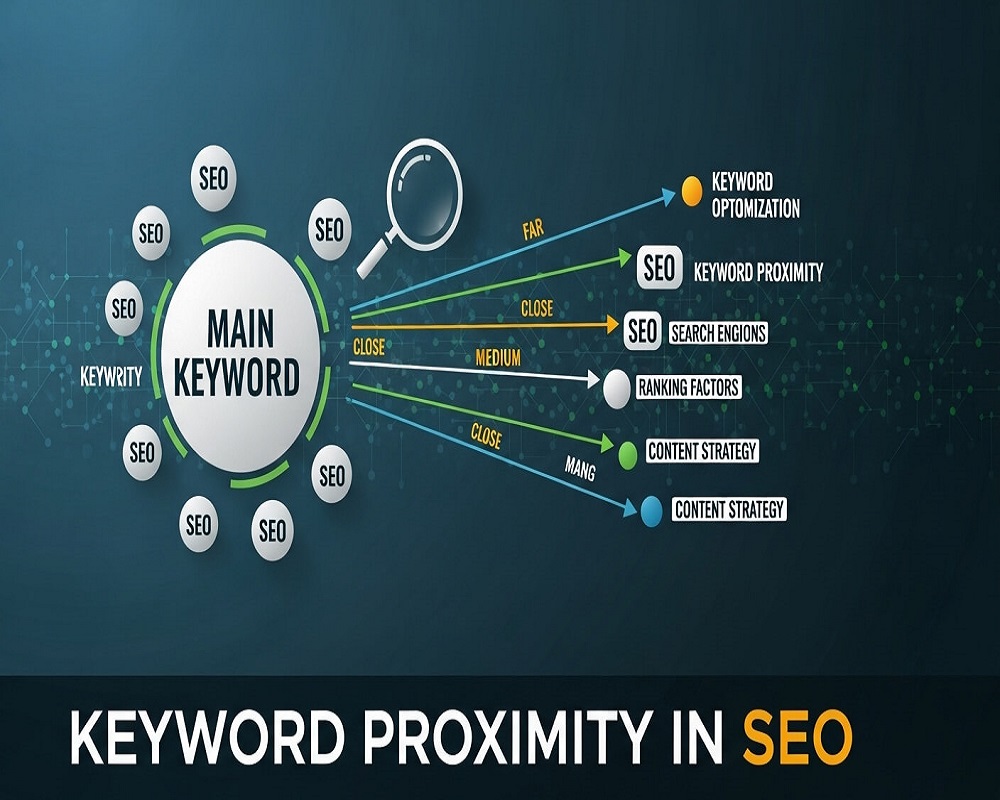
Short answer: Keyword proximity is how close together the words of a search phrase appear on your page. “Karachi web design agency” written as one phrase has close proximity; “web” in one sentence and “agency” three lines later has weak proximity. Keeping related words together in titles, headings and opening sentences helps readers and Google see the match, but Google does not publish proximity as a ranking rule, so write naturally rather than forcing exact phrases.
This guide is for writers, editors and site owners who have seen “keyword proximity” in an SEO checklist and want to know what it actually means, whether it is worth acting on, and how to use it without making the copy sound robotic. You will be able to spot weak and strong proximity in your own pages, fix the places where it matters, and ignore the places where it does not.
What keyword proximity means
Keyword proximity is the distance, usually counted in words, between the terms of a multi-word keyword. For the query “affordable dental implants Lahore”:
- Close proximity: “We offer affordable dental implants in Lahore.” All four terms sit within six words, in the same order as the search.
- Medium proximity: “Dental implants at our Lahore clinic are more affordable than you might expect.” The terms are there but spread across the sentence.
- Weak proximity: “Implants” in the first paragraph, “Lahore” in the footer and “affordable” in a pricing table. A reader has to assemble the meaning.
Proximity only applies to keywords of two or more words, which is why it matters most for long-tail keywords. For a one-word query there is nothing to be close to. It is usually discussed alongside three related ideas:
| Concept | What it measures | Question it answers | Example for “best biryani Karachi” |
|---|---|---|---|
| Proximity | Distance between the words of a phrase | Do the words appear together? | “the best biryani in Karachi” vs “biryani … best … Karachi” spread over a paragraph |
| Prominence | Where on the page the words appear | Are they in the title, H1 and opening? | The phrase in the H1 vs only in the last paragraph |
| Order | Sequence of the words | Do they follow the searcher’s wording? | “Karachi’s best biryani” keeps meaning; “biryani best Karachi” does not read naturally |
| Density | How often the phrase appears relative to page length | Is it repeated too much? | Twenty uses in 400 words is stuffing; see my guide to keyword density |
Does keyword proximity matter for SEO in 2026?
It matters, but not in the way older checklists suggest. Here is what Google has actually said, and what follows from it.
What Google confirms
- Google’s How Search Works page says the most basic relevance signal is a page containing the same keywords as the search, and that keywords in headings or body text can make information look more relevant.
- Google’s guide to its ranking systems describes BERT as a system that understands “how combinations of words express different meanings and intent”. When Google launched BERT in Search, its BERT launch announcement used the query “2019 brazil traveler to usa need a visa” to show that the small word “to” and its relationship to the words around it changed the meaning.
- The same guide lists neural matching, which matches concepts in queries and pages even when the exact words differ.
What that means in practice
Google reads words in relation to each other, which is the real reason proximity matters. A sentence that keeps “visa”, “Brazil” and “traveller to the USA” together makes the relationship clear. Scattered words make it ambiguous. At the same time, neural matching means Google does not need your exact phrase in an exact order. So proximity is about clarity, not about hitting a word-distance number.
No Google document gives a proximity score, threshold or formula, and I have not seen a credible study that isolates proximity as a ranking factor. Claims that “close proximity raises rankings by X%” are not something I can verify, so treat them with suspicion.
Where it clearly helps
- Titles and snippets: Google often highlights words that match the search in its results. A title that contains the phrase intact is easier to scan, which can help click-through. My guide to writing title tags covers this.
- Passages and AI answers: Google also uses passage ranking to judge individual sections of a page. A paragraph that answers a question in one tight, self-contained statement is easier to identify and quote, which matters for featured snippets and AI Overviews.
- Local and service pages: phrases like “AC repair in Gulshan-e-Iqbal” carry meaning only when the service and the place sit together.
Rather have an expert do this for you?
Hand it over and get back to running your business.
How to use keyword proximity well
- Find the real phrase. Use the wording searchers use, from Search Console queries or autocomplete; my keyword research guide shows how to collect it. On Pakistani sites that often includes Roman Urdu or mixed phrasing (“ac repair karachi”, “AC mistri near me”), so check the actual queries before choosing.
- Put it intact where people look first: the title tag, the H1, and the first sentence or two. Once each is enough.
- Keep modifiers next to the noun they modify. “Cheap flights to Dubai from Karachi” should not become “Flights to Dubai, with cheap options, from Karachi”. The modifiers usually carry the search intent.
- Use the phrase in a subheading only where that section is about it. Every H2 repeating the keyword is a common sign of over-optimisation.
- Elsewhere, write naturally. Use pronouns, synonyms and related terms. Google’s SEO Starter Guide warns that excessive repetition is tiring for users and that keyword stuffing breaks its spam policies.
- Read it aloud. If a sentence sounds like it was written for a robot, rewrite it. Proximity is never worth an awkward sentence.
Worked example: rewriting a service page intro
Before (weak proximity, padded): “Welcome to our company. We have been providing services for many years. Our team offers design solutions for websites. Businesses in Karachi trust us. Contact our agency today.”
The page targets “website design company in Karachi”. The words are all present, but spread across five sentences, so neither a reader nor Google gets the point quickly.
After: “We are a website design company in Karachi building fast, mobile-friendly sites for clinics, schools and retailers. Every project includes on-page SEO and a Core Web Vitals check before launch.”
The phrase appears once, intact, in the first sentence, followed by specifics that show expertise. No repetition is needed after that.
Common mistakes I see
- Forcing exact-match grammar: “best SEO company Karachi Pakistan cheap” written into a sentence. Google understands “an affordable SEO company in Karachi”.
- Repeating the full phrase in every heading and paragraph to keep proximity “high”. That is SEO over-optimisation, and it reads badly.
- Splitting the phrase across elements: “Dental Implants” in the H1 and “Lahore” only in the footer address. Join them in the opening sentence.
- Ignoring the separator words that carry meaning: “to”, “for”, “near”, “without”. “Flights to Dubai” and “flights from Dubai” are different searches.
- Optimising for one phrase when the page should cover a topic. A strong page answers related questions too; proximity on one phrase does not replace coverage. See semantic SEO for the wider approach.
Check your understanding
Which sentence has the closest proximity for the query “used cars Islamabad”?
- “Cars of every kind, many of them used, are sold across Islamabad.”
- “Browse used cars in Islamabad from verified sellers.”
- “Islamabad dealers sell new and pre-owned vehicles.”
B keeps all three terms within four words and in the searcher’s order. A spreads them across the sentence; C does not contain “used cars” at all.
What does Google publish about keyword proximity as a ranking factor?
- An ideal distance of three words or fewer
- A proximity score shown in Search Console
- No specific proximity rule; it describes systems such as BERT that read how words combine
Google has not published any proximity threshold. It says BERT helps it understand how combinations of words express meaning, which is why clear phrasing helps.
Where is it most worth keeping your main phrase intact?
- Title tag, H1 and the opening sentence
- Every H2 on the page
- The footer, so it appears on every page
These are the places readers and Google look first. Repeating the phrase in every heading or footer is over-optimisation.
Why is “flights to Dubai” not interchangeable with “Dubai flights from”?
- Because Google ignores short words like “to”
- Because small connecting words change the meaning of the search
- Because word order never matters
Google’s own BERT example showed that “to” changed the meaning of a visa query. Keep the connecting words that define what people want.
A quick proximity check for any page
Open the page and answer five questions. Is the main phrase intact in the title? In the H1? In the first two sentences? Are qualifiers (city, price, audience) sitting next to the service they describe? Does any sentence sound forced? My free on-page SEO checker pulls the title, headings and opening text into one view so this takes a minute, and the keyword density checker flags phrases you have repeated too often.
Frequently asked questions
Is keyword proximity a Google ranking factor?
Google has never named it as one or published a threshold. What Google does say is that its systems, such as BERT, read how combinations of words express meaning, and that matching keywords in headings and body text is a basic relevance signal. Clear phrasing helps; word-counting does not.
What is a good keyword proximity?
There is no official number. In practice, keep the words of your main phrase together, in natural order, in the title, H1 and opening sentence. Elsewhere, write as you would for a reader.
What is the difference between keyword proximity and keyword prominence?
Proximity is how close the words of a phrase are to each other. Prominence is where on the page the phrase appears, such as the title or first paragraph. Both matter most in the same few places.
Does word order matter for keyword proximity?
Often, yes, when it changes meaning. “Flights to Dubai” and “flights from Dubai” are different needs. Where order does not change meaning (“Karachi SEO consultant” and “SEO consultant in Karachi”), use whichever reads naturally.
Can keyword proximity lead to keyword stuffing?
Yes, if you repeat the full phrase everywhere to keep it “close”. Google’s guidance says excessive repetition is tiring for users and keyword stuffing breaks its spam policies. Use the phrase intact a few times and let synonyms do the rest.
Sources
- Google, “Understanding searches better than ever before” (The Keyword, 2019).
- Google Search Central, “A guide to Google Search ranking systems” (accessed 2026).
- Google, “How Search Works: Ranking results” (accessed 2026).
- Google Search Central, “SEO Starter Guide” (accessed 2026).
If your pages target the right phrases but still do not rank, the issue is rarely word distance. My on-page optimisation service looks at titles, headings, content coverage and internal links together, or you can send me a page to look at.
Request received
Thank you! Saad will contact you within the next 24 hours.
Keep an eye on your phone and inbox.