
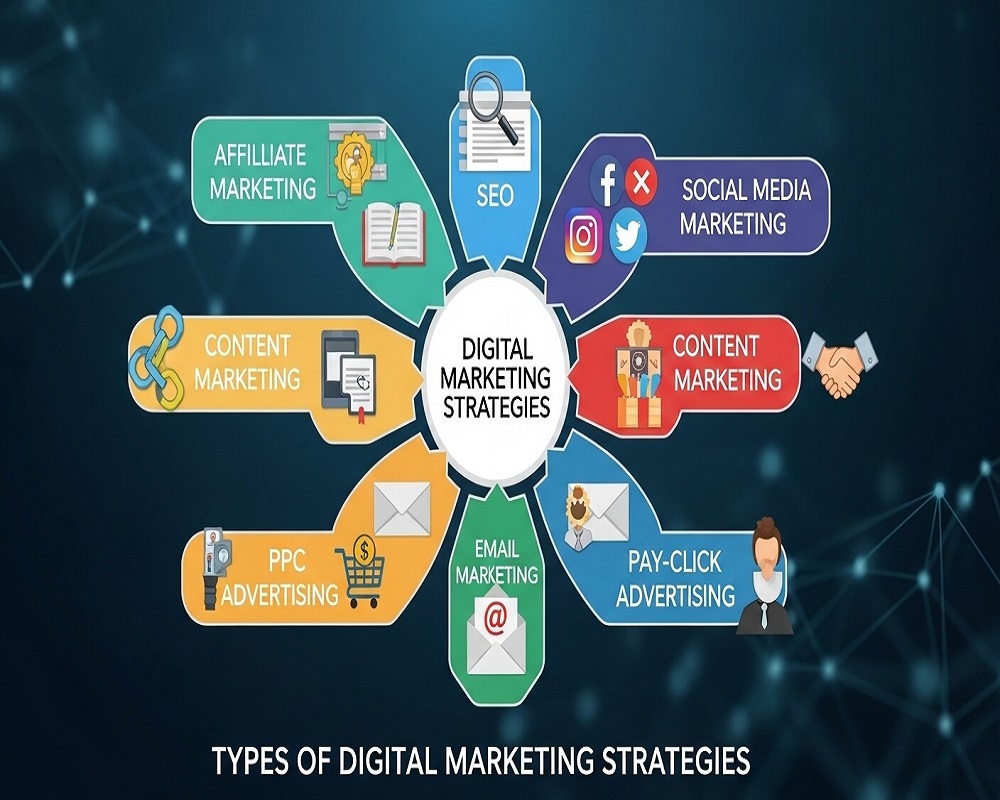
Short answer: The main types of digital marketing strategy are SEO, content marketing, paid search and social ads (PPC), social media marketing, email marketing, video marketing, influencer marketing, affiliate marketing, local search marketing and conversion-focused website work. You do not need all ten. Pick two or three that match where your customers already look and how quickly you need results, track each one properly, then add channels as budget allows.
This guide is for small and mid-sized business owners, and the marketers who work for them, who want to understand each digital channel well enough to choose between them. For every strategy you will see what it is good at, what it costs in time or money, how to start, and the mistakes I see most often when I review marketing set-ups for clients in Pakistan, the UK, the US and the Gulf. At the end there is a decision flow to help you pick where to begin.
Strategy, channel or tactic?
People use these words interchangeably, which is part of why marketing plans go wrong. A strategy is the plan for reaching a business goal with a defined audience. A channel is where you reach them (Google, Instagram, email). A tactic is a specific action inside a channel (a lead magnet, a retargeting campaign). “Post on Instagram three times a week” is a tactic. “Win first-time buyers aged 25 to 40 in Lahore through short video and retargeting, measured by cost per first order” is a strategy. Each of the ten types below is a channel-led strategy, and the right mix depends on your goal.
The 10 types of digital marketing strategies at a glance
| Strategy | Best for | Speed to results | Main cost | Key metric |
|---|---|---|---|---|
| SEO | Lasting demand capture | Months | Time and expertise | Organic leads or sales |
| Content marketing | Trust, research-stage buyers | Months | Writing and production | Assisted conversions |
| PPC (search and social ads) | Immediate traffic, testing offers | Days | Ad spend | Cost per acquisition |
| Social media marketing | Awareness, community | Weeks | Time, creative | Engaged reach, enquiries |
| Email marketing | Repeat sales, nurturing | Weeks once a list exists | Platform and list building | Revenue per send |
| Video marketing | Explaining products, trust | Weeks to months | Production time | Watch time, clicks |
| Influencer marketing | Borrowed trust in a niche | Campaign-based | Fees or product | Tracked sales per creator |
| Affiliate marketing | Performance-only sales | Months to build partners | Commission | Sales per affiliate |
| Local search marketing | Shops, clinics, trades | Weeks to months | Time, reviews | Calls and direction requests |
| Conversion optimisation | Getting more from existing traffic | Weeks | Testing and design | Conversion rate |
Rather have an expert do this for you?
Hand it over and get back to running your business.
1. Search engine optimisation (SEO)
SEO makes your site the best answer for the searches your customers already make, so you appear in unpaid results without paying per click. It covers content, technical health and reputation. If you are new to it, start with my plain guide to what SEO is and how it works.
How to start: verify Google Search Console, list the questions customers ask before buying, and give each main service or product category a page that answers them properly. Google’s guidance on creating helpful, people-first content is the best free brief you will find.
Mistake I see: businesses publishing dozens of near-identical city pages or AI-written posts. Google’s core updates have repeatedly hit exactly this kind of scaled, thin content. For the strategic side, see my list of SEO marketing strategies that grow traffic.
2. Content marketing
Content marketing means publishing useful material (guides, comparisons, tools, case examples, newsletters) that helps buyers before they are ready to buy. It feeds SEO, social and email at the same time, which is why I treat it as the engine rather than a separate channel.
How to start: collect the ten questions your sales team or front desk hears most and answer each one better than anyone else online. A comparison page or a pricing explainer often does more than ten generic blog posts. Newsletters on platforms such as Substack can work well for founders who write.
Mistake I see: a content calendar built around what the business wants to say rather than what customers search for. Run every idea through keyword research before writing it.
3. Pay-per-click advertising (PPC)
PPC covers Google Ads, Microsoft Ads and paid social such as Meta, TikTok and LinkedIn. You pay for clicks or impressions and can switch traffic on almost immediately, which makes it the fastest way to test whether an offer sells.
How to start: pick one high-intent campaign (for example “emergency plumber Clifton” rather than “plumbing”), send it to a landing page built for that query, and track real conversions, not just clicks. Tag every link with UTM parameters; my free UTM builder makes this quick.
Mistake I see: broad match keywords plus the home page as the landing page. Spend leaks to irrelevant searches and visitors land somewhere that does not answer them. My guide to search engine marketing strategies explains how paid and organic search work together.
4. Social media marketing
Social media marketing builds awareness and relationships on platforms where your audience spends time. The platform mix matters more than posting volume. In the US, Pew’s 2025 survey found YouTube used by 84% of adults and Facebook by 71%, with Instagram at about half and TikTok at 37%. With Pakistani clients, I find Facebook, YouTube, TikTok and WhatsApp do most of the work, and many enquiries arrive as WhatsApp messages rather than form fills.
How to start: choose one or two platforms where your buyers already are, decide the job each one does (awareness, customer service, community), and post formats that suit that platform. B2B buyers tend to respond to LinkedIn posts from a real person rather than a logo.
Mistake I see: judging social by follower count. Track enquiries, WhatsApp conversations and site visits from social instead.
5. Email marketing
Email lets you talk to people who have already shown interest, on a channel you own. It is usually the strongest channel for repeat purchases and for nurturing leads with long buying cycles.
How to start: offer something genuinely useful in exchange for an address (a checklist, a price guide, early access), send a short welcome sequence, then a regular newsletter. Segment by what people bought or downloaded.
Mistake I see: buying lists or adding customers without consent. Besides hurting deliverability, it can break privacy law: UK and EU businesses fall under GDPR and PECR, and the US has CAN-SPAM. Send only to people who opted in.
6. Video marketing
Video explains products, shows the people behind a business and ranks in both YouTube and Google. Short vertical video (Reels, Shorts, TikTok) drives reach; longer YouTube videos answer detailed questions and keep working for years.
How to start: film answers to your most common customer questions on a phone with decent sound. Publish the long version on YouTube, cut short clips from it, and embed the video on the matching page of your site. For channel growth tactics, see my guide on getting more YouTube views.
Mistake I see: polished brand films with no clear question answered and no next step.
7. Influencer marketing
Influencer marketing pays creators to feature your product to an audience that already trusts them. Smaller niche creators often bring a closer fit than celebrity accounts, but the only way to know is to track each creator with their own code or link.
How to start: shortlist creators whose followers match your customers, check engagement is real (comments that discuss the content, not just emojis), agree deliverables in writing and give creative freedom within brand rules.
Rules to follow: paid or gifted posts must be clearly labelled. The US FTC’s guidance for influencers says any personal, family, employment or financial relationship with a brand, including free products, is a material connection that must be disclosed in the post itself. The UK’s ASA and CMA take a similar line.
8. Affiliate marketing
Affiliates (bloggers, review sites, coupon sites, creators) promote your products and earn a commission on tracked sales. You pay only for results, which makes it attractive for ecommerce and software, but it needs a tracking platform, clear terms and active management.
How to start: set a commission you can afford after returns, publish clear rules (no bidding on your brand name, no misleading claims), recruit a handful of relevant partners and review their traffic sources monthly.
Mistake I see: coupon sites claiming credit for sales that would have happened anyway. Check whether affiliate sales are new customers or people who were already at checkout.
9. Local search marketing
For any business with a shop, clinic, office or service area, the Google Business Profile and map results often bring more calls than the website itself. Local search marketing covers the profile, reviews, citations and location pages. Voice searches such as “pharmacy open near me” mostly land here too; my guide to voice search optimisation covers the specifics.
How to start: choose the right primary category, fill every field, add real photos and ask every happy customer for a review. My local SEO services page explains what a full local set-up includes.
10. Conversion rate optimisation and the website itself
Every other strategy sends people to your site. If the site is slow, confusing or hides the phone number, all of them underperform. Conversion work means fixing forms, page speed, trust signals (reviews, guarantees, real photos) and calls to action, then testing changes.
How to start: watch five people try to buy or enquire on your site, note where they hesitate, and fix those points first. On Pakistani sites, adding a visible WhatsApp button and cash-on-delivery details often removes the biggest objections.
Which strategy should you start with?
Answer the questions below. It is a starting point, not a rule, and most businesses add a second channel within a few months.
Which digital marketing strategy to start with
Do customers come to a physical location, or do you serve a specific city or area?
Do people already search Google for what you sell (you can see search volume for it)?
Can you wait three to six months for results?
Is your product visual or easy to show in a short video?
Result: local search first. Get the profile, reviews and location pages right, then add search ads for your highest-value service.
Result: SEO plus content. Build pages that answer existing demand. Add a small search ads budget to learn which queries convert.
Result: search ads now, SEO alongside. Ads bring sales while organic pages mature. Move budget as rankings arrive.
Result: social video and creators. Demand needs creating, so short video and tracked influencer posts usually work best. Capture emails from day one.
Result: content plus LinkedIn or email. For low-search, considered purchases, educate buyers with expert content and nurture them by email.
How the strategies work together
The strongest plans I see connect channels rather than run them in silos. A typical flow: a short video reaches new people, a retargeting ad brings them back, an in-depth guide answers their questions, an email sequence keeps them warm, and a review on Google reassures them before they buy. Measure the whole path. In GA4, check the attribution paths report and tag every campaign link, otherwise organic and email get no credit for sales that paid ads finish. If you want proof of these channels working for real companies, my collection of documented digital marketing case studies links to the original sources.
Before you launch any channel
- One measurable goal: for example cost per lead under a set figure, not “more awareness”.
- A defined audience: who they are, where they look, what they type or watch.
- Conversion tracking: GA4 key events and ad platform tracking tested end to end.
- UTM tags on every campaign link.
- A landing page per offer, not the home page.
- Consent in place for email, cookies and tracking.
- A review date after enough data, usually four to eight weeks for paid channels.
- An owner who checks the numbers every week.
Ticks are saved in your browser.
Frequently asked questions
What are the main types of digital marketing?
The core types are SEO, content marketing, paid advertising, social media, email, video, influencer, affiliate, local search marketing and conversion optimisation. Most lists group them differently, but these cover almost everything a business can do online.
Which digital marketing strategy is most effective?
There is no single best one. Search channels (SEO and search ads) work best when people already look for what you sell. Social video and creators work better when you need to create demand. The most effective mix is the one tied to a clear goal and measured properly.
How much should a small business spend on digital marketing?
It depends on margins, competition and growth targets, so I avoid a fixed percentage. A practical method is to decide what you can afford to pay for one customer, then fund the channel that can deliver customers below that cost, starting small and scaling what works.
How many strategies should I use at once?
Start with two or three you can run well. A neglected social account or an untracked ad campaign wastes more than it earns. Add channels once the first ones are measured and stable.
How do I measure digital marketing results?
Set up GA4 key events and ad platform conversion tracking, tag campaign links with UTMs, and judge each channel by leads, sales or revenue rather than likes or clicks. Review monthly and compare cost per result across channels.
Sources
- Pew Research Center, “Americans’ Social Media Use 2025” (November 2025).
- DataReportal, “Digital 2025: Pakistan” (2025).
- Federal Trade Commission, “Disclosures 101 for Social Media Influencers”.
- Google Search Central, “Creating helpful, reliable, people-first content”.
If you want help choosing and measuring the right mix for your business, start with the free SEO ROI calculator to see what organic search could be worth, or get in touch for a review of your current channels.
Request received
Thank you! Saad will contact you within the next 24 hours.
Keep an eye on your phone and inbox.