
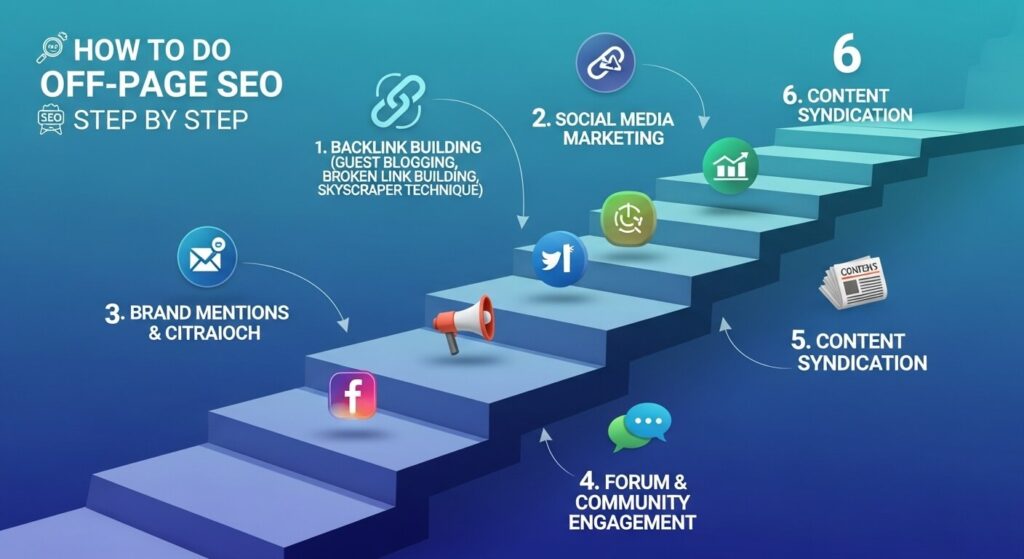
Short answer: To do off-page SEO step by step: audit your backlinks and your competitors’ links, fix your Google Business Profile and citations, create a page or asset worth citing, earn links through outreach, digital PR and partnerships, turn unlinked brand mentions into links, build a steady flow of reviews, and take part in the communities your customers use. Avoid paid links and link schemes, and track referring domains, rankings and enquiries monthly.
This guide is for business owners, marketers and newer SEOs who have their website in reasonable shape and now need it to be trusted and referenced by others. I set out the order I work in for clients, which tactics earn links that last, which ones put a site at risk, and how to judge whether a link opportunity is worth your time. There is a checklist to work through and an example outreach email you can adapt.
What off-page SEO is
Off-page SEO is the work you do away from your own website that affects how search engines and people judge it. On-page SEO is what you control on the page; technical SEO is how the site is crawled and indexed; off-page SEO is what the rest of the web says about you. The main signals are:
| Signal | What it is | Why it matters |
|---|---|---|
| Backlinks | Links from other sites to yours | Help Google discover pages and judge importance; relevance and quality count far more than volume |
| Brand mentions | References to your business, with or without a link | Help search engines and AI systems recognise you as a real, known entity |
| Reviews | Ratings on Google and industry platforms | Affect local visibility and whether people choose you |
| Citations | Your name, address and phone on directories | Consistency builds trust in your business details for local search |
| Community presence | Answers, talks, podcasts, forums | Not a direct ranking factor, but leads to links, branded searches and AI mentions |
Links still matter. In Backlinko’s study of 11.8 million Google results, the top result had about three times more referring domains than positions 2 to 10. That is a correlation, and strong pages attract links partly because they already rank, but it is consistent with what I see in audits: pages that rank for competitive terms almost always have relevant sites pointing to them.
Step 1: Audit your links and your competitors’
- In Google Search Console, open Links to see your top linking sites and most-linked pages. It is free and comes from Google’s own data.
- Use Ahrefs, Semrush or Moz to see referring domains over time and the anchor text used.
- Pick two or three competitors who rank where you want to. List sites that link to two or more of them but not to you: associations, suppliers, local news, resource pages and industry directories usually appear.
- Note any warning signs: sudden spikes from unrelated foreign sites, lots of exact-match anchors, or links from sites that exist to sell them.
On disavowing: Google ignores most spammy links automatically. I only use the disavow tool when a site has clearly bought or built manipulative links, or has a manual action for unnatural links. Disavowing at random can throw away links that were helping.
Rather have an expert do this for you?
Hand it over and get back to running your business.
Step 2: Fix the foundations most businesses skip
Before outreach, I make sure the easy, trust-building signals are in place, because they cost little and support everything else:
- Google Business Profile complete and accurate, with the right primary category.
- Core citations on Bing Places, Apple Business Connect, Facebook and the directories your industry actually uses, with identical NAP details. My local citations guide lists which are worth it.
- Existing relationships turned into links: suppliers, brands you stock, partners and associations you belong to often have stockist or member pages.
Step 3: Create something worth linking to
Outreach without a reason to link is spam. The assets that earn links most reliably are:
- Original data: a survey, an anonymised analysis of your own records, or a price index for your market. Writers need numbers to cite.
- Useful tools and templates: calculators, checklists, comparison tables.
- The best guide on a narrow topic you know from real work.
- Quick expert commentary on news in your industry.
- Local resources that local sites want to share.
Make sure the page you want links to is strong on-page too; links to a weak page help less. See my on-page optimisation services.
Step 4: Earn links through outreach
- Resource pages: search for “[topic] resources” or “[topic] useful links” and suggest your asset where it genuinely fits.
- Broken link building: find dead links on relevant pages with my free broken link checker, then suggest your page as a replacement if it covers the same thing.
- Guest contributions: write for publications your customers read. The audience is the value; the link is a bonus. My view on what still works is in guest posting in 2026.
- Podcasts and webinars: guest appearances usually come with a show-notes link and a relevant audience.
Keep pitches short and specific: who you are, why it helps their readers, and the exact page. Follow up once.
Example outreach email for a resource page
Subject: A resource for your [topic] page
Hi [Name], I was reading your page on [topic] and found the section on [specific part] useful. I run [business] in [city] and we recently published [asset], which covers [specific thing their list does not have]. It is free and has no sign-up. If you think it would help your readers, it might fit under [section name]: [URL]. Either way, thanks for putting the list together. [Your name, role]
Why it works: it proves you read the page, names the gap your asset fills, makes the request specific, and does not demand anything. Send it from a real person’s address and never send the same text to hundreds of sites.
Step 5: Use digital PR and journalist requests
Links from news sites and industry publications are among the most valuable you can earn. Pitch data stories, expert comment on current news, or local angles to journalists who cover your field. Journalist request services such as Qwoted, Featured.com and the relaunched HARO connect experts with writers; answer quickly, answer the actual question, and state your credentials. My guide to digital PR for small businesses covers how to find story angles with a small budget.
Step 6: Turn unlinked mentions into links
Set up Google Alerts for your brand, key people and products. When someone mentions you without linking, a short, polite note asking them to add a link so readers can find you often works, because they already know you. Check also for your images or data used without credit. The full process is in my guide to unlinked brand mentions.
Step 7: Build reviews
For any business serving a local area, reviews are often the biggest off-page lever. BrightLocal’s 2026 survey of 1,002 US adults found 97% read reviews for local businesses and 89% expect owners to respond. Ask every customer with a direct link, never offer incentives or ask only happy customers, and reply to every review. My guide on getting more Google reviews has the full routine.
Step 8: Take part in communities
Reddit, Quora, LinkedIn, Facebook groups and industry forums are where many buying questions are asked, and AI answers increasingly draw on them. Answer under your real name and link only when your page is the best answer. Most of these links carry nofollow or ugc attributes; the value is visibility and reputation, not ranking credit.
Step 9: Measure monthly
- New and lost referring domains, and which pages they point to
- Rankings and impressions for the pages you built links to
- Referral visits and enquiries from linking sites in GA4
- Review count, rating and branded search impressions
- Links earned per hour of effort by tactic, so you do more of what works
How to judge a link opportunity
When I review link prospects for clients, I ask the same questions every time. A link that fails them is not worth chasing, whatever its “authority” score says.
| Question | Good sign | Warning sign |
|---|---|---|
| Is the site relevant? | Same industry, audience or area | Publishes on every topic from casinos to health |
| Does it have real readers? | Organic traffic, comments, social engagement | Traffic graph that collapsed or never existed |
| Would the link be editorial? | Placed because it helps readers | “Write for us” page with a price list |
| Would you want the visit? | Readers could become customers | No one would ever click it |
| Is it labelled correctly? | Paid or sponsored placements use rel=”sponsored” | Paid link passed off as editorial |
Google’s guidance on qualifying outbound links asks sites to mark advertisements and paid placements with rel=”sponsored” and user-generated links with rel=”ugc”. Any paid partnership you take part in should follow that.
Off-page SEO checklist
Off-page SEO step-by-step checklist
- Export your links: top linking sites from Search Console saved as a baseline.
- Competitor gap list: sites linking to 2 or more competitors but not you.
- Warning signs checked: unnatural anchors or paid link history noted; disavow only if needed.
- Google Business Profile: complete, correct category, verified.
- Core citations: identical NAP on Bing, Apple, Facebook and key industry directories.
- Relationship links: suppliers, partners and associations asked for a listing.
- One linkable asset: data, tool, template or best-in-class guide published.
- Prospect list: 30 or more relevant sites that pass the link quality questions.
- Personal outreach: pitches sent, with one follow-up each.
- Journalist requests: signed up to at least one service and answering relevant queries.
- Brand alerts: Google Alerts set for brand, people and products.
- Review routine: every customer asked; every review answered.
- Community presence: active in one or two places your customers ask questions.
- Monthly report: referring domains, rankings, referrals and enquiries tracked.
Ticks are saved in your browser, so you can work through this over several weeks.
Tactics to avoid
Google’s spam policies define link spam as creating links to or from a site primarily to manipulate rankings. Its examples include:
- Buying or selling links for ranking purposes, including sending free products in exchange for a linked write-up.
- Excessive link exchanges and partner pages built only to cross-link.
- Automated programs or services that build links for you.
- Paid articles or press releases with ranking-passing, keyword-rich anchors.
- Links on low-quality directory or bookmarking sites, and optimised links in forum comments and signatures.
The same policies cover expired domain abuse, so buying an old domain to redirect its links is also risky. On Pakistani sites I audit, the most common problem is cheap “DA 50+ guest post” packages bought from marketplaces: dozens of links from sites that publish anything for a fee. They rarely help and can lead to a manual action. If your site has this history, an SEO audit with a link review is the place to start.
How long off-page SEO takes
Links need to be found and recrawled before they count, and authority builds over time. Most sites see movement in three to six months of steady work, longer in competitive markets. Review and citation fixes can improve local visibility sooner. Off-page work also depends on the rest of the site, so pair it with technical SEO where needed.
Frequently asked questions
What is the difference between on-page and off-page SEO?
On-page SEO improves what is on your own pages, such as content, titles and internal links. Off-page SEO builds signals elsewhere, such as links, mentions, reviews and citations, that show others trust and reference you.
Can I build backlinks without paying for them?
Yes. Create a genuinely useful asset, pitch it to relevant sites, answer journalist requests, reclaim unlinked mentions and use your existing business relationships. These links take longer but they last.
Does social media help off-page SEO?
Indirectly. Shares are not a ranking factor, but social platforms put your content in front of people who may link to it, search for your brand or become customers.
How many backlinks do I need to rank?
There is no fixed number. Look at how many relevant referring domains the pages ranking for your query have, and focus on relevance and quality rather than matching their count.
Should I disavow bad links?
Usually not. Google ignores most spammy links on its own. Use the disavow tool only if you built or bought manipulative links, or have a manual action for unnatural links.
Does off-page SEO help with AI search?
Yes. AI answers tend to mention brands referenced across several trusted sources. Mentions, reviews and links from relevant publications make your business easier for them to recognise.
Sources
- Backlinko, “We analyzed 11.8 million Google search results” (updated 2025).
- BrightLocal, “Local Consumer Review Survey 2026” (2026).
- Google Search Central, “Spam policies for Google web search” (documentation, accessed 2026).
- Google Search Central, “Qualify your outbound links to Google” (documentation, accessed 2026).
If you want a plan for earning links and mentions in your market without risky shortcuts, see my off-page SEO services or request a free SEO audit and I will start with your current link profile and competitors.
Request received
Thank you! Saad will contact you within the next 24 hours.
Keep an eye on your phone and inbox.