
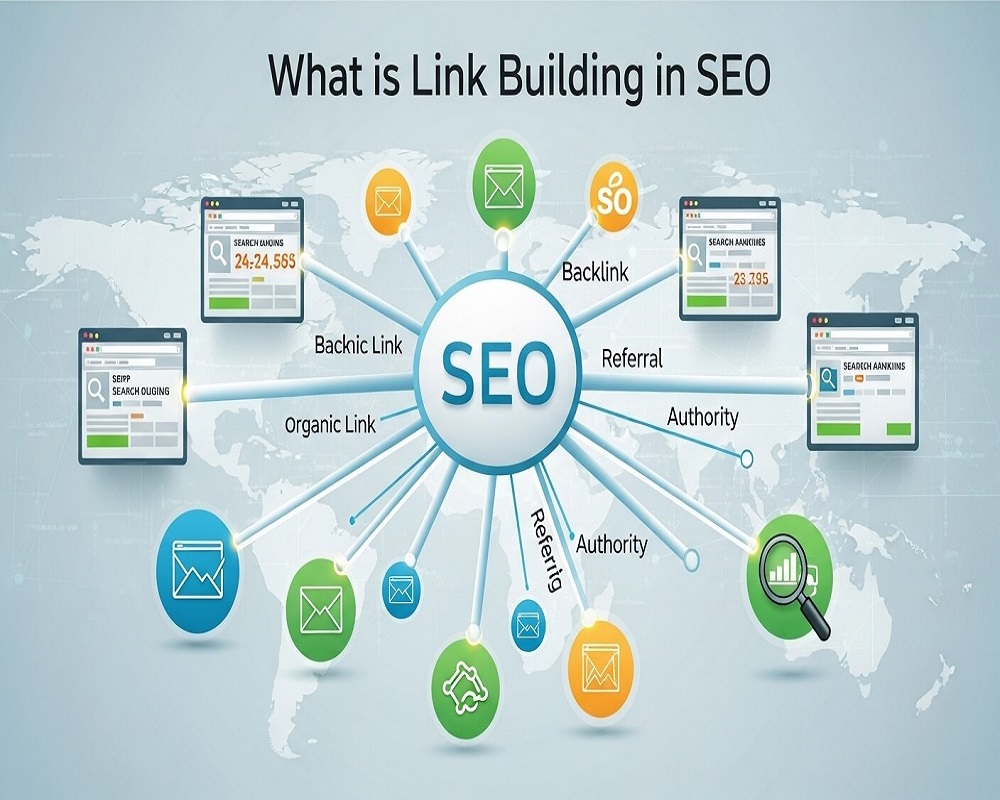
Short answer: Link building is the work of getting other websites to link to pages on your site. Google uses links to discover pages and, through systems such as PageRank, to judge which pages are useful and trusted. For beginners, the safe way is to earn relevant links: create pages worth citing, get listed where your customers look, reclaim unlinked mentions and reach out to sites that genuinely benefit from linking. Buying links for rankings breaks Google’s spam policies.
This guide is for business owners, bloggers and new SEOs who keep hearing that they “need backlinks” and want to know what that actually means and how to do it without risking their site. By the end you will understand how links work, which links are worth having, five beginner-friendly ways to build them, what to avoid, and how to tell whether it is working.
How links work in Google
A link is a vote of attention: when one site links to another, it tells readers “this is worth a look”. Google started with this idea in PageRank, which treats links as signals of importance, and its ranking systems guide confirms that PageRank is still part of the core ranking systems, alongside other systems that understand how pages link to each other.
Links do three jobs for you:
- Discovery: Googlebot follows links to find new pages. A page no one links to, internally or externally, can take a long time to be found.
- Trust and importance: links from relevant, respected sites suggest your page is a good answer.
- Referral traffic: a link in the right article can send customers directly, whatever it does for rankings.
Links are not the only thing that matters. A page with strong links that does not answer the query will not hold its position, and in my audits I often see sites with modest link profiles outranking bigger ones because their content and technical setup are better. Think of links as what helps good pages compete, not what rescues weak ones.
Link building terms you need to know
| Term | What it means | Why it matters |
|---|---|---|
| Backlink | A link from another site to yours (also called an inbound link) | The thing link building creates |
| Referring domain | A unique website linking to you; 50 links from one site is one referring domain | Usually a better measure than raw link counts |
| Anchor text | The clickable words of a link | Helps Google understand the target page; over-optimised anchors look manipulative |
| rel=”nofollow” | Asks Google not to associate your site with the linked page | Generally not followed for ranking; still useful for traffic and brand |
| rel=”sponsored” | Marks paid or advertising links | Required for paid placements under Google’s guidelines |
| rel=”ugc” | Marks user-generated links, such as comments and forum posts | Tells Google the site owner did not editorially place the link |
| Authority metrics (DA, DR) | Third-party scores from tools such as Moz and Ahrefs | Handy for comparison; not used by Google |
Google’s documentation on qualifying outbound links explains when sites should use sponsored, ugc and nofollow. My guide to choosing anchor text covers the clickable words. For more detail on the attributes, see my guide to nofollow links, and for the third-party scores, what Domain Authority really measures.
Rather have an expert do this for you?
Hand it over and get back to running your business.
What makes a link worth having
When I evaluate a link, I ask these questions in this order:
- Is it relevant? A link to a Lahore bakery from a Lahore food blog is worth more than one from a random tech directory.
- Would a real person click it? Links in the body of a useful article beat links in footers, sidebars and author bios.
- Is the site real? It has its own audience, organic traffic and editorial standards, not a site that exists to sell posts.
- Was it given editorially? Someone chose to link because your page helps their readers.
- Is the anchor natural? Brand name, URL or a descriptive phrase, not the same exact keyword every time.
My guide on how to evaluate a backlink has a full scoring sheet. The table below is the quick version for deciding where to spend your time.
| Link opportunity | Effort | Typical value | Verdict for beginners |
|---|---|---|---|
| Google Business Profile and major local directories | Low | Low for rankings, high for local trust and visibility | Do first |
| Suppliers, partners, associations you belong to | Low | Medium, very relevant | Do first |
| Unlinked brand mentions | Low | Medium to high | Do early |
| Resource pages in your niche | Medium | Medium | Worth it with a strong page |
| Guest articles on relevant, real publications | Medium to high | Medium to high | Selectively |
| Digital PR, original data, expert commentary | High | High | Once basics are done |
| Blog comments, forum signatures, profile spam | Low | Little to none | Skip |
| Paid links, link packages, private blog networks | Low effort, high cost | Risky | Avoid |
Five beginner-friendly ways to build links
1. Claim the links you are already owed
Start with relationships you already have. Suppliers often have “where to buy” pages; associations, chambers of commerce and alumni groups list members; event organisers link to sponsors and speakers. Then set up your Google Business Profile and the main local directories in your country, with consistent business details. These are rarely powerful links, but they are relevant and fast. For local businesses, I cover local link building separately.
2. Turn unlinked mentions into links
Search for your brand name, product names and the names of your experts in quotation marks, and check whether each mention links to you. A short, friendly note asking the writer to add a link converts better than any cold pitch, because they already chose to mention you. My guide to unlinked brand mentions walks through it.
3. Create something worth citing
People link to pages that make their own content better: original data, clear explanations, calculators, checklists, local guides, price comparisons. Ask “what would a journalist or blogger in my niche need to reference?” A Karachi property agent publishing average rent by area, updated each quarter, gives local writers something to cite; another “why buy property in Karachi” post does not.
4. Reach out to resource pages and broken links
Many sites keep lists of useful resources. If your page genuinely belongs on one, a short email explaining why is a reasonable ask. A variation is broken link building: find a dead link on a relevant page with a broken link checker, and suggest your page as a replacement if it covers the same thing.
5. Write for real publications and offer expertise
Guest articles still work when they are on publications your customers read and the article is genuinely useful; they fail when they are mass-produced for link sellers. See guest posting: what still works. Offering expert comments to journalists and podcasts, and digital PR for small businesses, can earn links from news sites that would never accept a guest post.
Template: a short outreach email that gets replies
Subject: Small addition to your [topic] guide
Hi [name], I read your guide to [topic] and found the section on [specific point] useful. I noticed the link to [resource] no longer works. I recently published [page title], which covers the same thing with [specific extra, e.g. 2026 figures for Pakistan]. If it is useful for your readers, here it is: [URL]. Either way, thanks for the guide. [Your name, role, site]
Keep it under 120 words, reference something specific, and follow up once at most.
What to avoid
Google’s spam policies list link spam examples including buying or selling links for ranking purposes, excessive link exchanges, automated link creation, widely distributed footer or template links, and low-value content made mainly to manipulate links. In practice, the offers I see most often aimed at Pakistani and Gulf businesses are:
- “100 high DA backlinks” packages for a small fee, usually from sites that exist only to sell links.
- Guest posts on general “news” or “business” blogs that publish anything for payment.
- Private blog networks: sites built on expired domains that all link to clients.
- Link exchange groups where members agree to link to each other.
These may work briefly, then get ignored or trigger a manual action. If you already have a history of bought links, do not panic: Google has said its systems largely ignore spammy links rather than penalising for them, and the disavow tool is for cases where you have a manual action or know you built manipulative links at scale.
How to measure link building
- Search Console Links report: free, and shows top linking sites and your most linked pages.
- Referring domains over time in a tool such as Ahrefs or Semrush, focusing on relevant new sites, not totals.
- Rankings and clicks for the pages you built links to, compared with similar pages you did not. See how to track SEO performance.
- Referral traffic and enquiries from the linking pages in GA4.
Expect a lag. New links can take weeks to be found and longer to show any effect, and most sites see meaningful movement over months, not days.
Check your understanding
Check your understanding
A site links to you 40 times from its footer. How many referring domains is that?
- 40
- 1
- It depends on Domain Authority
One website is one referring domain, no matter how many links it has. Sitewide footer links are also listed in Google’s link spam examples when they are widely distributed.
Which link is usually most valuable for a dental clinic in Lahore?
- A paid post on a general news blog
- A profile on a foreign web directory
- A mention in a local health journalist’s article on choosing a dentist
Relevance, editorial choice and a real audience matter far more than a metric. The paid post also breaks Google’s spam policies unless marked sponsored.
What should a paid link carry?
- rel=”sponsored” (or nofollow)
- Exact-match keyword anchor text
- Nothing, if it is on a high DA site
Google asks for paid and advertising links to be marked sponsored. Nofollow is still accepted but sponsored is preferred.
Does Google use Domain Authority to rank sites?
- Yes, it is a core ranking factor
- No, it is a third-party metric from Moz
- Only for local search
DA (Moz) and DR (Ahrefs) are tool estimates. They are useful for comparing sites but Google does not use them.
Frequently asked questions
Is link building still important for SEO?
Yes. Google confirms PageRank is still part of its core ranking systems, and links remain one of the ways it judges importance. But links help good pages compete; they do not make up for content that does not answer the query.
How many backlinks do I need to rank?
There is no fixed number. Look at the pages ranking for your target query and compare the number of relevant referring domains, not total links. In many local and niche searches, a handful of good links plus a strong page is enough.
Are nofollow links useless?
No. They are generally not followed for ranking, but they can send traffic, build brand awareness and lead to followed links later when other writers find you.
Is buying backlinks safe?
Buying links for ranking purposes is against Google’s spam policies. At best, Google ignores them and you lose the money; at worst, you get a manual action. Paid placements are fine for traffic or advertising if they are marked rel=”sponsored”.
What is the difference between link building and internal linking?
Link building earns links from other websites. Internal linking connects pages within your own site. Both matter: internal links pass the value of your strongest pages to the ones you want to rank.
How long does link building take to work?
Weeks for links to be discovered, and usually a few months before rankings reflect them. Results depend on how competitive the query is and how strong the page is.
Sources
- Google Search Central, “A guide to Google Search ranking systems” (accessed 2026).
- Google Search Central, “Spam policies for Google web search” (accessed 2026).
- Google Search Central, “Qualify your outbound links to Google” (accessed 2026).
- Backlinko, “We Analyzed 11.8 Million Google Search Results” (last updated 2025).
If you would rather have an expert plan and run safe link building for your site, my off-page SEO services focus on relevant, earned links, or you can ask me a question about your current backlink profile.
Request received
Thank you! Saad will contact you within the next 24 hours.
Keep an eye on your phone and inbox.