
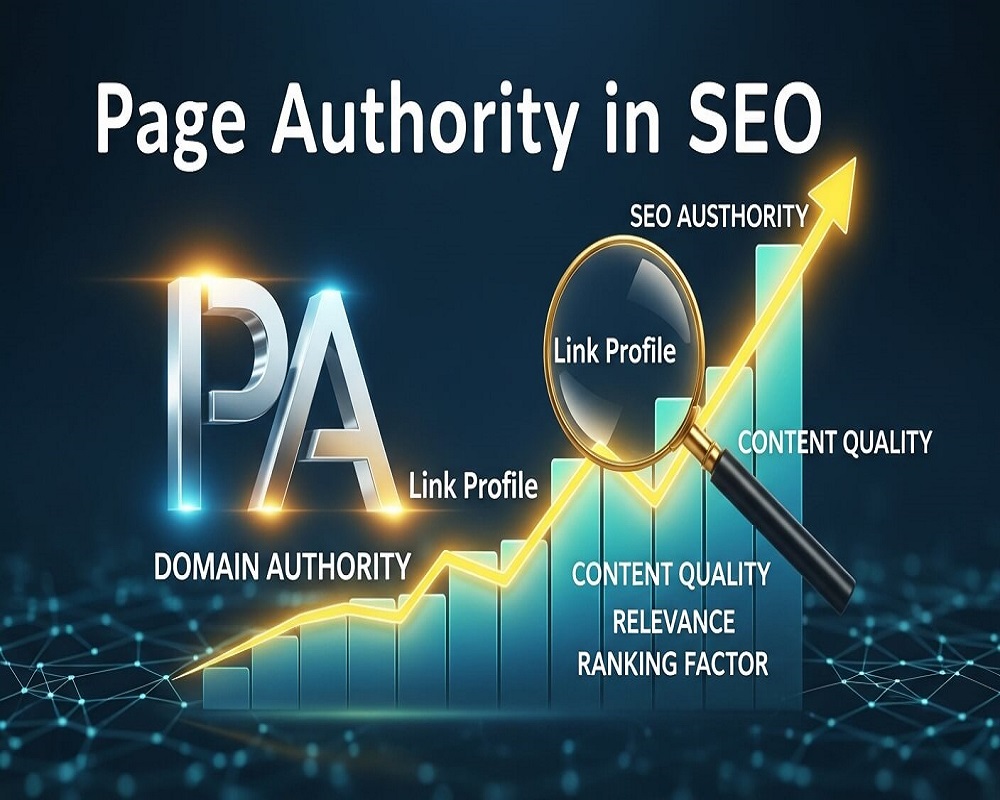
Short answer: Page Authority (PA) is a score from 1 to 100, created by Moz, that predicts how well a single page is likely to rank based mainly on the links pointing to it. It is not a Google metric and does not affect rankings directly. You increase it the same way you earn real ranking strength: get relevant links from trusted sites to that page, link to it well from your own pages, and make it worth linking to.
This guide is for site owners and marketers who have seen a Page Authority number in Moz, a browser toolbar or a link seller’s spreadsheet and want to know what it means and whether to chase it. You will learn how PA is worked out, how it differs from Domain Authority and Google’s own systems, what a “good” score looks like in practice, and the steps that raise it in a way that also helps rankings.
What is Page Authority?
Page Authority is Moz’s estimate of a single URL’s ability to rank, shown on a scale of 1 to 100. Moz builds it from its own index of links: how many sites link to the page, how trusted those linking sites are, and patterns that suggest spam. It sits alongside Domain Authority, which does the same job for a whole domain.
The most important thing to understand is what PA is not. Google does not use it. Moz itself says Page Authority does not directly affect search engine rankings and recommends using it as a relative metric against your direct competitors rather than as an absolute target (MediaPost). It is a third-party approximation of something Google measures in its own, private way.
Google’s equivalent is not a single score. Its guide to ranking systems describes link analysis systems, including PageRank, that use how pages link to each other to understand what pages are about and which might be most helpful. PageRank is still part of Google’s core ranking systems, but Google stopped showing it publicly years ago. Links are only one input among many Google ranking factors. Tools like PA, Ahrefs’ URL Rating (UR) and Semrush’s Authority Score exist to fill that gap.
How Page Authority is calculated
Moz does not publish the formula, but it has explained the general approach. Since the PA 2.0 update in September 2020, Page Authority has been a machine-learned model that uses more than 40 link-related factors, including Spam Score and patterns in link quality. Moz says the aim of the update was to improve how well PA predicts a page’s ability to rank.
In practice, the inputs that move the number are:
- Linking root domains: the number of separate websites linking to the page matters far more than the raw number of links.
- Quality of those domains: a link from a well-linked, trusted site counts for more than many links from new or thin sites.
- Spam signals: links from sites with spam-like features count for less, and can drag the estimate down.
- Internal links: links from your own strong pages pass some strength to the target page.
Two practical consequences follow. First, the scale is logarithmic, so gains get harder the higher you go: lifting a new page from 10 to 25 is quick compared with taking an established page from 55 to 65. Second, scores move when Moz updates its index or model, even if nothing changed on your site. When a client sends me a screenshot of PA “dropping five points”, the first thing I check is whether competitors dropped too. Usually they did.
Rather have an expert do this for you?
Hand it over and get back to running your business.
Page Authority vs Domain Authority vs Google
| Metric | Made by | Measures | Used by Google? | Best use |
|---|---|---|---|---|
| Page Authority (PA) | Moz | Predicted ranking strength of one URL | No | Comparing a page with the pages ranking for the same query |
| Domain Authority (DA) | Moz | Predicted ranking strength of a whole domain or subdomain | No | Rough comparison of sites, screening link prospects |
| URL Rating (UR) | Ahrefs | Strength of a URL’s backlink profile | No | Same job as PA in a different link index |
| PageRank and link analysis | How pages link to each other, as one input among many | Yes, internally | Not visible; you influence it through real links |
A page can have a high PA on a modest domain if it earned links of its own, for example a free tool or a piece of original research. The reverse also happens: a new article on a strong site starts with a low PA because nothing links to it yet, but it often ranks quickly because the site’s internal links and overall reputation carry it. That is one reason I never judge a page by PA alone.
What is a good Page Authority score?
There is no universal good score. A PA of 25 can be strong in a local niche where the top results sit at 15 to 20, and weak for a national finance query where every result is above 50. The useful question is: how does my page compare with the pages that currently rank for the query I want?
Worked example: reading PA against a real results page
Imagine you run a Lahore-based clinic and want your page on “hair transplant cost in Lahore” to rank. You check the top ten results in Moz and note each page’s PA and number of linking domains. The illustrative numbers below are the kind of spread I often see for local service queries:
- Positions 1 to 3: PA 28 to 34, each with 15 to 40 linking domains, all clinic pages with prices and doctor details.
- Positions 4 to 10: PA 12 to 30, a mix of clinics and directory pages.
- Your page: PA 9, 2 linking domains.
The gap is real but not huge. Content and local signals carry a lot of weight for this query, so the plan would be to improve the page itself first (clear prices, before-and-after evidence with consent, the surgeon’s credentials), link to it from your homepage and related treatment pages, then earn a handful of local links, for example from medical associations or local media. You would not need PA 50 to compete. If the top results were all national health publishers at PA 60 or more, the realistic strategy would change to a narrower query.
How to increase Page Authority (and actual rankings)
Everything that reliably raises PA also helps in Google, because both reward real, relevant links (the core of sound link building). Everything that raises PA artificially, such as buying links from link farms, risks a problem with Google’s spam policies. These are the steps I use, in order.
1. Choose the pages that deserve authority
Do not try to raise PA site-wide. Pick the pages that make money or answer your most important queries: service pages, category pages, a key guide. Check which of them already rank between positions 5 and 20; those respond fastest to extra link strength. My guide to striking distance keywords shows how to find them in Search Console.
2. Fix internal linking first
This is the quickest and cheapest win, and the one I find neglected most often. Google’s link best practices say every page you care about should have a link from at least one other page on your site, with anchor text that is descriptive and relevant. In practice:
- Link to the target page from your homepage, main navigation or a hub page if it is important enough.
- Add contextual links from related articles that already have backlinks.
- Use descriptive anchors that vary naturally, not the same exact keyword every time. See how anchor text works.
- Find orphan pages that have no internal links at all.
My guide to internal linking covers the structure in detail.
3. Make the page worth linking to
People link to pages that save them work: original data, a clear explanation of something confusing, a useful tool, a checklist, local information nobody else has published. A thin page will not attract links however much outreach you do. Before building links, ask what someone writing about the topic would cite from your page.
4. Earn relevant links to that specific page
- Digital PR: publish something newsworthy, such as a small survey or local price comparison, and pitch it to journalists who cover the topic. My guide to digital PR for small businesses shows how to do this on a small budget.
- Resource and broken link outreach: find pages that list resources on your topic, or link to dead pages, and suggest yours where it genuinely fits. The same crawl you use to fix broken links on your own site works on prospects’ sites.
- Partners and associations: suppliers, industry bodies and event organisers often link to members’ pages.
- Unlinked mentions: ask sites that mention your brand to link the mention to the relevant page; see unlinked brand mentions.
Judge each prospect on relevance and real traffic, not just its DA. My guide on how to evaluate a backlink lists the checks I use.
5. Consolidate weak duplicates
If you have three thin pages on the same topic, each with a few links, merging them into one strong page and 301 redirecting the others combines their links. This is often the fastest way to lift one page’s PA and rankings together, and it also fixes keyword cannibalisation.
6. Keep it fresh and measure the right things
Update the page when facts change, and track rankings, clicks and linking domains in Search Console and your link tool. PA is a lagging indicator; it only moves once Moz has crawled the new links and refreshed its model.
Page Authority improvement checklist
- Pick 3 to 5 priority pages: pages that earn money or target your key queries.
- Benchmark against the current top 10: note PA and linking domains for each ranking page.
- Check for orphans: make sure each priority page has internal links from related pages.
- Link from your strongest pages: homepage, hub pages, or articles that already have backlinks.
- Use descriptive, varied anchors: no repeated exact-match anchor across the site.
- Add something citable: original data, a tool, a template, local detail or a clear framework.
- Merge thin duplicates: combine overlapping pages and 301 redirect the old URLs.
- Reclaim broken backlinks: redirect dead URLs that still have links to the right page.
- Turn unlinked mentions into links: ask politely, pointing to the most relevant page.
- Run targeted outreach: resource pages, journalists and partners relevant to the page’s topic.
- Avoid paid link schemes: they can raise PA and still harm you in Google.
- Review monthly: rankings, clicks and new linking domains first, PA second.
Ticks are saved in your browser, so you can come back and continue.
Mistakes I see with Page Authority
- Reporting PA as the result. Clients care about enquiries and sales. PA is at most a diagnostic.
- Buying links because the seller shows a high DA or PA. These numbers can be inflated with link networks. Check whether the site has real organic traffic and a real audience.
- Panicking about drops after a Moz update. Compare with competitors before changing anything.
- Ignoring relevance. One link from a respected site in your industry usually does more for rankings than several unrelated high-PA links.
- Spending on links before fixing the page. If the page does not satisfy the query, extra authority rarely makes it rank for long.
Frequently asked questions
Is Page Authority a Google ranking factor?
No. Page Authority is Moz’s own metric and Google does not use it. Google uses its own link analysis systems, including PageRank, as part of ranking. PA is useful only because it tries to approximate the link strength Google might see.
How do I check Page Authority?
Use Moz’s Link Explorer or the free MozBar browser extension, which shows PA for any page you visit and for results on a Google results page. Ahrefs’ URL Rating and Semrush’s page-level Authority Score are alternatives from different link indexes.
Why did my Page Authority drop when I did nothing?
PA is relative and recalculated. If Moz updates its index or model, or other sites gain links faster than you, your score can fall without any change on your site. Check whether competing pages moved by a similar amount.
How long does it take to increase Page Authority?
It depends on how quickly you earn links and how often Moz crawls them. Internal linking changes can show within weeks; new backlinks usually take longer to be found and reflected. In my experience most pages see clear movement over a few months of steady work, but there is no guaranteed timeline.
Is Page Authority or Domain Authority more important?
For deciding how hard a specific query will be, PA is more useful because Google ranks pages, not domains. DA helps when comparing whole sites or screening link prospects. Neither matters as much as whether your page answers the query better than the others.
Sources
- MediaPost, “Moz Plans Updates To Its Page Authority Algorithm” (September 2020).
- Backlinko, “We Analyzed 11.8 Million Google Search Results” (updated April 2025).
- Google Search Central, “A guide to Google Search ranking systems” (last updated December 2025).
- Google Search Central, “Link best practices for Google” (documentation, accessed 2026).
If you want to know which of your pages deserve link building and which need fixing first, my off-page SEO services start with exactly that comparison, or you can get in touch with the page you are trying to rank.
Request received
Thank you! Saad will contact you within the next 24 hours.
Keep an eye on your phone and inbox.