
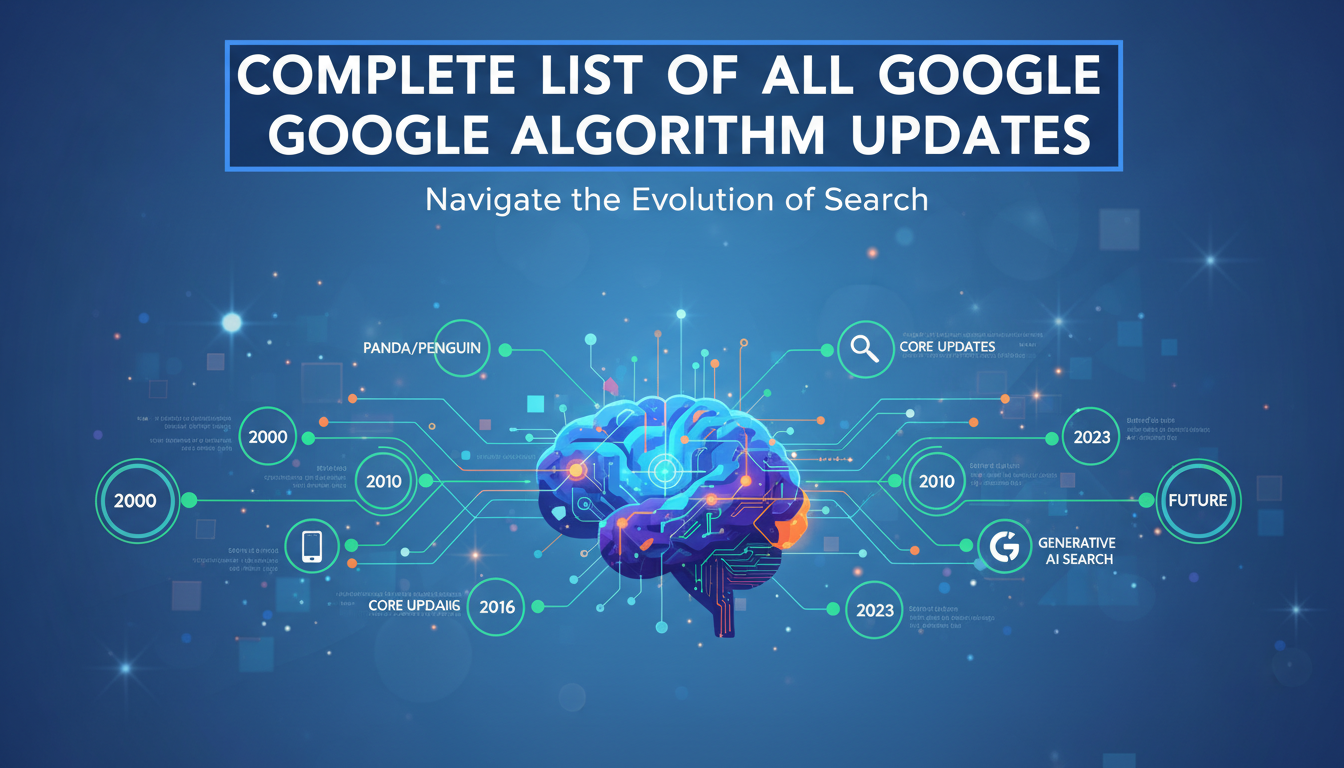
The Comprehensive Timeline: Google Algorithm Updates Complete List
For any digital marketer or business owner, staying ahead of Google’s ever-changing landscape is a full-time job. Since its inception, Google has transitioned from a simple link-counting engine to a sophisticated artificial intelligence powerhouse. Understanding the google algorithm updates complete list is not just a history lesson; it is a roadmap to understanding how the search engine giant defines quality and relevance today.
The journey of SEO has been shaped by major milestones. From the early days of keyword stuffing to the modern era of topical authority, Google’s goal remains the same: providing the most relevant, high-quality answer to a user’s query. Let’s dive into the extensive history of these updates.
The Early Years: Setting the Foundation (2000–2010)
In the beginning, Google updates were infrequent and often unannounced. However, certain shifts changed the industry forever.
1. The Toolbar PageRank (2000)
Google launched the browser toolbar, which introduced the concept of PageRank. For the first time, webmasters could see a numerical value assigned to their site’s authority based on its backlink profile. This eventually led to the rise of off-page SEO strategies, though many were manipulative at the time.
2. Florida Update (2003)
Florida was the first major update that struck fear into the hearts of SEOs. It targeted keyword stuffing and low-quality link building. Many sites lost their rankings overnight, signaling that Google was serious about content quality.
3. Big Daddy (2005)
This was a technical infrastructure update. It improved how Google handled URL canonicalization and redirects. Understanding how technical SEO works became vital during this transition as Google began filtering out supplemental results.
The Era of Quality: Panda and Penguin (2011–2014)
This period marked the most significant shift in search history, as Google began using automated filters to penalize “webspam.”
4. Panda Update (2011)
The Panda update targeted “thin” content and content farms. It rewarded websites that provided high-value information. To survive Panda, webmasters had to learn how to write SEO-friendly blog posts that actually helped users rather than just targeting bots.
5. Penguin Update (2012)
While Panda focused on content, Penguin focused on links. It penalized sites using “black hat” link-building schemes. This forced practitioners to adopt a more sustainable SEO marketing strategy centered on earning links rather than buying them.
6. Hummingbird (2013)
Hummingbird was a total overhaul of the core algorithm. It introduced semantic search, allowing Google to understand the intent behind a query rather than just matching keywords. This paved the way for the use of LSI keywords in SEO to provide context.
The Transition to Mobile and Intelligence (2015–2018)
As smartphones became the primary way people accessed the internet, Google’s algorithm shifted to prioritize the mobile experience.
7. Mobilegeddon (2015)
Google officially started using mobile-friendliness as a ranking factor. This was followed later by the Accelerated Mobile Pages (AMP) initiative to speed up the mobile web. Sites that weren’t responsive saw massive drops in mobile search rankings.
8. RankBrain (2015)
RankBrain was Google’s first foray into machine learning. It helped the engine process never-before-seen queries by associating them with known concepts. This was a massive step toward fuzzy logic in SEO, where exact matches became less critical than overall relevance.
9. Fred (2017)
This unconfirmed but widely acknowledged update targeted sites that prioritized monetization over user experience. It specifically hit sites with excessive ads and thin affiliate content. It highlighted the importance of on-page SEO balance.
The Modern Era: E-E-A-T and Core Updates (2018–Present)
In recent years, Google has moved toward “Core Updates” that happen several times a year, focusing on E-E-A-T (Experience, Expertise, Authoritativeness, and Trustworthiness).
10. The Medic Update (2018)
This core update disproportionately affected “Your Money or Your Life” (YMYL) sites—those in the medical and financial sectors. It emphasized that creators must have documented expertise. For businesses, working with a leading SEO expert became crucial to proving authority to Google.
11. BERT (2019)
BERT (Bidirectional Encoder Representations from Transformers) helped Google understand the nuance of prepositions and complex sentences. This made proper heading structures and natural language more important than ever. According to Google’s official blog, BERT affected 1 in 10 searches.
12. Core Web Vitals / Page Experience (2021)
Google integrated technical metrics like Largest Contentful Paint (LCP) and First Input Delay (FID) into its ranking signals. This cemented the role of technical SEO as a foundational pillar for any website looking to rank in the top positions.
13. Helpful Content Update (2022-2023)
The Helpful Content Update (HCU) was designed to ensure that searchers see more original, helpful content written by people, for people. It was a direct response to the surge of AI-generated content. For local businesses, such as a leading SEO expert in Lahore, demonstrating real-world experience became a ranking necessity.
14. March 2024 Core Update
This update was one of the largest in history, integrating the Helpful Content system into the core algorithm and cracking down on “scaled content abuse” (AI spam). It forced many sites to re-evaluate their search engine marketing strategies to focus on extreme quality.
How to Stay Resilient Against Updates
Looking at the google algorithm updates complete list, a pattern emerges: Google rewards sites that serve the user and punishes those that try to “game” the system. To keep your rankings stable, follow these best practices:
- Prioritize Technical Health: Regularly audit your site to ensure there are no crawl errors or speed issues. Refer to finding your SEO ranking frequently to spot sudden drops.
- Enhance User Experience: Focus on metrics like bounce rate and dwell time. If users leave quickly, Google assumes your content isn’t helpful.
- Build Quality Links: Use descriptive anchor text and avoid spammy backlink providers.
- Optimize for Intent: Whether you are looking for an SEO expert in Karachi or a specialist in Islamabad, the content must match the geographical and intent-based needs of the user.
Conclusion
The history of Google’s algorithms shows a steady march toward human-centric search. By understanding the google algorithm updates complete list, you can see that short-term tactics always fail in the long run. The most successful websites are those that combine strong on-page optimization with a deep commitment to providing value to their audience. For more insights on how these changes affect local markets, read about the impact of Google updates on SEO in Pakistan.
For further reading on the latest search trends, you can explore resources from Search Engine Land and Moz to stay updated with real-time volatility tracking.

Saad Raza is one of the Top SEO Experts in Pakistan, helping businesses grow through data-driven strategies, technical optimization, and smart content planning. He focuses on improving rankings, boosting organic traffic, and delivering measurable digital results.