
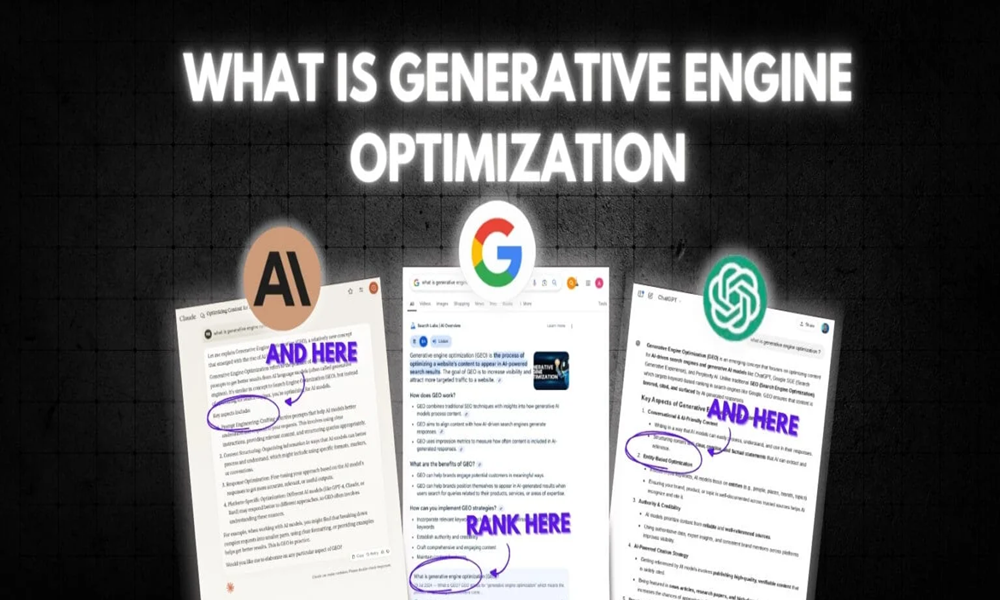
Short answer: Generative engine optimisation (GEO) is the practice of making your content easy for AI search tools, such as Google’s AI Overviews and AI Mode, ChatGPT search, Perplexity and Copilot, to find, understand, trust and cite. It builds on SEO: the page must be crawlable and indexed, then answer questions clearly, include verifiable facts, statistics and sources, show real expertise, and be mentioned by other trusted sites.
This guide is for site owners, marketers and content teams who are seeing AI answers take a growing share of attention and want their brand to be the one quoted. You will learn what GEO is, how it differs from SEO and AEO, which tactics the research supports, and how to measure whether AI tools are citing you.
What is generative engine optimisation?
A generative engine is a search tool that writes an answer instead of only listing links. Google’s AI Overviews and AI Mode, ChatGPT search, Perplexity, Microsoft Copilot and Gemini all work this way. They retrieve pages, pick the passages that best answer the question, and synthesise a response, usually with links to the sources they used.
GEO is the work of being one of those sources. The term comes from a 2023 research paper by researchers at Princeton University and IIT Delhi, “GEO: Generative Engine Optimization”, which built a benchmark of queries (GEO-bench) and tested how changes to a page affected its visibility in generated answers (arXiv). The best methods improved visibility by up to 40%.
GEO vs SEO vs AEO
| SEO | AEO | GEO | |
|---|---|---|---|
| Goal | Rank pages in organic results | Be the direct answer (featured snippets, voice) | Be cited or mentioned inside AI-written answers |
| Where it shows | Blue links | Snippets, “People also ask”, assistants | AI Overviews, AI Mode, ChatGPT, Perplexity, Copilot |
| Main levers | Relevance, links, technical health | Concise answers, question headings | Extractable passages, facts with sources, entity clarity, third-party mentions |
| Success measure | Rankings, clicks | Snippet ownership | Citations, brand mentions, AI referral traffic |
In practice they overlap heavily. Google says pages appear as links in AI Overviews and AI Mode only if they are indexed and eligible to show a snippet, so GEO without SEO does not work. If you want the snippet-focused side, my guide to answer engine optimisation covers it.
How AI search engines choose sources
- Retrieval. The engine searches an index. Google uses its own; ChatGPT search and Copilot rely heavily on Bing; Perplexity uses its own crawler plus partners. If your page is not in that index, it cannot be cited.
- Query fan-out. Google says AI Overviews and AI Mode may run several related searches across subtopics to build one answer. A page that covers the follow-up questions has more chances to be picked.
- Selection. The engine picks passages that answer a sub-question directly and look reliable: clear statements, specific numbers, named sources.
- Synthesis. It writes the answer and attaches links to some of the sources.
Two practical consequences follow. First, Bing matters: if ChatGPT and Copilot draw on Bing, make sure your site is verified in Bing Webmaster Tools. Second, each section of a page should make sense when read alone, because engines quote passages, not whole articles.
Is ChatGPT recommending your competitors?
See how your brand shows up in AI answers.
GEO tactics that the evidence supports
1. Add statistics, quotations and cited sources
In the GEO paper, adding relevant statistics, quotations from credible people and citations to sources were among the methods that improved visibility. Keyword stuffing did not; it scored below the unoptimised baseline. So replace vague claims with specific, sourced facts: “Google says there are no additional requirements for AI Overviews” is more quotable than “AI Overviews are easy to get into”.
2. Write passages that answer one question each
- Use question-style headings that match how people ask.
- Answer in the first one or two sentences under each heading, then add detail.
- Use lists, steps and tables for comparisons and processes.
- Define terms the first time you use them.
My guide to optimising content for AI Overviews shows examples of before-and-after passages.
3. Cover the topic, not just the keyword
Because of query fan-out, answer the questions a reader would ask next: costs, comparisons, risks, steps, alternatives. Building topical authority through a cluster of related pages helps an engine trust you on the whole subject.
4. Show experience and expertise
Name the author, show credentials, include first-hand examples, and keep an accurate About page. Google’s quality rater guidelines describe this as E-E-A-T: experience, expertise, authoritativeness and trust. See my notes on E-E-A-T signals on the page.
5. Make your brand a clear entity
Use consistent names, descriptions and contact details everywhere. Add Organization or LocalBusiness structured data with links to your official profiles. AI tools blend information from many sources; consistency reduces the chance they describe you wrongly.
6. Earn mentions on sites AI tools already cite
AI answers often draw on review sites, directories, forums, industry publications and news. Being mentioned and recommended there matters as much as links. For a Karachi clinic that might mean accurate listings on local directories and health platforms, genuine Google reviews, and coverage in local news; for a software company, comparison sites and community discussions.
7. Keep content fresh and dated
Show a visible “updated” date, refresh figures when new data is published, and remove outdated advice. Answers about prices, rules and tools go stale quickly.
8. Let the right crawlers in
Check robots.txt and any firewall or CDN bot rules. Blocking OAI-SearchBot, PerplexityBot or Bingbot can keep you out of those answers. Blocking training crawlers such as GPTBot or Google-Extended is a separate decision that does not remove you from Google Search. My guide to AI crawlers and robots.txt lists each one.
A GEO checklist for one page
GEO page checklist
- Indexed: the page is indexed in Google and Bing and not blocked by nosnippet.
- Direct answer: the main question is answered in the first 100 words.
- Question headings: H2s and H3s match real follow-up questions.
- Self-contained sections: each section makes sense if quoted alone.
- Specific facts: numbers, dates and names instead of vague claims.
- Cited sources: statistics link to the original source with a year.
- Expert quote or first-hand example: at least one per page.
- Table or list: for any comparison or process.
- Author and date: named author with bio, visible update date.
- Structured data: Article and Organization markup valid.
- Internal links: to related pages in the same topic cluster.
- Crawler access: search-focused AI crawlers allowed in robots.txt and firewall.
Ticks are saved in your browser.
How to measure GEO
- AI referral traffic: in GA4, create a channel group or exploration for referrals from chatgpt.com, perplexity.ai, copilot.microsoft.com and gemini.google.com. My guide to AI referral traffic in GA4 has the regex.
- Prompt tracking: keep a list of 20 to 50 questions your customers ask, run them monthly in each tool, and record whether you are cited or mentioned and how you are described.
- Search Console: AI Overviews and AI Mode traffic is included in the Web search type, so watch impressions and clicks for question-style queries.
- Brand searches: growth in searches for your brand name often follows more AI mentions.
More detail on tools and methods is in my guide to tracking brand visibility in AI assistants.
Worked example: rewriting a passage for GEO
Before: “Our SEO services are the best in Pakistan and help businesses grow online quickly with proven strategies.” Nothing here is quotable: no facts, no source, no answer to a question. After: “How long does SEO take in Pakistan? For a new local business site, most see measurable movement in Google within 3 to 6 months, depending on competition and how quickly technical issues are fixed. Speed depends mostly on fixing indexing problems first and publishing pages that answer what local customers ask.” The rewrite answers a real question in the first sentence, gives a hedged range and a specific reason, which is the kind of concrete, quotable passage the GEO research rewarded.
Common GEO mistakes
- Treating GEO as a replacement for SEO. If a page does not rank or is not indexed, AI tools rarely find it.
- Stuffing keywords or brand names into content. The GEO research found keyword stuffing performed worse than doing nothing.
- Inventing statistics to look quotable. AI tools and readers can check, and it damages trust.
- Blocking all AI bots by default through a security plugin or CDN setting, without realising it.
- Relying on llms.txt as a shortcut. It is a proposal, not a standard that Google uses; see my llms.txt explainer.
- Measuring only clicks. Many AI answers mention a brand without sending a visit, so track mentions too.
Frequently asked questions
Is GEO different from SEO?
It is an extension of SEO. The foundations are the same: crawlable, indexed, helpful pages. GEO adds a focus on quotable passages, verifiable facts and brand mentions across the web, because the goal is to be cited inside an AI answer rather than only ranked in a list.
How do I get my website cited in AI Overviews?
Google says there are no special requirements beyond being indexed and eligible to show a snippet. In practice, pages that answer specific sub-questions clearly, with sourced facts, and that already rank well for related queries are cited most often.
Does GEO work for local businesses?
Yes. AI tools answer “best dentist near me” style questions using Google Business Profile data, reviews, directories and local websites. Accurate listings, genuine reviews and clear service pages are the GEO basics for a local business.
How long does GEO take to show results?
AI tools that search the live web, such as Perplexity and ChatGPT search, can pick up changes within days or weeks once pages are recrawled. Being cited consistently usually follows months of building authority, as with SEO.
Should I block AI crawlers?
Block training crawlers if you do not want your content used to train models, but allow search-focused crawlers if you want to be cited. Check each bot’s purpose before deciding.
Sources
- Aggarwal, Murahari, Rajpurohit, Kalyan, Narasimhan and Deshpande, “GEO: Generative Engine Optimization”, arXiv 2311.09735 (2023, revised 2024).
- Pew Research Center, “34% of U.S. adults have used ChatGPT, about double the share in 2023” (2025).
- Google Search Central, “AI features and your website” (last updated 2025).
If you want to know how AI tools currently describe your business and which pages to fix first, my SEO audit service now includes an AI visibility check. You can also get in touch with a question.
AI search guides: these guides cover each platform and practical task in depth:
- ChatGPT Search SEO: How to Get Your Business Cited
- Perplexity SEO: How to Get Cited in Perplexity Answers
- Google AI Mode SEO: What It Changes and What to Do
- AI Visibility Tracking: Monitor Your Brand in AI Answers
- AI Referral Traffic in GA4: How to Measure It Properly
- llms.txt Explained: What It Is and Do You Need One
- AI Crawlers Explained: GPTBot, ClaudeBot, PerplexityBot
- Agentic SEO: How to Make Your Website Work for AI Agents
- Bing SEO for AI Search: Webmaster Tools, IndexNow and Copilot
- Reddit SEO: How Community Content Shapes Google and AI Answers
Request received
Thank you! Saad will contact you within the next 24 hours.
Keep an eye on your phone and inbox.