
Introduction
In the competitive landscape of digital marketing, content excellence alone is no longer sufficient to guarantee top search engine rankings. While high-quality information is the foundation of any successful website, the architecture of that information—how it is organized, formatted, and presented—plays an equally critical role. Understanding how to structure blog posts for SEO is the bridge that connects compelling narratives with algorithmic visibility. As an experienced ghostwriter and SEO strategist, I have witnessed countless well-researched articles falter in the SERPs (Search Engine Results Pages) simply because they lacked a coherent, crawlable structure.
Structuring your content is not merely about aesthetics; it is a fundamental component of on-page SEO strategy. Search engines like Google utilize sophisticated bots to crawl and index content. These bots rely on specific structural signals—such as heading hierarchies, logical flow, and semantic organization—to understand the context and relevance of your page. If your post is a monolithic block of text without signposts, search engines struggle to interpret its value, and users are likely to bounce immediately.
Furthermore, the modern reader’s attention span is fleeting. Studies show that users rarely read word-for-word; instead, they scan for specific information. A robust structure caters to this behavior, improving user experience (UX) and increasing dwell time, which are vital ranking factors. In this comprehensive guide, we will dissect the anatomy of a perfectly structured blog post, exploring how to weave on-page SEO best practices into your writing workflow to drive traffic, engagement, and authority.
The Core Pillars of SEO Content Structure
Before diving into the technical mechanics of HTML tags, it is essential to understand the philosophy behind structural optimization. A well-structured post serves two masters: the human reader and the search engine algorithm. Fortunately, their needs often overlap. Google’s updates, such as the Helpful Content Update, prioritize content that provides a satisfying user experience. Therefore, learning how to structure blog posts for SEO effectively means creating a blueprint that facilitates easy reading and efficient crawling.
The Hierarchy of Headings
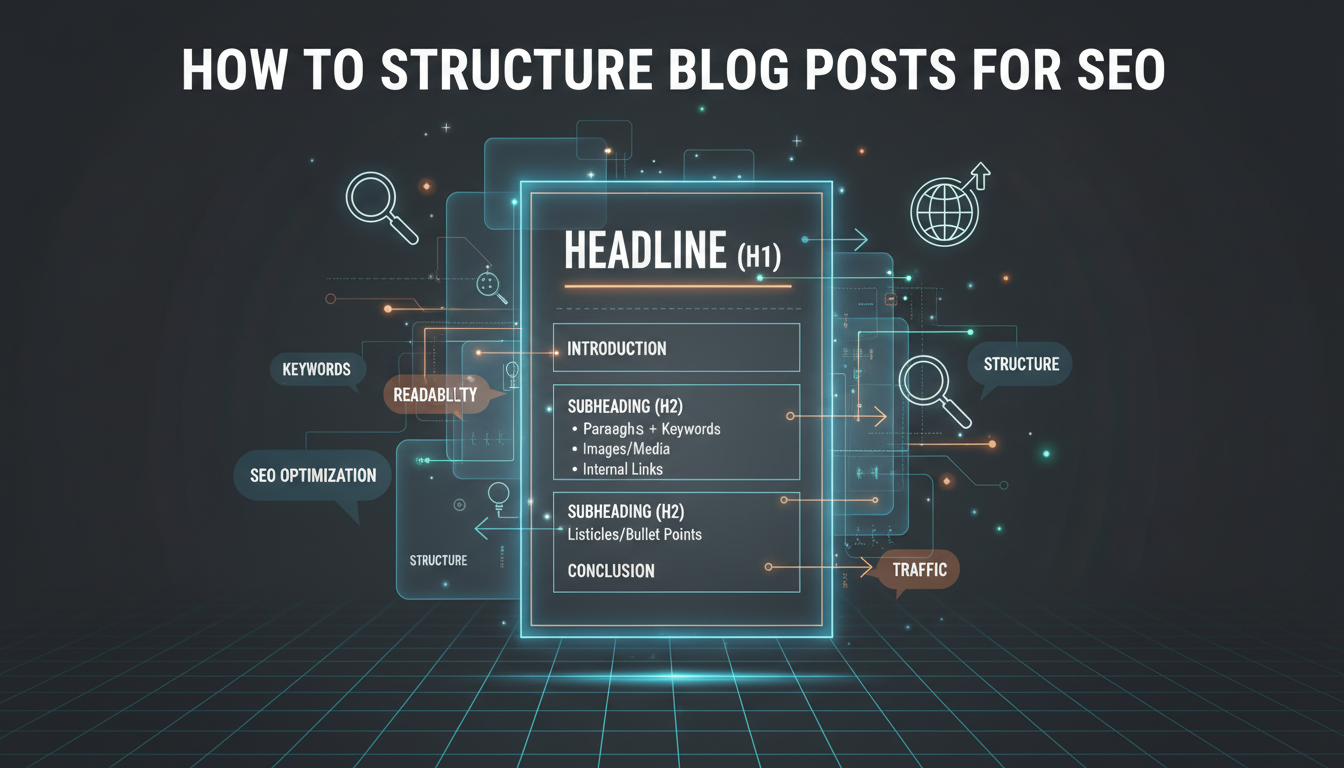
The skeleton of your blog post is defined by your header tags (H1, H2, H3, etc.). These are not just formatting tools to make text larger; they are hierarchical indicators of importance. Proper usage of header tags allows search engines to outline your content and understand the relationship between different sections.
Your H1 tag is the headline and should contain your primary keyword. It acts as the title of the book. Following this, H2 tags serve as chapters, breaking down the main topic into subtopics. H3 and H4 tags act as sub-sections within those chapters. This logical nesting helps Google comprehend the semantic structure of your argument. For a deeper dive into the technical implementation of these tags, effective use of headings is crucial. You can learn more about this specific aspect in our guide on how to use header tags for SEO.
The Power of the Introduction and the Hook
The first few paragraphs of your blog post are arguably the most critical. From an SEO perspective, your primary keyword should appear naturally within the first 100 words. This signals to search engines immediately what the content is about. From a user perspective, the introduction must employ the “inverted pyramid” style used in journalism—delivering the most important value proposition upfront.
Avoid long-winded, fluffy introductions. Instead, articulate the problem the reader is facing and promise a specific solution. This reduces the bounce rate, sending positive engagement signals to Google. If you are struggling with crafting introductions that convert, reviewing basics on how to write SEO-friendly blog posts can provide the foundational skills needed to hook your audience instantly.
Optimizing for Readability and User Experience (UX)
Structure extends beyond HTML tags; it encompasses the visual presentation of text. A “wall of text” is the enemy of SEO. When users encounter a dense block of uninterrupted text, cognitive load increases, and they are likely to leave the page. To combat this, you must structure your content for “skimmability.”
Short Paragraphs and Sentence Variation
Limit paragraphs to 2-3 sentences max. This creates white space, which allows the reader’s eye to breathe. It makes the content appear less intimidating and easier to digest, particularly on mobile devices. According to the Nielsen Norman Group, users often read in an F-shaped pattern, scanning down the left side of the content. Keeping paragraphs short ensures they catch the first few words of each thought.
Bullet Points and Lists
Whenever you are presenting a set of data, steps, or features, use bullet points or numbered lists. Search engines love lists. In fact, properly formatted lists often increase the chances of winning a Featured Snippet (position zero) on Google. This structural element breaks the monotony of prose and highlights key takeaways efficiently.
Visual Assets and Media
Interspersing text with relevant images, infographics, and videos is a key aspect of structure. These elements act as visual speed bumps that keep the reader engaged. Furthermore, optimizing these images with descriptive Alt Text provides another opportunity to signal relevance to search engines. While discussing structure, we cannot ignore the impact of page performance; heavy media can slow down a site. Ensuring your structure supports fast loading times is part of optimizing Core Web Vitals, which are critical for maintaining rankings.
Semantic SEO and Topical Depth
Modern SEO is less about keyword stuffing and more about topic coverage. To structure your blog post for authority, you must cover the subject comprehensively. This involves using Semantic SEO strategies to include related terms, entities, and concepts that search engines expect to see in a high-quality article on the topic.
When outlining your post, look for gaps in your narrative. Are you answering the “who, what, where, when, and why”? Tools like Google Search Central recommend creating content that demonstrates expertise and depth. Structuring your content to include a dedicated section for definitions, background history, or step-by-step processes helps you capture long-tail keyword variations naturally.
For example, if you are writing about “SEO Marketing,” you shouldn’t just repeat that phrase. You should structure sections around related concepts like “digital marketing channels,” “organic traffic growth,” and “keyword research tools.” This approach aligns with semantic SEO principles, helping Google connect your content to the broader knowledge graph.
Search Intent and Content Alignment
One of the biggest mistakes writers make is structuring a post without considering Search Intent. Before writing a single word, you must analyze what the user is actually looking for when they type a query. Is it informational (looking for an answer), transactional (looking to buy), or navigational (looking for a specific site)?
If the keyword is “how to structure blog posts for SEO,” the intent is clearly informational and educational. Therefore, the structure should be a “How-To” guide or a tutorial. It should follow a logical, chronological progression. Conversely, if the keyword was “best SEO writing tools,” the structure should be a listicle or a comparison table. Misaligning your structure with intent will result in poor performance, regardless of how well-written the prose is. To master this, you must deeply understand what search intent is in SEO and how to map your headings to satisfy that intent.
Internal Linking Architecture
A blog post does not exist in a vacuum. Its structure contributes to the overall architecture of your website. Internal linking is the practice of linking to other relevant pages within your own domain. This helps distribute “link equity” (ranking power) across your site and encourages bots to crawl deeper into your archive.
When structuring your post, plan where these links will go. Don’t just tack them on at the end. Weave them naturally into the context of your paragraphs. For instance, if you mention that structure aids in on-page optimization, that is a perfect moment to link to a detailed guide on on-page factors. This creates a web of relevance that establishes your site as a topical authority. For a detailed breakdown of this strategy, refer to our resource on what is internal linking in SEO.
Technical Formatting Considerations
Beyond the visual and textual flow, there are technical structural elements that can boost your SEO.
Table of Contents (ToC)
For long-form content (over 1,500 words), including a clickable Table of Contents at the top is highly recommended. This allows users to jump directly to the section they need. Google also frequently adds “Jump to” links in the search results for pages with a clear ToC, increasing your Click-Through Rate (CTR).
Schema Markup
While invisible to the human reader, Schema Markup is a code structure that helps search engines understand your content. Using “Article” or “BlogPosting” schema can give Google precise data about your headline, author, publish date, and image. This technical structure enhances your eligibility for rich snippets.
URL Structure
The URL of your blog post is the very first structural element a bot encounters. Keep your URLs short, clean, and keyword-rich. Avoid using dates or random strings of numbers. A structure like yourdomain.com/blog/how-to-structure-blog-posts is far superior to yourdomain.com/2023/10/25/cat=482. Clean URLs are easier for users to share and for bots to index.
The Drafting Workflow: From Outline to Final Polish
To consistently produce well-structured content, you need a reliable workflow. Here is the process used by elite ghostwriters:
- Keyword Research & Intent Analysis: Identify the primary keyword and secondary LSI keywords. Determine the user intent.
- The Skeleton Outline: Draft your H1, H2, and H3 headers before writing any body text. This ensures your argument flows logically.
- Drafting: Fill in the sections with high-quality content, focusing on short paragraphs and active voice.
- Reviewing Hierarchy: Check if any sections are too long. If a section exceeds 300 words, break it down with H3 headers or bullet points.
- Optimization: Add internal links, external citations to authority sites like Moz or Wikipedia, and optimize images with Alt text.
By strictly following this structural protocol, you transform a simple article into a high-performance asset that continues to drive value for years.
Frequently Asked Questions
How long should a blog post be for SEO?
There is no magic number, but long-form content (1,500 to 2,500 words) tends to rank better for competitive keywords because it covers the topic more thoroughly. However, the length should always be dictated by the depth required to satisfy the user’s query comprehensively.
What is the difference between H1 and H2 tags?
The H1 tag is the main title of the page and should only be used once per page. It tells Google what the entire page is about. H2 tags are used for the main subheadings within the content to separate different major sections. Think of H1 as the book title and H2s as chapter titles.
How many internal links should I include in a blog post?
There is no strict rule, but a good practice is to include 3-5 relevant internal links for every 1,000 words. The key is relevance; the links must provide value to the reader and fit naturally within the context of the sentence.
Does bolding keywords help SEO?
Directly, bolding keywords has a minimal impact on rankings. However, using strong tags helps highlight key concepts for readers scanning the page. This improves user experience and dwell time, which indirectly signals quality to search engines.
Should I use a Table of Contents for every post?
A Table of Contents is highly recommended for long-form guides or complex articles. It improves navigation and user experience. For shorter news updates or opinion pieces (under 500 words), it may not be necessary.
Conclusion
Mastering how to structure blog posts for SEO is a fundamental skill that separates amateur bloggers from professional content strategists. It is the intersection where technical precision meets creative storytelling. By implementing a logical hierarchy of headings, optimizing for readability with short paragraphs and visual breakers, and aligning your content with search intent, you create a seamless experience for both users and search engine crawlers.
Remember that structure is not a one-time checklist but an evolving discipline. As Google’s algorithms become smarter, they prioritize the user’s ease of access to information above all else. A well-structured post respects the reader’s time, answers their questions efficiently, and positions your brand as an authoritative voice in your industry. Start applying these structural principles today, and you will see a tangible improvement in your organic traffic and engagement metrics.

Saad Raza is one of the Top SEO Experts in Pakistan, helping businesses grow through data-driven strategies, technical optimization, and smart content planning. He focuses on improving rankings, boosting organic traffic, and delivering measurable digital results.