
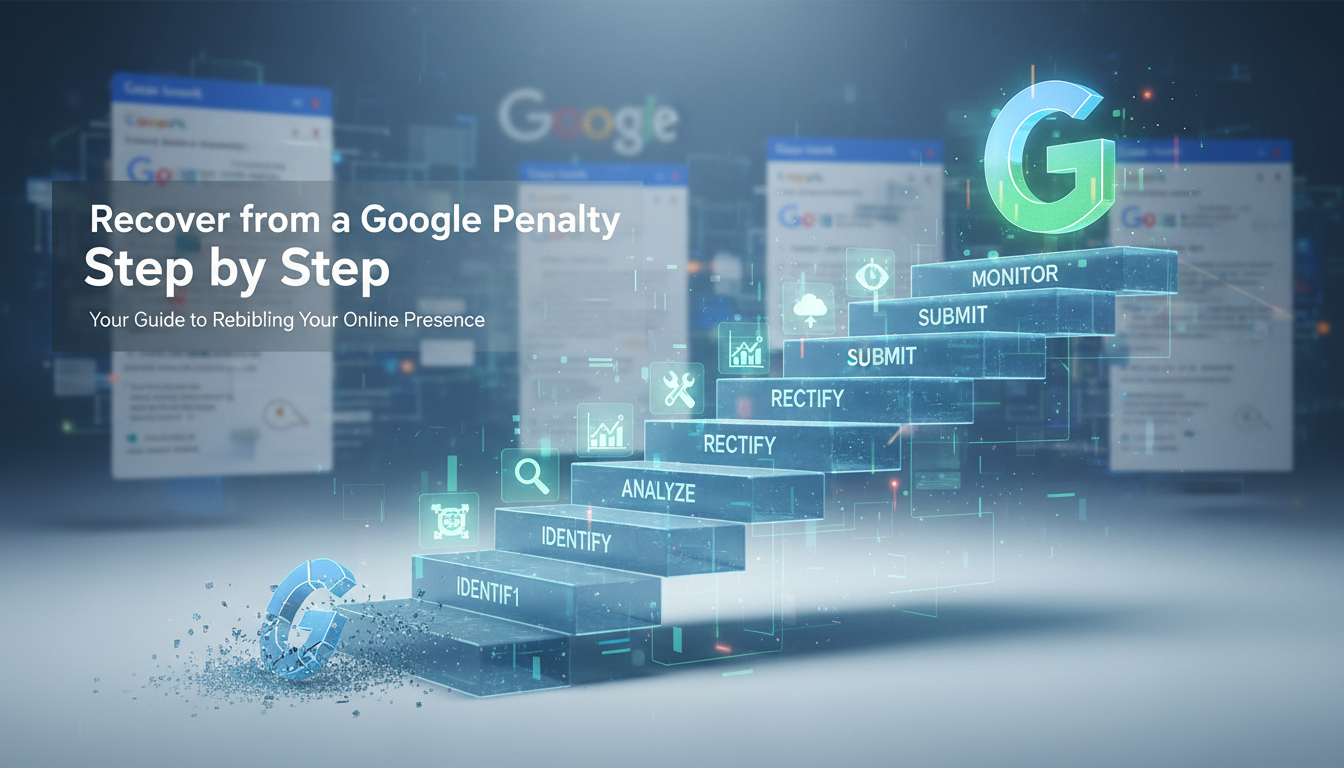
Waking up to find your website traffic has plummeted to near zero is every digital marketer’s worst nightmare. It is the digital equivalent of a shop owner arriving at their storefront to find the doors boarded up and the windows painted over. If your rankings have vanished or significantly dropped overnight, you are likely facing a Google penalty. Understanding how to recover from google penalty situations is not just about technical fixes; it is about restoring trust with the world’s most powerful search engine.
Recovery is possible, but it requires patience, precision, and a complete adherence to Google’s guidelines. Whether you have been hit by a manual action imposed by a human reviewer or an algorithmic devaluation caused by a core update, the path to redemption involves a rigorous audit of your site’s content, technical structure, and backlink profile. This guide serves as your comprehensive blueprint for diagnosing the issue, cleaning up your digital footprint, and regaining your hard-earned organic visibility.
Understanding the Nature of Google Penalties
Before you can fix the problem, you must understand exactly what hit you. In the SEO industry, we generally categorize ranking drops into two distinct buckets: Manual Actions and Algorithmic Devaluations.
1. Manual Actions
A manual action occurs when a human reviewer at Google determines that pages on your site are not compliant with Google’s spam policies. This is the strictest form of penalty. If you have a manual action, you will be explicitly notified via Google Search Console (GSC). Common reasons include unnatural inbound links, user-generated spam, or cloaking.
2. Algorithmic Devaluations
Technically, this is not a “penalty” in the traditional sense, but the result feels the same. This happens when Google’s automated systems (like the core ranking algorithm) decide your site no longer meets the quality standards required to rank highly. This is often tied to specific updates, such as Panda (content quality) or Penguin (link quality). To understand the mechanics behind this, one must grasp the complexity of the Google search algorithm, which uses thousands of signals to determine ranking order.
Step 1: Diagnosing the Root Cause
The first step in learning how to recover from google penalty impacts is accurate diagnosis. Acting blindly can worsen the situation.
Check Google Search Console
Log in to Google Search Console and navigate to the “Security & Manual Actions” tab. If you see a message here, you are dealing with a Manual Action. The message will typically describe the issue (e.g., “Unnatural links to your site”) and which pages are affected.
Analyze Traffic Drop Dates
If there is no manual action listed, check your organic traffic reports in Google Analytics. Identify the exact date the traffic drop began. Cross-reference this date with known Google algorithm update calendars provided by industry news sources like Search Engine Land. If your drop coincides with a major Core Update, your issue is likely algorithmic, requiring a holistic improvement of site quality rather than a specific “fix.”
Step 2: Conducting a Content Quality Audit
Content is often the primary culprit in algorithmic devaluations. Google’s Helpful Content system rewards content that satisfies user intent and punishes content created primarily for search engines. Recovery requires a brutal assessment of your existing pages.
Identify Thin Content
One of the most common triggers for a quality-based penalty is the presence of low-value pages. This is often referred to as thin content in SEO. These are pages with very little text, duplicate content, or content that offers no unique value compared to other sites. You must identify these pages and decide whether to improve them (add depth, data, and expertise), consolidate them with other relevant pages, or delete them entirely (returning a 404 or 410 status code).
Evaluate E-E-A-T
Google places immense weight on Experience, Expertise, Authoritativeness, and Trustworthiness (E-E-A-T). If your content, particularly in YMYL (Your Money Your Life) niches, lacks clear authorship or credible sourcing, you may be suppressed. Ensure every blog post has an author bio and that your “About Us” page clearly demonstrates your organizational expertise.
Step 3: The Backlink Audit and Cleanup
For years, the Penguin algorithm has targeted sites with unnatural backlink profiles. If you have engaged in buying links, link schemes, or have suffered a negative SEO attack, your off-page profile might be toxic.
Analyzing Link Velocity and Quality
A sudden, unnatural spike in backlinks can trigger spam filters. You should analyze your link velocity in SEO to see if there were abnormal acquisition periods that correlate with your ranking drop. Use tools like Ahrefs, SEMrush, or Majestic to export your entire backlink profile.
Filter this list for low-quality indicators:
- Links from sites with zero traffic.
- Links from irrelevant niches (e.g., gambling links pointing to a cooking blog).
- Over-optimized anchor text (using the exact keyword repeatedly).
- Site-wide footer links.
The Disavow File
Once you have identified the toxic domains, you must instruct Google to ignore them. This is done using the Google Disavow Tool. Create a text file (.txt) listing the domains you want to disavow (format: domain:example.com). Upload this to the Disavow Tool. Warning: Use this tool with extreme caution. Disavowing high-quality links by mistake can destroy your rankings further. For official guidance, refer to Google’s documentation on disavowing links.
Step 4: Technical SEO and User Experience
Technical foundations are the stage upon which your content performs. If the stage is broken, the performance fails. Google’s Page Experience update made user experience a direct ranking factor.
Optimizing Core Web Vitals
Slow loading times and shifting layouts frustrate users. Google measures this via Core Web Vitals (LCP, FID/INP, and CLS). If your site fails these metrics, it may be devalued in favor of faster, more stable competitors. Use Google PageSpeed Insights to identify issues and work with developers to optimize image loading, script execution, and server response times.
Crawlability and Indexing
Ensure that Google can actually access your improved content. Sometimes, in an attempt to hide bad pages, webmasters accidentally block critical resources. always double-check your robots.txt file to ensure you aren’t blocking Googlebot from crawling your CSS, JS, or main content areas. A clean crawl path is essential for recovery.
Step 5: The Reconsideration Request (Manual Action Only)
If—and only if—you received a Manual Action, you must submit a Reconsideration Request after fixing the issues. This is a message sent to the Google Webspam team.
How to write a successful request:
- Be Honest: Acknowledge what went wrong. Do not make excuses.
- Be Specific: detailed exactly what you fixed. If it was bad links, link to the Google Sheet where you audited them and share screenshots of your removal requests to webmasters.
- Be Future-Focused: Explain the safeguards you have put in place to ensure this violation never happens again.
For algorithmic penalties, there is no request button. You simply have to wait for Google to recrawl your site and process the changes, which can take weeks or even months.
Step 6: Monitoring and Prevention
Once you have implemented your fixes, the waiting game begins. Recovery is rarely instant. During this phase, vigilance is key. You need to monitor how search engines are interacting with your site to ensure your changes are being picked up.
One advanced method is to verify exactly how often Googlebot hits your site. You can do this by learning how to conduct a log-based SEO audit. Server logs provide the absolute truth about crawl budget and errors that GSC might delay in reporting. This data confirms whether Google is acknowledging your improvements.
Furthermore, ensure you are building a diversified traffic strategy. Relying 100% on Google is a business risk. Incorporate email marketing and social media to insulate your business from future volatility. According to StatCounter, while Google dominates search, user behavior is increasingly fragmented across various platforms, making a multi-channel approach vital for longevity.
Conclusion
Learning how to recover from google penalty setbacks is a rite of passage for many SEO professionals. It is a grueling process that tests your resilience and technical knowledge. However, sites that successfully emerge from a penalty often come back stronger, leaner, and more competitive than before. By shifting your focus from “manipulating the algorithm” to “satisfying the user,” you build a defensive moat around your website that protects it from future updates. Start your audit today, be thorough in your cleanup, and prioritize quality above all else to regain your rightful place in the SERPs.

Saad Raza is one of the Top SEO Experts in Pakistan, helping businesses grow through data-driven strategies, technical optimization, and smart content planning. He focuses on improving rankings, boosting organic traffic, and delivering measurable digital results.