
Introduction
In the constantly shifting landscape of Search Engine Optimization (SEO), few changes have caused as much discussion—and panic—as Google’s rollout of the Helpful Content Update (HCU). For website owners, digital marketers, and content creators, understanding this algorithmic shift is no longer optional; it is a survival requirement. If you are looking to have the google helpful content update explained simply and comprehensively, you have arrived at the right place.
For years, the SEO industry often prioritized search engines over humans. Writers were trained to hit keyword densities, meet arbitrary word counts, and structure articles for bots rather than readers. This resulted in the internet becoming cluttered with fluff—articles that promised answers but required users to scroll through endless paragraphs of irrelevant backstory to find them. Google recognized this deteriorating user experience and launched the Helpful Content Update to correct the course.
This update is part of a broader effort to ensure people see more original, helpful content written by people, for people, in search results. It introduces a new site-wide signal that targets content that seems to have been primarily created for ranking in search engines rather than helping or informing people. Whether you are managing a small blog or looking for the best SEO expert to overhaul a corporate enterprise site, aligning with these new signals is critical.
In this extensive guide, we will break down exactly what the update entails, how it differs from previous core updates, and the actionable strategies you must implement to ensure your content not only survives but thrives in this new era of search.
What is the Google Helpful Content Update?
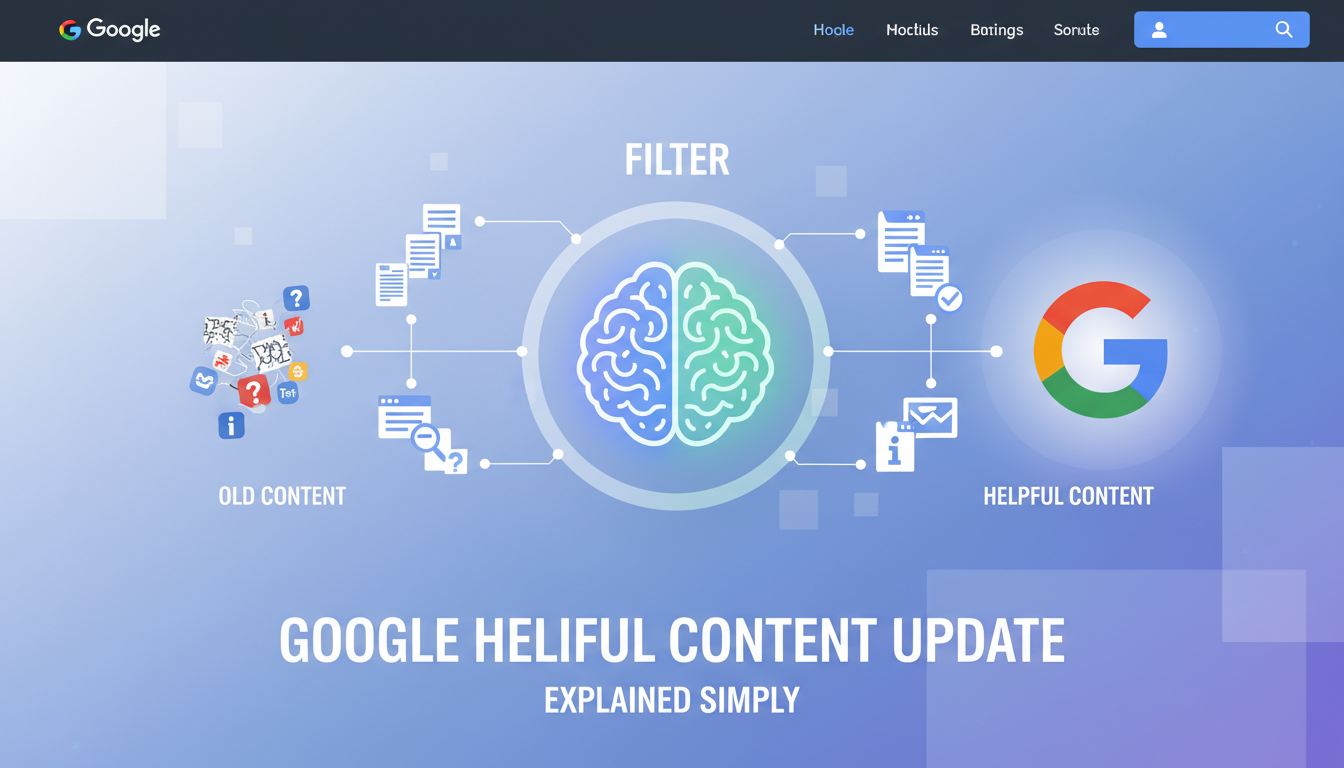
To have the google helpful content update explained effectively, we must first look at the mechanism behind it. Unlike specific core updates that might target link spam or technical glitches, the HCU is a classifier process. It runs continuously and generates a signal that Google uses alongside many other signals (like PageRank and relevance) to rank content.
The primary goal is to reward content that provides a satisfying experience while demoting content that leaves visitors feeling like they need to search again to get a better answer. According to Google’s official documentation, this is a weighted signal. This means that if a website has a relatively high amount of unhelpful content, the entire site suffers—even the high-quality pages on that domain might rank lower because the overall domain signal is tainted.
This “site-wide” aspect is what makes the HCU so potent. In the past, you could have a few low-quality landing pages and still rank well on your main service pages. Now, a cluster of thin, programmatic, or AI-spam pages can drag down your entire site’s authority. This necessitates a holistic approach to content strategy, often requiring a deep dive into technical SEO to ensure that low-quality pages are either improved, de-indexed, or removed entirely.
The Shift from SEO-First to People-First
The core philosophy of this update is the distinction between “SEO-first” content and “people-first” content. SEO-first content is created primarily to attract search engine visits. It often wanders off-topic, lacks real expertise, or simply summarizes what other sites are saying without adding value. People-first content, conversely, is created to serve a specific audience and satisfy a specific intent.
Characteristics of People-First Content
- Targeted Audience: The site has a primary purpose and focus. A cooking blog that suddenly starts reviewing credit cards just to capture high-volume keywords is a red flag for the HCU.
- First-Hand Expertise: The content demonstrates that the writer has actually used the product, visited the location, or holds the relevant qualifications. This ties heavily into Google’s E-E-A-T (Experience, Expertise, Authoritativeness, and Trustworthiness) guidelines.
- Satisfying Experience: After reading your content, does the user leave satisfied? If they have to bounce back to Google to check another source, your content was not helpful.
If you are struggling to pivot your strategy, it may be time to consult with a leading SEO expert in Lahore or your local region to conduct a comprehensive content audit.
Analyzing the Signals: What Google Hates
To master the HCU, you must understand what triggers a negative signal. Google’s algorithms are now sophisticated enough to detect nuances in text that suggest a lack of depth. Here are specific “unhelpful” traits to avoid:
1. The “Word Count” Myth
For years, SEOs believed that longer was always better. Writers would stretch a 300-word answer into a 2,000-word essay filled with fluff. The HCU penalizes this. If you can answer a user’s question in two paragraphs, do so. Forcing length for the sake of length decreases the signal of helpfulness.
2. Summarizing Without Insight
Aggregating content is common, but if your article merely rephrases the top three search results without adding new data, a unique perspective, or personal experience, it is deemed unhelpful. Google wants to rank the source of information, not the echo.
3. Answering Questions You Have No Answer For
This is common in the entertainment and tech niches (e.g., “iPhone 16 Release Date”). If the product hasn’t been announced, but you write a 1,500-word article speculating just to capture the traffic, you are creating a frustrating user experience. This is a primary target of the update.
4. Automation Without Curation
While automation is useful, programmatic SEO that spins up thousands of pages with generic content (like “Best Plumber in [City Name]” for 5,000 cities) with zero local nuances is dangerous. Professional SEO services now focus on quality over quantity to combat this.
The Role of E-E-A-T in the Helpful Content Era
You cannot discuss the helpful content update without discussing E-E-A-T. Google added the extra “E” (Experience) specifically to combat AI-generated, generic content. They want to know that a human with actual experience is behind the keyboard.
For example, if you are writing about medical advice, are you a doctor? If you are writing about fixing a car engine, have you actually held a wrench? This requires better bio pages, clear authorship, and content that speaks from the “I” perspective with anecdotal evidence. When we work on on-page SEO for clients, we ensure that author schema and credible external linking are implemented to bolster these trust signals.
How to Recover from a Helpful Content Hit
If your traffic flatlined after an update, you have likely been hit by the classifier. Because the signal is site-wide, you cannot just tweak one page to recover. You need a domain-level strategy. Here is a step-by-step recovery plan:
1. The Pruning Strategy
Identify the “dead weight” on your site. Look for pages with high bounce rates, low dwell time, and zero conversions. If these pages are not serving a user need, delete them. If they are necessary but thin, consolidate them into a single, comprehensive resource. Removing unhelpful content lifts the aggregate score of the remaining content.
2. The Quality Injection
For the pages you keep, you must inject “experience.” Add original images (not stock photos), add video walkthroughs, and include personal takes that AI cannot replicate. According to data from Semrush, sites that updated content with unique data points saw faster recovery times.
3. UX and Readability
Helpful content is also accessible content. A wall of text is not helpful. Use bullet points, clear headings, and table of contents. Ensure your site loads fast. A slow site is inherently unhelpful. If your Core Web Vitals are failing, you need to address this immediately. Review our case studies to see how technical performance correlates with traffic recovery.
AI Content: Friend or Foe?
A major confusion regarding the google helpful content update explained involves Artificial Intelligence. Does Google penalize ChatGPT or Jasper AI content? The answer is nuanced.
Google has explicitly stated that they reward high-quality content however it is produced. They do not ban AI. However, raw AI output rarely meets the bar for “Helpful.” AI tends to hallucinate facts, use repetitive sentence structures, and lacks true “Experience” (the E in E-E-A-T). Using AI as an assistant to outline or draft is acceptable, but human editing is mandatory to inject the nuance and value required to rank.
Strategic Internal Linking for Authority
One often overlooked aspect of helpfulness is how you guide the user through your website. If a user lands on a page about “SEO Basics,” helpfulness implies guiding them to the next logical step. This is where strategic internal linking comes in.
Do not just link randomly. Link to deepen the user’s journey. If they are reading about local SEO, guide them to a resource about the leading SEO expert in Karachi to show local authority. If they are a business owner looking to scale, direct them to your pricing or consultation pages naturally within the text. This reduces bounce rate and signals to Google that your site is a comprehensive web of information.
The Future of Search: What Comes Next?
The Helpful Content Update is not a one-time event; it is a continuously evolving standard. As Google integrates Gemini and other AI features into the Search Generative Experience (SGE), the definition of “helpful” will become even stricter. Content that simply provides factual answers may be swallowed by the AI snapshot. To survive, content creators must provide perspective, opinion, and community.
This means the future of SEO belongs to those who build brands, not just niche sites. It belongs to creators who engage with their audience. Whether you are a solo blogger or looking for the number one SEO expert in Pakistan to guide your enterprise, the strategy remains the same: Obsess over the user, not the algorithm.
Frequently Asked Questions
1. Is the Helpful Content Update a penalty?
Technically, Google refers to it as a signal, not a manual penalty. However, the effect feels like a penalty. If your site is classified as having unhelpful content, your rankings will be suppressed algorithmically until the signal updates.
2. How long does it take to recover from the HCU?
Recovery is not immediate. Because the classifier runs continuously, you must prove over a period of months that your content has improved. Google needs to observe a sustained pattern of helpfulness before lifting the suppression.
3. Can I use AI tools like ChatGPT and still rank?
Yes, provided the content is accurate, edited, and helpful. If you publish raw AI output that adds no new value or hallucinates facts, you will likely trigger the unhelpful content signal.
4. Does this update affect all languages?
Initially launching for English searches globally, the system has expanded to apply to all languages. It is a core part of Google’s global ranking systems today.
5. Does the update impact high-authority domains?
Yes. While high domain authority (backlinks) helps, it does not grant immunity. Major publishers have seen visibility drops for churning out mass-produced content that lacks depth, proving that relevance and helpfulness are now paramount.
Conclusion
Having the google helpful content update explained is the first step; taking action is the second. This update marks a permanent shift in how we must approach content creation. The days of gaming the system with keyword stuffing and thin content are over. Today, victory in the SERPs belongs to those who truly understand their audience’s pain points and solve them with empathy, expertise, and authority.
It requires a rigorous look at your current content inventory. It requires the bravery to delete what isn’t working and the discipline to invest in high-quality, experience-driven writing. Whether you need to audit your current strategy or build a new one from scratch, focusing on the user is the only sustainable path forward. If you are ready to elevate your digital presence and ensure your site is future-proofed against these updates, do not hesitate to reach out to a professional. You can review our contact page to start the conversation about building a resilient, people-first SEO strategy.

Saad Raza is one of the Top SEO Experts in Pakistan, helping businesses grow through data-driven strategies, technical optimization, and smart content planning. He focuses on improving rankings, boosting organic traffic, and delivering measurable digital results.