


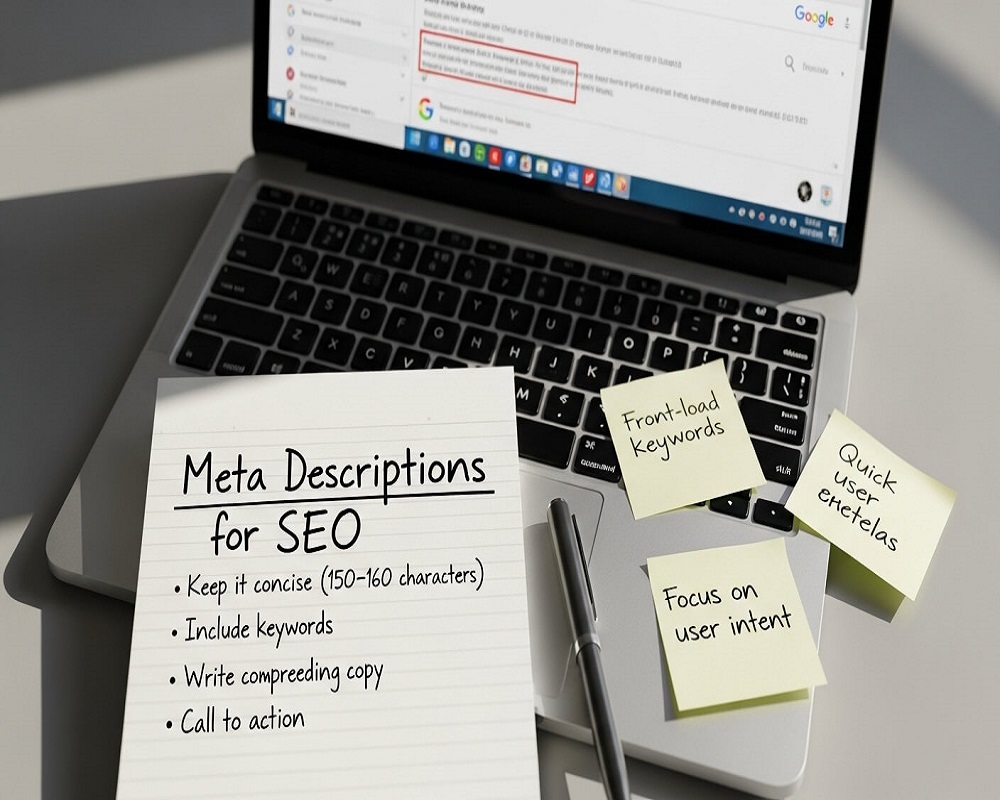
Short answer: To write a meta description for SEO, summarise what the page gives the searcher in one or two plain sentences, include the main keyword naturally, add a specific detail or reason to click, and keep it to roughly 140 to 155 characters so the key point is not cut off. Make it unique for every important page. It does not directly lift rankings, but a good one can earn more clicks.
This guide is for bloggers, store owners and marketers who fill in the meta description box in Yoast or Rank Math and are not sure what to write. You will get a simple formula, examples for different page types, a length checker, the reasons Google ignores some descriptions, and a way to measure whether a new one works.
What a meta description is
A meta description is an HTML tag in the head of a page that summarises the page:
<meta name="description" content="Learn how to write meta descriptions that earn clicks, with a formula, examples by page type and a length checker.">
Google may show it as the grey text under your title in search results. Google’s snippet documentation says snippets are primarily created from the page content itself, and that Google sometimes uses the meta description if it gives users a more accurate description than text taken from the page. So the description is a suggestion, not a guarantee.
Meta description vs title tag vs social description
The title tag is the headline and carries more weight for both relevance and clicks. The meta description supports it with detail. Social platforms use og:description if you set one; otherwise many fall back to the meta description. You can check how a shared link looks with my social share preview.
Do meta descriptions still matter?
Yes, but for clicks, not rankings. A meta description is not something Google describes as a ranking factor. Its value is that, when Google uses it, it is your chance to tell a searcher why your result is the one to open. That matters more as clicks get scarcer: SparkToro’s 2024 study of clickstream data found 58.5% of US Google searches ended with no click.
Ahrefs found Google rewrote descriptions 62.78% of the time, and slightly more often for long-tail queries. Do not read that as “do not bother”. It means descriptions work best on pages that target a clear main query, and that the page content itself also needs to answer the query clearly, because that is what Google pulls from when it rewrites.
A simple formula for writing one
When I write descriptions for client sites, I use four parts. Not every description needs all four, but checking against them catches most weak ones.
- What it is: name the topic or product in the words searchers use.
- What they get: the specific outcome, format or answer (a checklist, prices, delivery time, a calculator).
- Why this page: one differentiator (local, updated for 2026, free, first-hand testing, Cash on Delivery).
- Next step: an implied or explicit action (“see the checklist”, “book a free consultation”), only if it fits naturally.
Write in active voice, keep the main keyword natural (Google often bolds words that match the query), and do not repeat the title word for word.
Worked example: from weak to strong
Weak (a Karachi bakery’s cake page, auto-generated from the first paragraph): “Welcome to our bakery. We have been serving customers since many years with love and passion and we make many types of things…” It says nothing about cakes and is cut off before it gets anywhere. Strong: “Custom birthday cakes in Karachi, made to order in 24 hours. See designs and prices, choose your flavour and get delivery across DHA and Clifton.” That is 147 characters. It names the product and city (what it is), shows designs and prices (what they get), gives a 24-hour turnaround and delivery areas (why this page), and ends with an action.
Meta description length checker
Google says there is no limit on how long a meta description can be, but the snippet is truncated as needed, typically to fit the device width. In practice about 140 to 155 characters shows in full on most desktop results, and mobile shows a little less. Put the most important words first so a cut does not matter. Count your draft with the character counter, then enter the numbers below.
Meta description length checker
How to read it: 155 characters is a practical guide based on what usually displays, not a Google rule. Google truncates by pixel width, so wide letters use space faster. Preview the result in the free SERP snippet preview.
Examples by page type
| Page type | What to include | Example |
|---|---|---|
| Blog guide | The question answered, the format, one differentiator | Learn how to find keywords your customers actually search, with a free spreadsheet template and examples from a real local business. |
| Product page | Product, key specs, price or offer, delivery | Men’s khaddar kurta in navy, sizes S to XXL. Rs 3,450 with free delivery across Pakistan and easy 7-day exchange. |
| Category page | Range, filters, a reason to shop here | Shop 120+ women’s running shoes from top brands. Filter by size and cushioning, with Cash on Delivery in all major cities. |
| Local service | Service, area, proof of availability, contact route | Same-day AC repair in Gulshan-e-Iqbal and Johar. Gas refills, PCB repair and servicing by trained technicians. Call or WhatsApp to book. |
| Home page | Who you are, what you do, for whom | BrandName makes simple accounting software for small shops in Pakistan, with Urdu support, FBR-ready invoices and a free 14-day trial. |
Prices, product counts and features in these examples are placeholders; use the real ones for your page. Google’s guidance specifically mentions that details such as price, date or author can be useful in a description because they may not otherwise appear in the snippet.
Large sites: templates that do not read like templates
Google’s snippet documentation says identical or similar descriptions on every page are not helpful, and that for large database-driven sites, generating descriptions programmatically is appropriate and encouraged. The trick is to pull real data into the template, not just swap one word. For a store, a good template might combine product name, two key attributes from the product data, the price and a sitewide benefit. For thousands of thin pages that do not deserve hand-written copy, a well-built template beats a missing description or a repeated sitewide one. If you are building templates at scale, my guide to programmatic SEO without thin pages covers the wider pattern.
Why Google ignores your description, and what to do
- It does not match the query. A page that ranks for many different searches will often get a page-text snippet for the ones your description does not cover. That is normal; write for the main query.
- It is a keyword list. Google says descriptions made of long strings of keywords are less likely to be displayed.
- It is duplicated across many pages, often by a theme or plugin default.
- It is inaccurate or out of date, for example an old price or a past event.
If you want to control what Google can show, you have three options from the same documentation: nosnippet to show no snippet, max-snippet:[number] to limit its length, and the data-nosnippet attribute to keep specific parts of the page out of snippets. Use these sparingly, as a missing snippet usually reduces clicks.
Mistakes I see on Pakistani and international sites
- Blank descriptions on key pages, so Google pulls the cookie notice or “Welcome to our website”.
- One sitewide description set in the theme and repeated on every page.
- Copying the first paragraph, which usually starts with background rather than the answer.
- Superlatives with no substance: “best”, “No. 1”, “top quality” without a single fact.
- Ignoring local search language: customers search “COD”, “price in Pakistan” or Roman Urdu terms that the description never mentions.
- Not updating seasonal offers, so an “Eid sale” description runs for months afterwards.
Meta description checklist
- Unique: no other page uses the same or nearly the same description.
- Accurate: it describes what the page actually contains today.
- Keyword natural: the main query appears once, in normal language.
- Specific detail: includes a price, format, location, number or other concrete fact.
- Benefit early: the main reason to click appears in the first 120 characters.
- Length checked: roughly 140 to 155 characters, previewed on desktop and mobile.
- Active voice: starts with a verb or the topic, not “This page is about”.
- Not the title again: adds something the title does not say.
- No keyword lists or empty superlatives.
- Seasonal text dated: offers and dates have a reminder to update or remove.
- Measured: date of change logged and CTR compared in Search Console after four weeks.
Ticks are saved in your browser.
How to measure whether it worked
Search Console does not tell you whether Google used your description, but it shows the result. Note the date you changed it, wait at least four weeks, and compare clicks and CTR for the same queries before and after in the Performance report, checking that average position stayed roughly the same. My guide to click-through rate in SEO explains how to compare fairly, and the performance report guide shows where each filter lives. Search the main query yourself to see whether your text is being shown.
Descriptions are one small part of on-page work; for the rest, see how to optimise meta tags.
Frequently asked questions
How long should a meta description be?
Aim for roughly 140 to 155 characters. Google sets no limit but truncates snippets to fit the device, so put the key benefit in the first 120 characters to keep it visible on mobile.
Do meta descriptions affect rankings?
Not directly. Their value is in persuading searchers to click when Google displays them. A better description can increase traffic at the same ranking position.
Why does Google not use my meta description?
Google uses the description only when it thinks it describes the page more accurately for that query than text from the page. It often rewrites descriptions for long-tail queries, keyword-stuffed descriptions, duplicates and outdated text.
Should every page have a meta description?
Every important page should. For very large sites, a template that pulls in real page data is fine for less important pages. A unique, accurate template is better than leaving thousands blank or repeating one sitewide description.
Should I include a call to action?
Where it fits naturally, yes: “see prices”, “download the template” or “book a visit” tell searchers what happens next. Avoid generic “click here” phrasing.
Can I use AI to write meta descriptions?
You can use it for drafts, especially at scale, but check every one for accuracy and specifics. AI drafts tend to be generic and use the same phrases across pages, which is exactly what makes Google ignore them.
Sources
- Google Search Central, “Influencing your search result snippets” (last updated 2026).
- Ahrefs, “Google rewrites meta descriptions 62.78% of the time” study (2020).
- SparkToro, “2024 Zero-Click Search Study” (2024).
If your pages rank but rarely get clicked, my on-page optimisation service rewrites titles and descriptions based on your Search Console data, or you can get in touch with a question.