
Introduction
In the early days of the internet, search engine optimization (SEO) was akin to the Wild West. Website owners discovered a simple, albeit crude, loophole to skyrocket their rankings: repetition. By indiscriminately pasting target phrases into their content, footer, and even hidden code, they could trick primitive search algorithms into believing their page was the most relevant authority on a topic. This practice, known as keyword stuffing, dominated the digital landscape for years. However, the search landscape has evolved dramatically since then. Today, modern algorithms are powered by artificial intelligence and natural language processing, making them far more sophisticated in detecting manipulation.
This evolution begs the question: is keyword stuffing bad for seo in the current digital era? The short answer is a resounding yes. Not only does it fail to improve rankings, but it can also actively destroy your website’s visibility and reputation. Search engines like Google now prioritize user experience, semantic relevance, and high-quality information over mechanical keyword matching. Continuing to rely on outdated tactics is a surefire way to incur penalties and alienate your audience.
In this comprehensive guide, we will dissect why keyword stuffing is detrimental to your organic performance, explore the history of search engine algorithm updates that made it obsolete, and provide actionable, modern strategies to optimize your content effectively. We will look at how to balance keyword usage with readability and how to leverage semantic search principles to build genuine topical authority.
What Exactly Is Keyword Stuffing?
Keyword stuffing refers to the unethical practice of overloading a webpage with target keywords or numbers in an attempt to manipulate a site’s ranking in Google search results. These keywords often appear in a list or group, or out of context (not as natural prose). The goal is to artificially inflate the relevance of the page for specific search queries. While this might sound like a logical strategy to the uninitiated—”if I say it more, Google will think I’m more relevant”—it is fundamentally flawed in today’s ecosystem.
There are two primary forms of keyword stuffing: visible and invisible. Visible stuffing is obvious to the reader; it involves repeating the same phrase in almost every sentence, making the text clunky, repetitive, and difficult to read. Invisible stuffing, on the other hand, is a more deceptive “black hat” technique. It involves hiding text by making the font color the same as the background, positioning text off-screen using CSS, or hiding keywords behind images. Both methods are violations of Google’s Spam Policies and are heavily penalized.
The Evolution of Search Algorithms: From Keywords to Context
To understand why keyword stuffing is dangerous, one must understand the history of Google’s algorithm updates. In the early 2000s, search engines relied heavily on keyword density—the percentage of times a keyword appeared on a page relative to the total word count. This metric was easily manipulated. However, the game changed forever with the introduction of major updates designed to prioritize quality content.
The most significant of these was the Google Panda update in 2011. Panda was specifically designed to lower the rank of “low-quality sites” or “thin sites,” in particular those with poor user experience and content that lacked depth. This was the first major blow to keyword stuffers. Later, the Hummingbird update (2013) and RankBrain (2015) introduced semantic search and machine learning, allowing Google to understand the intent behind a query rather than just matching string characters. More recently, the BERT update has enabled Google to understand the nuance and context of words in search queries better than ever before. To navigate this complex history and its implications, it is vital to understand the impact of Google algorithm updates on modern SEO strategies.
Why Is Keyword Stuffing Bad for SEO?
The negative consequences of keyword stuffing extend far beyond just failing to rank. It creates a domino effect of poor performance metrics that can haunt a domain for years. Here are the critical reasons why you must avoid this tactic at all costs.
1. It Destroys User Experience (UX)
The primary goal of a search engine is to provide the best possible answer to a user’s query. Content that is stuffed with keywords reads unnaturally and offers little value. When a user lands on a page that reads like a robot wrote it, they leave almost immediately. This action creates a high bounce rate and a low dwell time. Search engines interpret these signals as indicators that the page is not relevant or helpful. To diagnose if your current content is suffering from this issue, you need to understand what is bounce rate in SEO and how it correlates with content quality.
2. It Triggers Search Penalties
Google takes spam seriously. If your site is flagged for keyword stuffing, you may be hit with a Manual Action. This is where a human reviewer at Google determines that your site violates their quality guidelines and manually removes your pages from the index or demotes them significantly. Even without a manual penalty, algorithmic filters will likely bury your content deep in the search results (SERPs), rendering it invisible to potential traffic. To protect your site’s longevity, it is essential to learn how to avoid black hat SEO techniques that promise quick wins but deliver long-term damage.
3. Loss of Credibility and Trust
Modern consumers are savvy. They can spot low-quality, spammy content from a mile away. If your brand publishes articles that are barely readable due to excessive keyword repetition, it signals incompetence or desperation. High-authority brands focus on educating and helping their audience, not tricking algorithms. Once you lose the trust of your audience, it is incredibly difficult to regain it, regardless of where you rank in search results.
The Myth of Keyword Density
Many SEO beginners obsess over specific percentages, asking questions like, “What is the perfect keyword density?” In the past, a density of 2-5% might have been recommended. Today, there is no magic number. Google’s John Mueller has explicitly stated that keyword density is not a ranking factor that you should focus on. While keywords must appear in the text to signal relevance, they should appear naturally.
Understanding the difference between healthy optimization and stuffing is key. Optimization means placing keywords in strategic locations—such as the title tag, headers, and meta description—where they help structure the content. Stuffing means forcing them into sentences where they don’t belong. If you are struggling to find the balance, reading up on what is keyword density in SEO can provide clarity on how to measure frequency without obsessing over it.
What to Do Instead: Modern SEO Best Practices
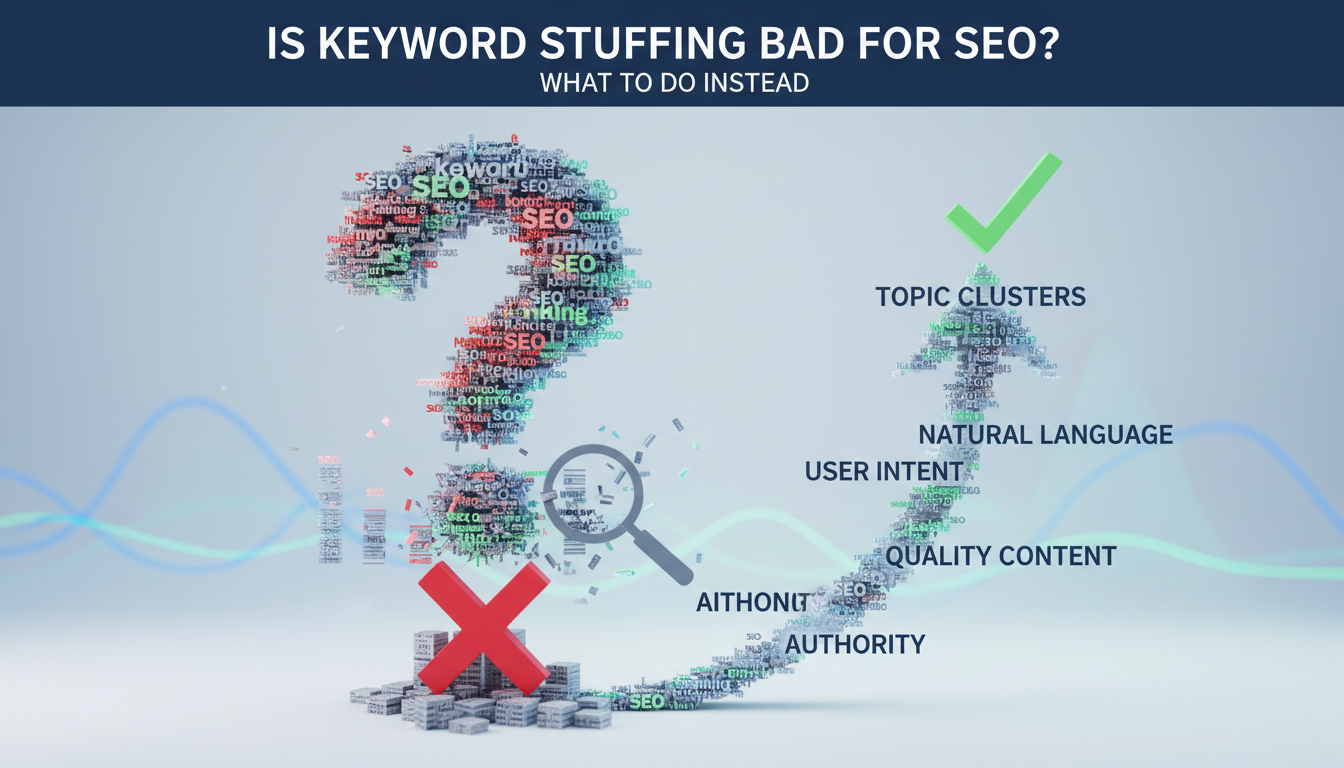
If is keyword stuffing bad for seo is the question, then “Semantic SEO” is the answer. Instead of repeating a single phrase, you should focus on covering a topic comprehensively. Here is how to optimize your content for 2024 and beyond.
1. Focus on Search Intent
Search intent (or user intent) is the why behind a search query. Is the user looking to buy something (transactional), find a specific website (navigational), or learn something (informational)? Your content must satisfy this intent. If a user searches for “best running shoes,” they likely want a list of reviews and comparisons, not a page that repeats the phrase “best running shoes” 50 times without offering any insights. Aligning your content with intent is the cornerstone of how to write SEO-friendly blog posts that rank naturally.
2. Utilize LSI Keywords and Synonyms
Latent Semantic Indexing (LSI) keywords are terms and phrases that are conceptually related to your main keyword. Search engines use these to understand the context of your content. For example, if you are writing about “Apple,” Google looks for related words like “fruit,” “pie,” and “orchard” to distinguish it from “Apple” the tech company (which would be associated with “iPhone,” “Mac,” and “Tim Cook”).
By using synonyms and related concepts, you make your content more readable and richer in context. This practice is a core component of semantic SEO, which helps search engines understand your content as a complete entity rather than a bag of words. This approach signals topical authority and expertise.
3. Optimize for Long-Tail Keywords
Long-tail keywords are longer, more specific phrases that users search for when they are closer to a point of purchase or need a specific answer. Instead of trying to rank for the broad term “SEO,” you might target “how to do on-page SEO for e-commerce websites.” These phrases are less competitive and often convert better. Because they are specific, they naturally prevent keyword stuffing because you can’t awkwardly shoehorn a 7-word phrase into every sentence without it sounding ridiculous.
4. Prioritize Content Structure and Readability
Good SEO is indistinguishable from good writing. Use header tags (H1, H2, H3) to break up your content logically. Use bullet points and short paragraphs to improve readability on mobile devices. When you structure your content effectively, you provide a better user experience, which leads to higher engagement metrics. According to Google’s helpful content guidelines, creating content for people, not search engines, is the primary directive for success.
5. Improve Your Vocabulary and Depth
Instead of repeating the same noun, use variations. If you are writing about “digital marketing,” you can also use terms like “online advertising,” “web marketing strategies,” or “internet promotion.” This variety keeps the reader engaged and signals to Google that your vocabulary is robust and authoritative. Comprehensive content that answers all potential user questions on a topic will naturally contain a wide variety of relevant keywords without the need for force. This connects deeply with the concept of topical authority, where you prove expertise by covering a niche exhaustively.
Tools to help avoid Over-Optimization
While you should rely on your editorial judgment, several SEO tools can help ensure you haven’t accidentally crossed the line into keyword stuffing. Plugins like Yoast SEO or RankMath for WordPress analyze your content in real-time. They will flag if your target keyword appears too frequently. More advanced tools like Surfer SEO or Clearscope compare your content against the top-ranking pages in the SERPs to suggest a natural range of keyword usage and related terms to include.
However, a word of caution: do not follow these tools blindly. If a tool tells you to add a keyword three more times, but doing so would ruin the flow of the sentence, do not do it. Readability and user value must always take precedence over green lights on an SEO plugin.
The Future of SEO is Entity-Based
As we move forward, search engines are shifting from “strings” (keywords) to “things” (entities). An entity is a concept—a person, place, or thing—that is distinct and independent. Google’s Knowledge Graph maps how these entities relate to one another. To succeed in this new environment, your content needs to clearly define entities and their relationships. This is far more complex and rewarding than simple keyword repetition.
For example, effective optimization now involves marking up your content with Schema data to help search engines understand the entities on your page. This technical layer of SEO ensures that machines can parse your data accurately. You can learn more about how technical implementations support content visibility in our guide on technical SEO.
Frequently Asked Questions
1. Can I be penalized for keyword stuffing?
Yes, absolutely. Google can issue a Manual Action against your site, removing it from search results entirely. More commonly, algorithmic updates like Panda will automatically demote your content, making it difficult to rank for any terms, not just the stuffed ones.
2. What is a good keyword density percentage?
There is no universally accepted “good” percentage. Most SEO experts suggest keeping it under 2% to maintain natural readability. However, focusing on writing naturally and comprehensively is far more effective than chasing a specific mathematical ratio.
3. Does keyword stuffing work on other search engines like Bing?
While Bing’s algorithm is different from Google’s, it also utilizes modern NLP and AI technologies. Bing Webmaster Guidelines explicitly advise against keyword stuffing. Doing so on Bing will likely result in similar penalties and loss of visibility.
4. How do I fix keyword stuffing on my old blog posts?
Conduct a content audit. Read through your older posts aloud. If a sentence sounds robotic or repetitive, rewrite it. Use synonyms or pronouns to replace the repetitive keywords. You can also expand the content to add more value, which naturally dilutes the density of the keyword.
5. Is hiding keywords (invisible text) still considered keyword stuffing?
Yes, hiding text (e.g., white text on a white background) is considered a “black hat” technique and is a form of keyword stuffing. It is a severe violation of Google’s Spam Policies and often results in harsher penalties than visible keyword stuffing because it indicates malicious intent to deceive.
Conclusion
So, is keyword stuffing bad for seo? Without a doubt. It is an archaic, ineffective, and dangerous tactic that belongs in the digital history books. In the modern era of semantic search and AI-driven algorithms, success comes from respecting your audience. Search engines have evolved to act as robust delivery systems for helpful content, not just matching engines for text strings.
Instead of trying to manipulate the system with excessive repetition, focus your energy on creating high-quality, comprehensive content that solves real problems. utilize semantic keywords, focus on user intent, and ensure your website provides a stellar user experience. By shifting your strategy from “keyword-first” to “user-first,” you build a sustainable foundation for long-term organic growth. Remember, the best SEO sounds like it wasn’t written for SEO at all—it sounds like it was written for you.

Saad Raza is one of the Top SEO Experts in Pakistan, helping businesses grow through data-driven strategies, technical optimization, and smart content planning. He focuses on improving rankings, boosting organic traffic, and delivering measurable digital results.