
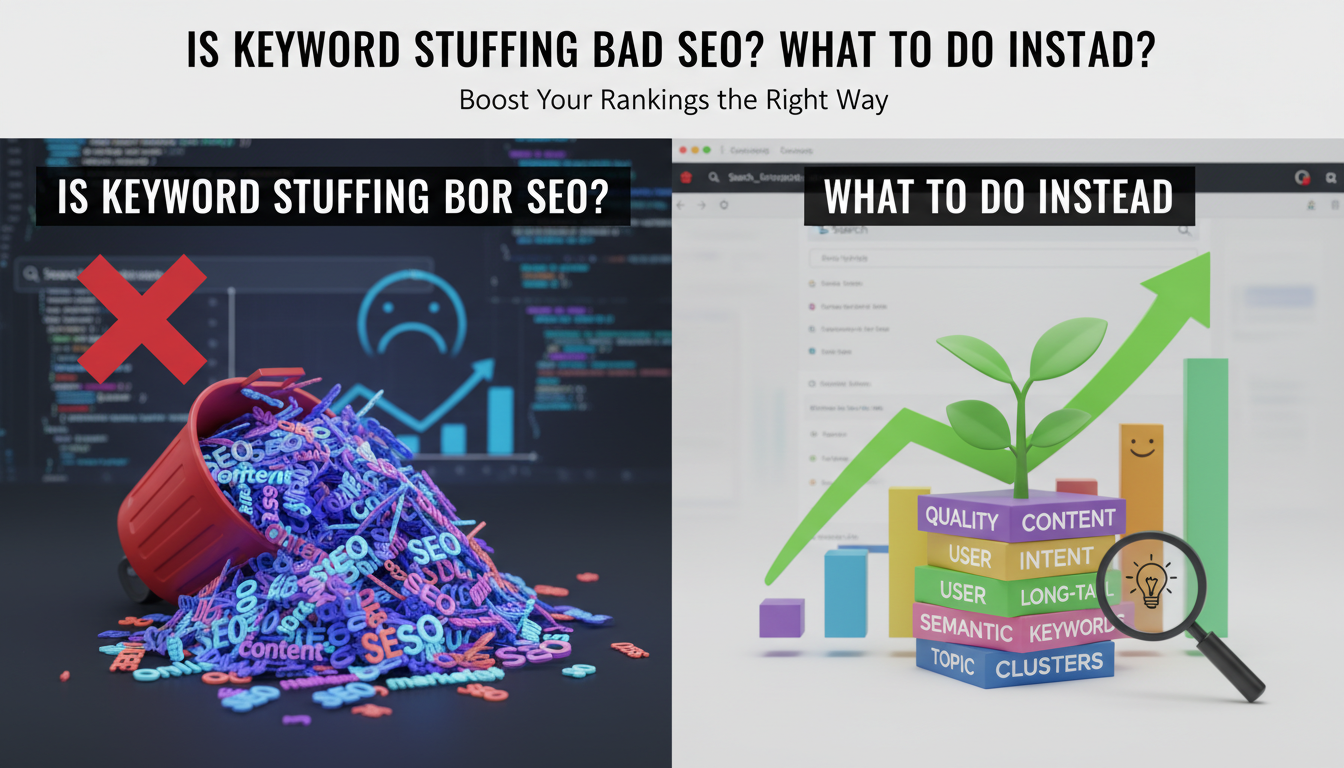
Introduction
In the early days of the digital frontier, ranking a website was a game of sheer volume. Webmasters would identify a target phrase and mechanically repeat it dozens, if not hundreds, of times within a single page. It was an era where algorithms were primitive, and context was secondary to frequency. However, the digital landscape has shifted dramatically. Today, business owners and content creators frequently ask: is keyword stuffing bad for SEO in the modern age?
The short answer is an emphatic yes. Not only is it ineffective, but it is also a dangerous practice that can lead to severe penalties from search engines. As an expert SEO content strategist with over a decade of experience in the ghostwriting industry, I have witnessed the evolution of search algorithms firsthand. The transition from “keyword matching” to “intent matching” has rendered the robotic repetition of phrases obsolete. Google’s sophisticated updates, such as Panda, Hummingbird, and BERT, have been specifically engineered to prioritize user experience and natural language over manipulation tactics.
In this comprehensive guide, we will dismantle the practice of keyword stuffing, exploring why it destroys your site’s credibility and rankings. More importantly, we will discuss advanced alternatives—such as semantic SEO and topic clustering—that professional ghostwriters use to drive organic traffic without sacrificing readability. If you want to build a high-authority brand, understanding the mechanics of keyword density and semantic relevance is non-negotiable.
What Exactly Is Keyword Stuffing?
Before analyzing the repercussions, it is essential to define what constitutes keyword stuffing. In the realm of search engine optimization, keyword stuffing refers to the practice of overloading a webpage with specific keywords or numbers in an attempt to manipulate a site’s ranking in Google search results. These keywords often appear in a list or group, or out of context (not as natural prose).
There are generally two types of keyword stuffing:
- Visible Stuffing: This involves repeating the target phrase unnecessarily in the body text, headers, and meta descriptions to the point where the content becomes unreadable. For example: "We sell the best running shoes. If you want running shoes, buy our running shoes because our running shoes are the best running shoes."
- Invisible Stuffing: A deceptive "black hat" tactic where keywords are hidden from the user but visible to crawlers. This includes text the same color as the background, text hidden in code, or manipulating CSS to position text off-screen.
While the latter is a deliberate attempt to deceive, the former is often a mistake made by amateur writers trying too hard to optimize their content. This is where the distinction between professional SEO-friendly blog posts and amateur content becomes glaringly obvious. Professional writers understand that modern SEO is about nuance, not repetition.
The Mechanics of Search Engine Penalties
To understand why the answer to "is keyword stuffing bad for SEO" is so definitive, one must look at how Google analyzes content today. Search engines use complex Natural Language Processing (NLP) models to understand the relationship between words. When a spider crawls your page, it isn’t just counting instances of a word; it is analyzing the sentiment, syntax, and semantic structure of your content.
When you stuff keywords, you disrupt the natural flow of language. Google’s algorithms, particularly the Helpful Content Update, are designed to detect this anomaly. Content that is written for search engines first and humans second is flagged as low-quality. This can result in manual actions (penalties applied by human reviewers) or algorithmic devaluation, where your pages are simply buried deep in the search results, never to be seen by your target audience.
Furthermore, keyword stuffing triggers negative signals regarding user experience (UX). If a user lands on your page and finds robotic, repetitive text, they will likely leave immediately. This increases your bounce rate and decreases dwell time—two critical metrics that Google uses to gauge the relevance and quality of a page. Essentially, by trying to trick the algorithm, you end up failing the user, which in turn tells the algorithm that your site is unworthy of ranking.
Why Keyword Stuffing Destroys Credibility
Beyond the technical implications, there is a branding crisis associated with over-optimization. In the competitive world of digital marketing, trust is your most valuable currency. High-quality content positions your brand as a thought leader and a reliable source of information. Conversely, content riddled with stuffed keywords screams unprofessionalism.
Imagine a potential client reading a service page that repeats the phrase "best digital marketing agency" in every sentence. It feels spammy, desperate, and inauthentic. It suggests that the company cares more about gaming the system than providing value to the client. This is why many businesses turn to professional ghostwriting services. Expert writers know how to integrate high-value keywords naturally, ensuring the text flows smoothly while still signaling relevance to search engines. Maintaining a natural tone is critical when you learn how to avoid black hat SEO techniques that could tarnish your reputation permanently.
The Evolution of Search: From Strings to Things
To truly grasp the danger of keyword stuffing, we must look at the history of Google’s algorithm updates. In the early 2000s, search engines matched "strings" of text. If you searched for "cheap pizza," the engine looked for pages containing that exact string frequently.
However, the introduction of the Hummingbird update in 2013 changed everything. Hummingbird allowed Google to understand the intent behind a query. Later, RankBrain introduced machine learning to the mix, and BERT (Bidirectional Encoder Representations from Transformers) enabled Google to understand the context of words in a sentence.
Today, Google thinks in terms of "entities" and "concepts," not just strings of characters. This shift has given rise to semantic SEO. Instead of repeating "best coffee maker," a semantic approach involves discussing related concepts like "brewing temperature," "grind size," "drip filter," and "French press." This signals to Google that you have topical authority and are covering the subject comprehensively. Stuffing a single keyword ignores this breadth of coverage, signaling a lack of depth to search engines.
The Myth of Keyword Density
For years, SEOs obsessed over "keyword density"—the percentage of times a keyword appears relative to the total word count. A common myth was that a density of 2-3% was the "golden ratio." In reality, there is no magic number. Google has explicitly stated that they do not use keyword density as a ranking factor in that manner.
While you certainly need to include your target keyword to signal relevance, focusing on a specific percentage often leads to unnatural writing. If you are constantly calculating percentages, you aren’t focusing on the reader. For a deeper dive into this metric, you can explore what is keyword density in SEO, but remember that context always trumps calculation. The goal is to write at a length that fully answers the user’s query, using language that feels conversational and professional.
What to Do Instead: Modern SEO Best Practices
So, if keyword stuffing is a relic of the past, how do you optimize content in 2025? The solution lies in a holistic content strategy that prioritizes user intent and semantic richness. Here is the blueprint that elite copywriters use to rank content without resorting to spam tactics.
1. Focus on User Intent (Search Intent)
Before writing a single word, ask yourself: Why is the user searching for this? Are they looking to buy (transactional), looking for information (informational), or trying to find a specific website (navigational)? Your content must satisfy this intent.
If a user searches "how to fix a leaky faucet," they want a step-by-step guide, not a sales page for plumbing services that repeats "plumber near me" fifty times. By aligning your content with search intent in SEO, you naturally use the language the user expects to see, which leads to better engagement signals and higher rankings.
2. Utilize LSI Keywords and Synonyms
Latent Semantic Indexing (LSI) keywords are terms conceptually related to your main keyword. They provide context. If you are writing about "Apple," Google needs to know if you mean the fruit or the technology giant. Words like "pie," "orchard," and "harvest" indicate the fruit, while "iPhone," "MacBook," and "Cupertino" indicate the company.
Using synonyms and related variations prevents the repetitive stress of keyword stuffing. Instead of repeating "cheap laptop," use phrases like "affordable notebook," "budget-friendly computer," or "low-cost device." This enriches your text and captures a wider variety of search queries.
3. Optimize Page Structure and UX
Google places massive weight on the Google ranking factors related to user experience. This means your content should be easy to scan. Use descriptive H2 and H3 headers (which can naturally include keywords), bullet points, and short paragraphs.
A wall of text is intimidating. Breaking up content makes it digestible. When you structure your content logically, you provide a better experience, which encourages users to stay longer. This “dwell time” is a powerful signal to Google that your content is valuable, far more effective than stuffing keywords into a dense block of text.
4. Long-Tail Keywords
Long-tail keywords are longer, more specific phrases that visitors are likely to use when they’re closer to a point-of-purchase or when using voice search. These keywords have lower search volume but higher conversion rates. Because they are more specific, they are easier to rank for and harder to "stuff" unnaturally.
For example, instead of targeting "shoes," target "best orthopedic running shoes for flat feet." You only need to use this phrase once or twice in the content to signal relevance. The rest of the article should support this specific topic. This strategy often aligns with finding low competition keywords for SEO, allowing you to dominate niche segments of your market.
5. Write for Humans, Optimize for Robots
This is the golden rule of modern copywriting. Write your content as if you are speaking to a client across a desk. Be persuasive, helpful, and empathetic. Once the draft is written, go back and review it for SEO opportunities. Can you add the primary keyword in the first paragraph? Is it in the title tag? Is it in one subheading?
This "post-editing" approach ensures that the flow of the article remains natural. According to Google’s Search Central guidelines, creating helpful, reliable, people-first content is the primary way to ensure long-term ranking success. If you force keywords where they don’t belong, you violate this core principle.
The Role of Technical SEO
While content is king, the technical foundation of your site dictates how that content is delivered. You can have the most beautifully written, non-stuffed article in the world, but if your site loads slowly or isn’t mobile-friendly, it won’t rank. Ensure your site has a clean architecture. This includes proper internal linking, fast load times, and secure connections (HTTPS).
Technical SEO works hand-in-hand with on-page content. When your technical foundation is solid, search engine crawlers can easily access and index your content, allowing your semantic keyword strategy to shine. For instance, understanding technical SEO ensures that your high-quality content isn’t held back by backend errors.
Conclusion on Strategy
Ultimately, the question "is keyword stuffing bad for SEO" highlights a misunderstanding of how the web works today. SEO is no longer a cheat code or a series of loopholes to exploit. It is a discipline of communication. It requires understanding your audience’s needs and delivering answers faster and better than your competitors.
Companies that rely on obsolete tactics like keyword stuffing are building their digital houses on sand. As algorithms continue to become more human-like, the gap between "SEO writing" and "great writing" will disappear completely. The future belongs to those who provide genuine value.
Frequently Asked Questions
1. Can I be penalized for accidental keyword stuffing?
Yes, Google’s algorithms do not necessarily differentiate between malicious intent and poor writing. If your content creates a bad user experience due to excessive repetition, your rankings can suffer. It is crucial to read your content aloud; if it sounds robotic, rewrite it.
2. What is a safe keyword density percentage?
There is no officially recognized "safe" percentage. However, most SEO experts recommend keeping the target keyword frequency between 0.5% and 1.5%. The focus should always be on natural flow rather than hitting a mathematical target.
3. Does keyword stuffing work on other search engines like Bing?
While Bing’s algorithm is different from Google’s, it also prioritizes user experience and relevance. Modern search engines across the board (including YouTube and Amazon) are moving toward semantic search. Moz notes that stuffing is universally considered a spam tactic.
4. How do I fix old content that is keyword stuffed?
Conduct a content audit. Identify pages with unnatural phrasing. Rewrite them to focus on topics and entities rather than specific strings. Use synonyms and expand the content to cover the subject more comprehensively using LSI keywords.
5. Is it keyword stuffing if I use the keyword in every heading?
Using the exact target keyword in every H2 and H3 is generally considered over-optimization and can look spammy. It is better to use variations, questions, or related phrases in your subheadings to maintain a natural structure.
Conclusion
In the high-stakes world of digital visibility, the answer to "is keyword stuffing bad for SEO" is a resounding, unqualified yes. It is a relic of a bygone era that damages user experience, erodes brand trust, and invites penalties from search engines. As the digital landscape evolves towards AI-driven semantic understanding, the only sustainable strategy is to produce high-quality, user-centric content.
By shifting your focus from keyword frequency to topical authority, search intent, and comprehensive coverage, you safeguard your website against future algorithm updates. Whether you are a business owner or a content creator, remember that you are writing for people first. When you prioritize value over manipulation, rankings follow naturally. If you struggle to strike this balance, leveraging the expertise of seasoned SEO writers and strategists is the smartest investment you can make for your long-term organic growth.

Saad Raza is one of the Top SEO Experts in Pakistan, helping businesses grow through data-driven strategies, technical optimization, and smart content planning. He focuses on improving rankings, boosting organic traffic, and delivering measurable digital results.