Introduction
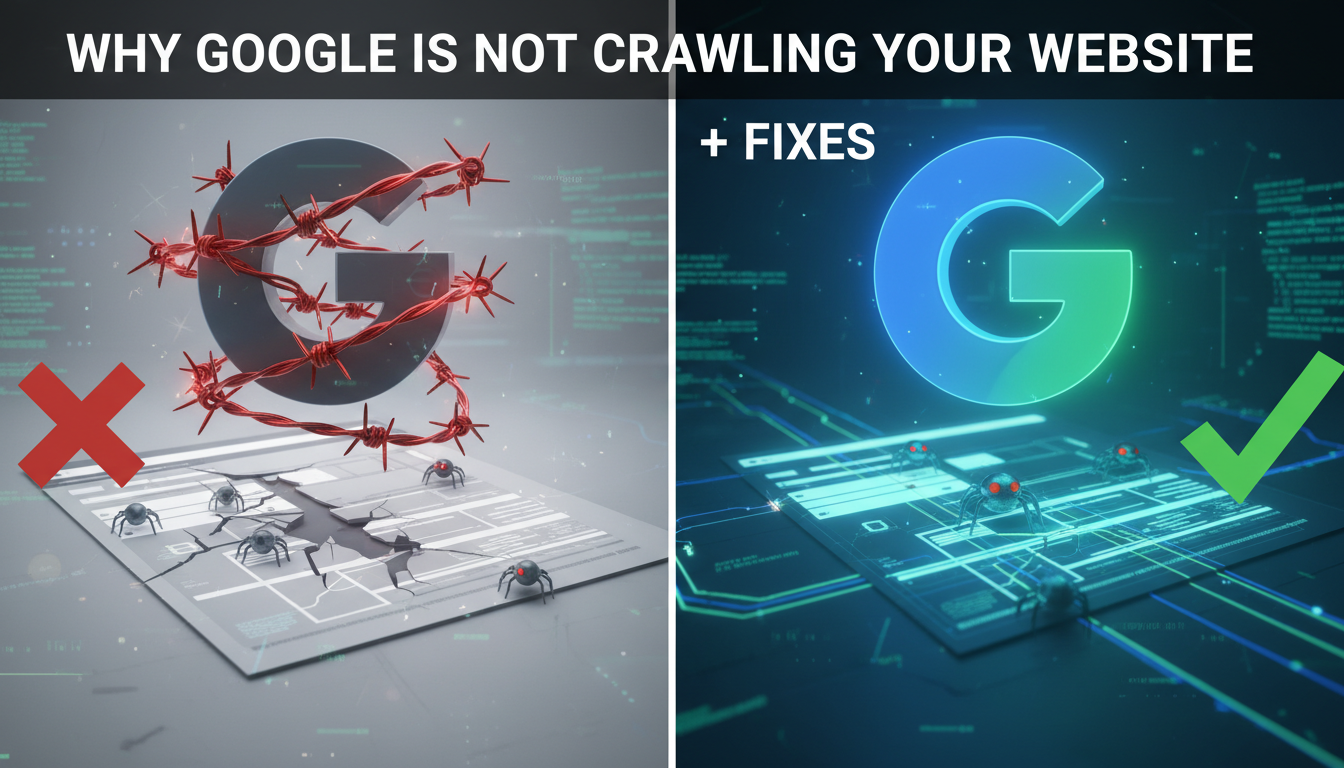
Imagine spending countless hours crafting the perfect website. The design is sleek, the copy is persuasive, and you have poured your expertise into every blog post. You launch with high hopes, waiting for the organic traffic to start rolling in. Days turn into weeks, and your analytics show a flatline. You perform a quick search for your brand or keywords, and nothing appears. Panic sets in. You realize that why Google not crawling my website is the critical question standing between you and digital success.
This is a nightmare scenario for webmasters and business owners alike, yet it is incredibly common. Before your content can rank, it must be indexed. But before it can be indexed, it must be crawled. Crawling is the foundational step in the search engine mechanism where Googlebot (Google’s web crawler) discovers your pages by following links. If this process fails, your site effectively does not exist in the eyes of the search engine.
As an SEO expert, I have diagnosed hundreds of sites suffering from visibility issues. The problem is rarely a penalty; it is usually technical. Whether you are dealing with a brand-new domain that hasn’t established trust or a legacy site plagued by technical debt, the reasons for a lack of crawling are identifiable and fixable. In this comprehensive guide, we will dissect the technical architecture of search, identify the specific barriers stopping Googlebot at your door, and provide actionable solutions to get your pages discovered, crawled, and ranked.
The Mechanism of Search: Crawling vs. Indexing
To fix the problem, you must first understand the distinction between crawling and indexing, as they are often used interchangeably but represent different stages of the pipeline. Crawling is the discovery phase. Googlebot sends out a team of spiders (bots) to fetch web pages. They look at the code, read the content, and follow links to find other pages. If you want a deeper dive into this specific process, reading a complete guide to crawling and indexing is highly recommended to grasp the nuances.
Indexing, on the other hand, is the storage phase. Once a page is crawled, Google analyzes it to understand its topic and value. If it meets quality standards, it is stored in the Google Index—a massive database of valid web pages. Only indexed pages can appear in search results. Therefore, if Google is not crawling your website, indexing is impossible, and ranking is a pipe dream. The root cause usually lies in how your server communicates with these bots or how your site structure facilitates (or hinders) their journey.
Common Technical Barriers to Crawling
When clients ask, “Why is Google not crawling my website?” the answer almost always lies in one of the following technical pitfalls. Let’s explore these in depth.
1. The Robots.txt Roadblock
The most frequent culprit is the robots.txt file. This text file lives in your site’s root directory and acts as a instruction manual for bots. It tells them which parts of your site they are allowed to visit and which are off-limits. It is a powerful tool for managing crawl budget, but a single typo can deindex your entire site.
If your file contains the command User-agent: * Disallow: /, you are explicitly telling every search engine bot to stay away from your entire website. This often happens when developers forget to remove privacy settings after moving a site from a staging environment to a live server. Understanding the syntax and proper configuration of robots.txt is crucial for ensuring you aren’t accidentally locking the doors to your own digital storefront.
2. Sitemap Configuration Errors
Your XML sitemap serves as a roadmap for Googlebot. While Google is smart enough to find pages through internal links, a sitemap is essential for ensuring that deep pages or new content are discovered quickly. If you haven’t submitted a sitemap to Google Search Console, or if your sitemap contains errors (like listing non-canonical URLs or broken pages), you are making the crawler’s job significantly harder.
A well-structured sitemap XML file should list all the URLs you want to be indexed. It should be clean, up-to-date, and free of redirect chains. If your sitemap is outdated, Googlebot may waste time trying to crawl dead links, ignoring your fresh content in the process.
3. Poor Internal Linking Structure
Googlebot functions like a traveler; it needs paths to move from one location to another. These paths are your internal links. If a page on your website has no internal links pointing to it, it is known as an orphan page. Without a link from another page on your site (or an external backlink), Googlebot has no way of finding it unless it’s explicitly listed in your sitemap.
Orphan pages are a major reason for partial site crawling issues. You might find that your homepage is crawled, but your blog posts or product pages are ignored. To solve this, you must build a logical hierarchy where the homepage links to categories, and categories link to individual posts. Learning how to create an internal linking structure is vital not just for crawling, but for spreading link equity throughout your domain.
4. Server Errors and Connectivity Issues
Sometimes, the issue isn’t your code, but your server. If Googlebot attempts to visit your site and encounters a server error (5xx status code) or a connection timeout, it will back off. If these errors persist, Googlebot will reduce its crawl rate significantly to avoid overloading your server. In severe cases, it may stop crawling altogether until the site stabilizes.
Regularly monitoring your server logs and hosting performance is part of holistic technical SEO. If your hosting provider cannot handle the traffic or bot requests, you may need to upgrade your plan or optimize your database to ensure a 200 status code is returned promptly every time a bot knocks.
5. Slow Page Speed
Google has a finite amount of time and resources it can dedicate to crawling the entire internet. If your website is incredibly slow to load, Googlebot consumes more time crawling a single page. This inefficiency forces the bot to abandon the crawl before it reaches your deeper pages.
Site speed is not just a ranking factor; it is a crawling factor. Optimizing images, leveraging browser caching, and minimizing JavaScript execution are necessary steps. If you are struggling with performance, you need to research how to increase website speed for SEO to ensure the bot can traverse your site swiftly.
Crawl Budget: The Hidden Economy of SEO
For larger websites with thousands or millions of pages, the concept of crawl budget becomes the primary concern. Crawl budget refers to the number of pages Googlebot is willing and able to crawl on your site within a given timeframe. This budget is determined by two main factors: crawl rate limit (how much your server can handle) and crawl demand (how popular or important your pages are).
If you have a massive eCommerce site or a news portal, wasting crawl budget on duplicate content, faceted navigation URLs, or low-value utility pages can prevent your important money pages from being crawled. Managing this resource is an advanced skill. You must prioritize your most valuable content and use directives like “noindex” or robots.txt to prevent bots from wasting resources on low-value pages. Understanding what crawl budget is in SEO allows you to direct Google’s attention exactly where you need it.
Immediate Fixes: How to Force Google to Crawl Your Site
If you have identified the barriers above, here is a step-by-step protocol to resolve the issue and encourage Google to return.
Step 1: The URL Inspection Tool
The fastest way to diagnose and fix a specific page is using the URL Inspection Tool inside Google Search Console (GSC). Enter the URL that isn’t being crawled. GSC will tell you if the URL is on Google, if it’s indexable, and when it was last crawled. If the page is not indexed but has no errors, click “Request Indexing.” This adds the URL to a priority queue for crawling. While you cannot do this for thousands of pages manually, it is effective for critical landing pages.
Step 2: Fix Broken Links and Redirect Chains
When Googlebot encounters a broken link (404 error), it hits a dead end. When it hits a long chain of redirects, it stops following them to conserve resources. Cleaning up your site architecture is mandatory. Use tools like Screaming Frog or Ahrefs to scan your site for these issues. Once identified, you should know how to fix broken links for SEO effectively—either by updating the link to a live page or implementing a proper 301 redirect.
Step 3: Acquire High-Authority Backlinks
Google discovers new content primarily by following links from known, authoritative sites. If your website is an island with no incoming bridges, Googlebot may simply never find it. Building a backlink profile is not just about ranking power; it is about discovery. When a high-traffic, frequently crawled news site links to you, Googlebot will follow that link to your domain almost immediately. This is why off-page SEO strategies are often the cure for crawling stagnation.
Step 4: Update Your Content Regularly
Crawl demand is influenced by freshness. If Google notices that your site hasn’t been updated in six months, it will reduce the frequency of its visits. Conversely, if you publish high-quality content daily, Googlebot learns to visit frequently to catch the new updates. Consistency signals to the search engine that your site is alive and relevant.
The Role of JavaScript in Crawling Issues
Modern web development often relies heavily on JavaScript frameworks like React or Angular. While these provide dynamic user experiences, they can be a nightmare for crawlers. Googlebot is capable of rendering JavaScript, but it is a resource-intensive process that happens in a second wave, often days or weeks after the initial HTML crawl.
If your crucial content (links, text, metadata) is loaded only via client-side JavaScript, Googlebot might see an empty page during the initial pass. This is known as the “rendering gap.” To ensure your site is crawlable, you should implement Server-Side Rendering (SSR) or dynamic rendering, ensuring that the bots receive a static HTML version of the page immediately. This ensures that your internal links are visible in the source code, allowing the spider to continue its journey without delay.
Monitoring Your Success
Fixing crawling issues is not a one-time task; it requires ongoing vigilance. Your primary dashboard for this is the Crawl Stats report in Google Search Console. This report shows you the total number of crawl requests over the last 90 days, the average response time, and the breakdown of file types crawled.
An upward trend in crawl requests combined with a stable or decreasing server response time indicates a healthy technical environment. If you see a sudden drop in crawl activity, check your server logs immediately. If you see a spike in 5xx errors, contact your hosting provider. By staying proactive, you ensure that your hard work in content creation is never wasted due to technical invisibility.
Frequently Asked Questions
1. Why is my new website not showing up on Google?
New websites often face a delay known as the “Sandbox” effect. Google needs time to discover, crawl, and trust a new domain. It can take anywhere from a few days to a few weeks for a new site to be crawled. Ensure you have submitted your sitemap to Google Search Console to speed up this process.
2. Can I force Google to crawl my website instantly?
You cannot force an “instant” crawl, but you can request it. Using the “URL Inspection” tool in Google Search Console allows you to submit individual URLs for priority crawling. However, Google does not guarantee a specific timeframe; it usually happens within hours or days.
3. Does social media help Google crawl my website?
Indirectly, yes. While social media links are typically “nofollow” and don’t pass link equity, the buzz and traffic generated can alert Google to your content’s existence. Furthermore, if people share your content on their own blogs or forums, those backlinks will directly aid discovery.
4. What does “Discovered – currently not indexed” mean?
This status in Google Search Console means Google knows the URL exists but hasn’t crawled it yet. This is often a crawl budget issue or a sign that Google doesn’t perceive the content as high-priority enough to warrant an immediate crawl. Improving site authority and internal linking usually resolves this.
5. How do I know if my robots.txt file is blocking Google?
You can test your robots.txt file using the Robots.txt Tester in Google Search Console or by manually navigating to yourdomain.com/robots.txt. Look for lines that say Disallow: /. If you see this under User-agent: *, you are blocking all bots from the entire site.
Conclusion
Realizing that Google is not crawling your website can be disheartening, but it is rarely a permanent condition. It is a technical puzzle that requires a systematic approach to solve. By ensuring your robots.txt allows access, verifying your sitemap is error-free, optimizing your server performance, and establishing a strong internal linking structure, you open the gates for Googlebot. Remember, the internet is a vast ecosystem, and Google’s resources are finite. You must make your website as easy as possible to access and understand. Once the technical barriers are removed, the crawler will do its job, paving the way for your content to be indexed, ranked, and ultimately seen by your target audience. Monitor your Google Search Console regularly, keep your infrastructure healthy, and your visibility will follow.

Saad Raza is one of the Top SEO Experts in Pakistan, helping businesses grow through data-driven strategies, technical optimization, and smart content planning. He focuses on improving rankings, boosting organic traffic, and delivering measurable digital results.