
Introduction
In the high-stakes world of digital marketing, flying blind is a surefire way to crash. Imagine trying to win a Formula 1 race without knowing the layout of the track or the horsepower of the cars next to you. That is exactly what happens when you launch an SEO strategy without first understanding the landscape. This process is known as competitor analysis, and it is the bedrock of any successful campaign. If you want to dominate the Search Engine Results Pages (SERPs), you must master how to do competitor analysis for SEO.
Competitor analysis is not merely about spying on your rivals; it is a strategic deep dive into their tactics, strengths, and weaknesses. It involves reverse-engineering the success of the websites currently ranking above you to understand exactly what Google prefers for your specific niche. By analyzing their keyword profiles, backlink structures, and content strategies, you can uncover gaps in the market that you can exploit. It turns data into a roadmap, moving you from guesswork to precision execution.
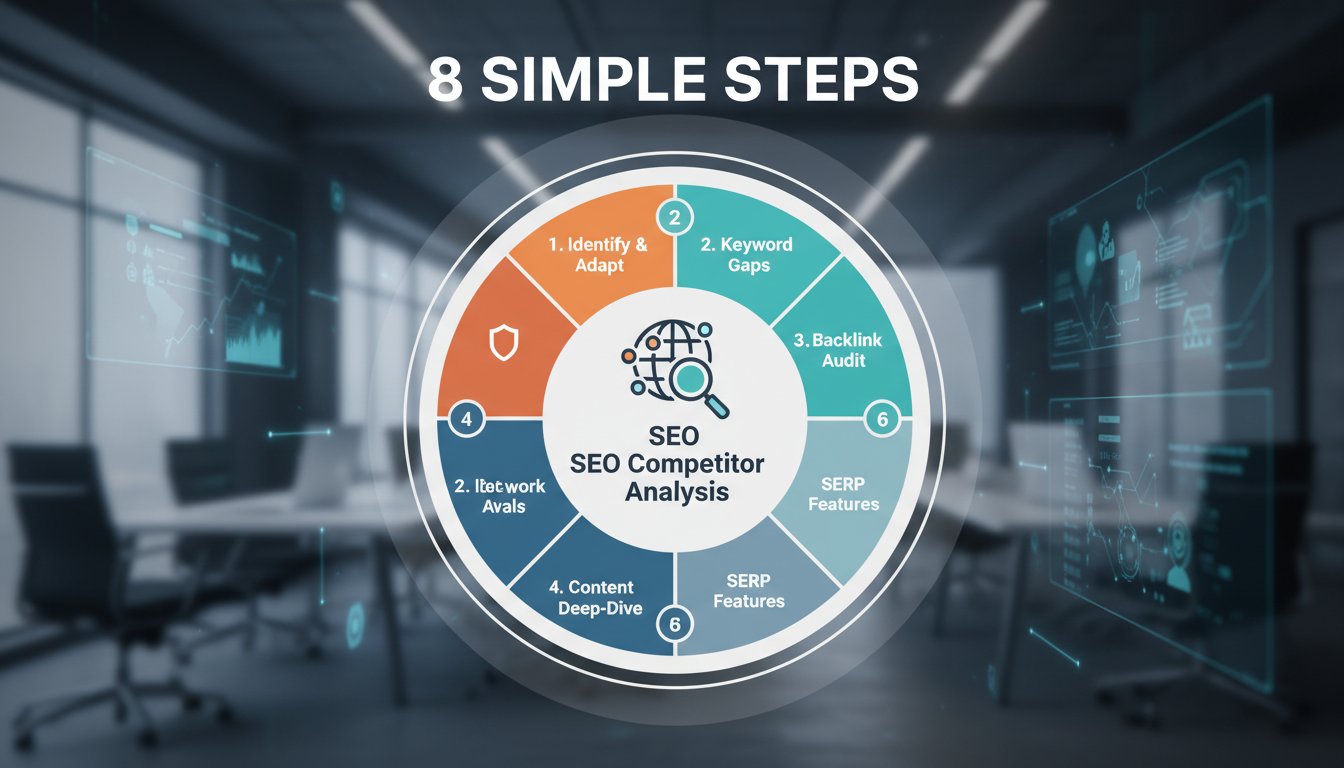
Whether you are a startup founder or a seasoned marketing director, understanding the competitive landscape allows you to allocate resources more efficiently. Instead of wasting budget on keywords that are too difficult to rank for, or creating content that nobody is searching for, you can target low-hanging fruit and high-impact opportunities. In this comprehensive guide, we will walk through 8 detailed steps to perform a forensic audit of your competition, leveraging the expertise found in professional SEO services to help you outrank the industry giants.
Step 1: Identify Your True SEO Competitors
The first step in learning how to do competitor analysis for SEO is realizing that your business competitors are not always your SEO competitors. Your business competitor might be the shop across the street, but your SEO competitors are the websites occupying the top spots in Google for your target keywords. These could be major publications, Wikipedia, or niche blogs that don’t even sell a product but dominate the informational search intent.
To identify them, start by listing your top 10 core keywords—the terms that best describe your product or service. Type these into Google (in Incognito mode to avoid personalized results) and note down the domains that consistently appear in the top 3 to 5 positions. You will likely notice two types of competitors emerging:
- Direct Competitors: Businesses that sell the same products or services as you.
- Indirect Competitors: Informational sites, directories, or forums that rank for your keywords but serve a different user intent.
Use tools like Semrush or Ahrefs to validate this list. These tools provide a "Competitors Report" that visualizes the overlap between your keyword set and other domains. A comprehensive strategy, like those developed by Saad Raza SEO, focuses on analyzing both direct and indirect competitors to ensure no traffic opportunity is missed.
Step 2: Perform a Keyword Gap Analysis
Once you know who you are fighting against, you need to know the battlefield. A keyword gap analysis helps you identify the keywords your competitors rank for, but you do not. This is often the quickest way to find high-value traffic opportunities. The goal here is to find the "sweet spot": keywords with decent search volume, high relevance to your business, and manageable ranking difficulty.
When conducting this analysis, look for three specific categories of keywords:
- Missing Keywords: Terms where your competitors rank, but your site has no presence at all. These represent immediate content opportunities.
- Weak Keywords: Terms where you rank, but significantly lower than your competitors (e.g., they are on page 1, and you are on page 5). These pages need optimization or better internal linking.
- Untapped Keywords: Keywords that neither you nor your direct competitors rank for, but are relevant to the industry. These are blue-ocean opportunities.
Don’t just look at the volume; look at the intent. Are these transactional keywords (people ready to buy) or informational (people looking to learn)? A balanced SEO strategy targets both.
Step 3: Analyze Competitor Content Strategy
Content is the vehicle that delivers rankings. To outrank your competitors, you cannot simply write "more" content; you must write better content. Analyzing your competitors’ top-performing pages gives you a benchmark for what Google considers "quality" in your niche.
Evaluate their content based on the following criteria:
- Content Length and Depth: Are they writing 500-word overviews or 3,000-word comprehensive guides? According to studies by Backlinko, longer content tends to accumulate more backlinks and rank higher.
- Format and Media: Do they use custom infographics, original videos, or interactive tools? Visuals increase time-on-page, a crucial user engagement signal.
- Readability and Tone: Is their tone academic and dry, or conversational and engaging? Humanizing your content can be a major differentiator.
- Freshness: How often do they update their content? Google loves fresh data.
If you notice your competitor has a ranking article titled "10 Tips for SEO," you shouldn’t just write "10 Tips." You should write "20 Data-Backed SEO Strategies with Case Studies." This is the skyscraper technique: finding the tallest building in town and adding 10 floors to it.
Step 4: Conduct a Technical SEO Audit
Even the best content will fail if the underlying technical foundation of the website is flawed. Technical SEO refers to the backend structure that allows search engine spiders to crawl and index your site effectively. When analyzing competitors, you want to see if their site is faster, more secure, or better structured than yours.
Key technical elements to investigate include:
- Page Speed: Use Google’s PageSpeed Insights to check their Core Web Vitals. If their site loads in 1 second and yours takes 5, you are at a severe disadvantage.
- Mobile Friendliness: With mobile-first indexing, a site that isn’t responsive is invisible. Check how their site behaves on different devices.
- Site Architecture: How deep are their important pages? Ideally, no page should be more than 3 clicks away from the homepage.
- Schema Markup: Are they using structured data to get rich snippets (stars, FAQs, recipes) in the search results?
Technical issues can be complex to diagnose and fix. If you discover that your competitors are outperforming you technically, you may need to consult a specialist in technical SEO to clean up your code, optimize your server response times, and ensure your XML sitemaps are pristine.
Step 5: Evaluate the Backlink Profile
Backlinks remain one of the top three ranking factors for Google. They act as votes of confidence from other websites. If your competitor has 1,000 high-quality backlinks and you have 10, they will almost certainly outrank you, regardless of how good your content is. This is the domain of off-page SEO.
Use tools to analyze the Backlink Gap. Look for:
- Domain Authority (DA) / Domain Rating (DR): A metric predicting how likely a website is to rank. Compare your score to theirs.
- Referring Domains: The total number of unique websites linking to them. Quality matters more than quantity—one link from the New York Times is worth more than 1,000 from low-quality directories.
- Anchor Text Distribution: Are they using exact-match keywords in their links, or branded terms? Over-optimizing anchors can lead to penalties, but a natural mix helps rankings.
- Link Velocity: How fast are they acquiring new links? A sudden spike might indicate a PR campaign or a viral post.
Your goal is to find the sites linking to your competitors and ask yourself: "Can I get a link from them too?" This is often done through broken link building or guest posting.
Step 6: Assess On-Page Optimization
On-page SEO involves optimizing individual web pages to rank higher. When you look at a competitor’s page, you need to dissect how they are using keywords within the HTML of the page itself. This is often where the battle for the top spot is won or lost on a granular level.
Pay close attention to these elements:
- Title Tags: Are they front-loading their target keyword? Are they using emotional triggers (e.g., "Best," "Fast," "Easy")?
- Header Tags (H1, H2, H3): structured hierarchies help Google understand context. Look at how they use H2s to target long-tail keywords.
- Internal Linking: How are they passing authority between pages? A strong internal linking structure keeps users on the site longer and helps crawlers index deep content. Effective on-page SEO ensures that every element, from image alt text to meta descriptions, is working hard to rank the page.
- Keyword Density: While keyword stuffing is dead, relevant keyword placement is vital. Check if they are using LSI (Latent Semantic Indexing) keywords—conceptually related terms that give context to the main topic.
Step 7: Analyze User Experience (UX) and Core Web Vitals
Google has officially made User Experience a ranking factor. It is no longer enough to just provide information; you must provide a delightful experience. If users bounce from your site immediately but stay on your competitor’s site, Google interprets this as a signal that your competitor is more relevant.
Analyze your competitor’s UX by looking at:
- Navigation: Is their menu intuitive? Can users find what they need instantly?
- Call-to-Actions (CTAs): Where are they placing buttons and forms? Are they intrusive or helpful?
- Layout: Is the text broken up with bullet points and white space, or is it a wall of text?
- Pop-ups: Do they use aggressive interstitials that block content, or helpful exit-intent modals?
Tools like Google Search Console and heat-mapping software can help you understand how users interact with pages. If your competitor provides a seamless, fast, and enjoyable journey, you must elevate your design and functionality to match or exceed them.
Step 8: Monitor SERP Features and Snippets
Finally, look at the actual search results page. Google is no longer just a list of 10 blue links. The SERP is now crowded with features like Featured Snippets, "People Also Ask" boxes, Local Packs, and Knowledge Panels. These features steal a significant amount of clicks from the traditional organic results.
Analyze if your competitors are capturing these features. If they have the "Featured Snippet" (position zero) for a query like "how to do competitor analysis for seo," analyze the format of their answer. Is it a paragraph, a list, or a table? Google prefers concise, direct answers for snippets. By reformatting your content to directly answer the query in a succinct way (often 40-60 words), you can steal this prime real estate.
Understanding the intent behind SERP features is critical. If a search result shows a video carousel, writing a long blog post won’t help you rank; you need to create video content. Aligning your format with the SERP reality is the final piece of the puzzle.
Frequently Asked Questions
What tools are best for SEO competitor analysis?
The industry standards for competitor analysis are Semrush, Ahrefs, and Moz. These tools offer comprehensive data on keywords, backlinks, and traffic estimates. For a free alternative, Google Search Console and Ubersuggest provide valuable, albeit more limited, insights.
How often should I conduct competitor analysis?
SEO is dynamic, not static. You should perform a deep-dive audit quarterly to adjust your strategy. However, you should monitor your competitor’s rankings and new content on a monthly basis to react quickly to market changes.
Can I do competitor analysis without paid tools?
Yes, you can do manual analysis by checking SERPs, analyzing source code, and using free tools like Google Keyword Planner. However, paid tools significantly speed up the process and provide data (like backlink history) that is impossible to get manually.
What is the difference between direct and indirect competitors?
Direct competitors sell the same product or service as you. Indirect competitors create content around the same topics and rank for your keywords but might monetize differently (e.g., a blogger vs. an e-commerce store). You must compete with both for visibility.
How do I use this data to improve my rankings?
Use the data to create a "Gap Strategy." Create content for keywords you are missing, improve existing content where you are ranking low, build links from domains that link to your rivals, and fix technical errors that are slowing you down compared to them.
Conclusion
Mastering how to do competitor analysis for SEO is the difference between guessing and growing. It provides a data-driven foundation for every decision you make, from the content you write to the technical optimizations you implement. By systematically breaking down your competitors’ strategies—analyzing their keywords, content, technical health, backlinks, and on-page tactics—you demystify their success and create a clear roadmap to overtake them.
Remember, SEO is a zero-sum game in many respects; there is only one #1 spot. To claim it, you must be more relevant, more authoritative, and faster than the current placeholder. This process requires patience, precision, and expertise. If you are ready to take your digital presence to the next level but need expert guidance to navigate the complexities of the data, consider partnering with a proven expert. You can read more about Saad Raza and how a dedicated strategy can transform your business, ensuring you don’t just compete, but dominate.

Saad Raza is one of the Top SEO Experts in Pakistan, helping businesses grow through data-driven strategies, technical optimization, and smart content planning. He focuses on improving rankings, boosting organic traffic, and delivering measurable digital results.