


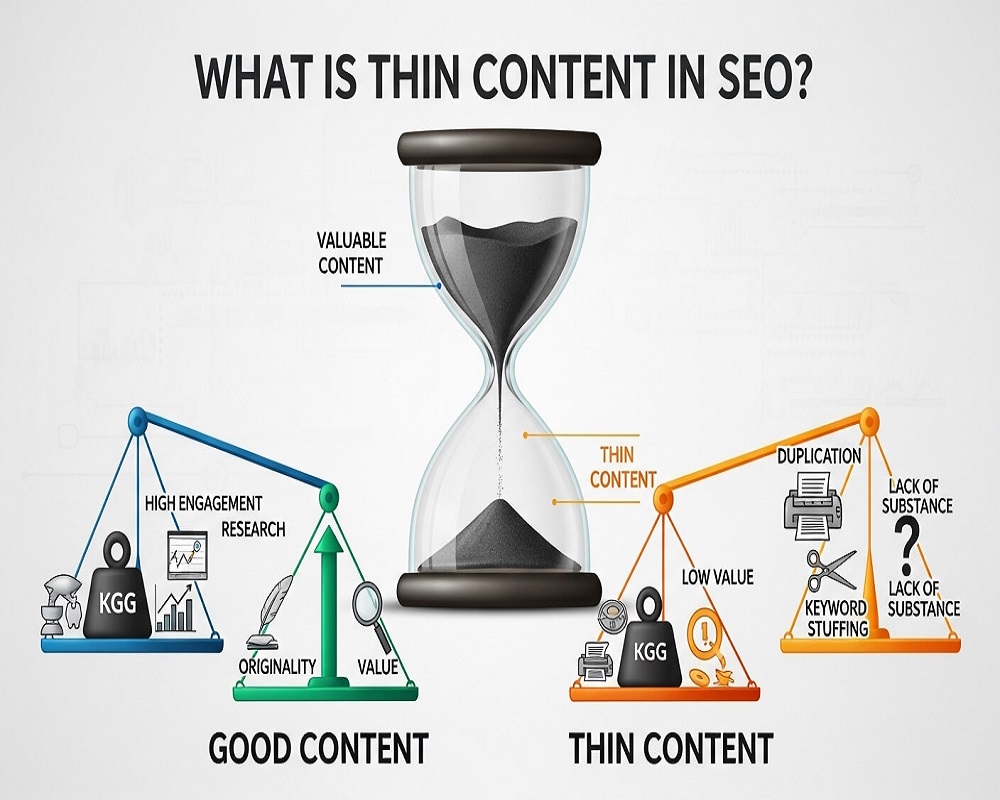
Short answer: Thin content is a page that gives searchers little or no real value: copied or scraped text, auto-generated or near-duplicate pages, thin affiliate pages, doorway pages, or short pages that do not answer the query. It is not defined by word count. Fix it page by page: improve pages that deserve to rank, merge overlapping ones, noindex pages users need but searchers do not, and remove or redirect the rest.
This guide is for site owners and SEOs who suspect that weak pages are holding the whole site back, perhaps after a core update or a “Crawled, currently not indexed” spike. You will learn what Google actually counts as thin, how to find those pages, and how to decide whether each one should be improved, merged, noindexed or removed.
What is thin content?
Thin content is any page whose main content adds little or nothing for the person who lands on it. Google’s own wording, in its manual actions documentation, describes “low-quality pages or shallow pages” using techniques that “don’t provide users with substantially unique or valuable content”.
The key word is value, not length. Google’s SEO Starter Guide says the length of content alone does not matter for ranking and there is no magical word count target, minimum or maximum. A 150-word page with opening hours, a map and a phone number can be exactly what a local searcher needs. A 2,000-word article that restates the same three points is thin.
Common types of thin content
| Type | What it looks like | Where Google covers it |
|---|---|---|
| Scraped or copied content | Text republished from other sites or manufacturers without adding anything | Spam policies: scraping |
| Scaled or auto-generated pages | Many pages generated mainly to rank, with little value, whether by AI, templates or people | Spam policies: scaled content abuse |
| Thin affiliate pages | Product descriptions and reviews copied from the merchant with affiliate links and nothing original | Spam policies: thin affiliation |
| Doorway pages | Near-identical pages for each city or variant that funnel users to one place | Spam policies: doorway abuse |
| Near-duplicate internal pages | Tag archives, filtered listings, printer versions, empty categories | Duplicate URL consolidation |
| Shallow articles | Generic posts that do not answer the query better than what already ranks | Helpful content guidance |
The first four rows come directly from Google’s spam policies, which define scaled content abuse as generating many pages “for the primary purpose of manipulating search rankings” that provide “little to no value to users, no matter how it’s created”. The last two are quality problems rather than spam, but they hurt in the same way.
Why thin content hurts the whole site
Thin content has been a target since Google’s Panda change in February 2011, which Google said noticeably affected 11.8% of queries and was aimed at sites that are “low-value add for users” or “copy content from other websites” (Google, 2011). Today these quality judgements are part of Google’s core ranking systems. The effects I see on audits:
- Site-wide quality signals drop. A large share of weak pages can pull down how Google sees the site as a whole, not just the weak pages. This is a common pattern after a core update.
- Pages stop being indexed. Google crawls them but chooses not to index them. My guide to crawled, currently not indexed covers this status.
- Crawling is wasted. On large sites, thousands of thin URLs use up crawling that should go to important pages. See index bloat.
- Manual actions. In serious cases, a reviewer applies a “Thin content with little or no added value” manual action, visible in Search Console.
How to find thin content on your site
- Check Search Console first. Look at Security and Manual Actions for a thin content action, and at the Page indexing report for large numbers of “Crawled, currently not indexed” or “Duplicate without user-selected canonical” URLs.
- Crawl the site. Use a crawler to list every indexable URL with word count, title, H1 and duplicate content flags. Sort by word count and by duplicate titles. Low word count is a prompt to look, not a verdict.
- Add performance data. Join 12 months of Search Console clicks and impressions, plus conversions from analytics, to each URL. Pages with no impressions over a year are the main candidates.
- Look for patterns. Thin content usually comes in batches: city pages, tag archives, auto-created product variants, old news posts. Fixing a template fixes hundreds of pages.
- Check for copied text. Paste a few sentences from product and service pages into Google in quotes. If manufacturer or competitor pages appear, your text is not original.
- Read the pages. Compare a sample against what ranks for the same query. Would a searcher be glad they clicked yours?
My content audit guide has the spreadsheet layout I use for this, and my free word counter is handy for quick checks.
Decide what to do with each thin page
Every thin page needs one of four decisions. Work through this for each URL or template.
Improve, merge, noindex or remove?
Does the page target a search people actually make, with an intent no other page on your site covers?
Can you add genuine value: first-hand detail, original examples, specifics, answers to the questions searchers ask?
Does another page on your site cover the same intent?
Do users need the page on your site even though searchers do not (for example, login, filtered views, thank-you pages)?
Does the page have useful backlinks or meaningful traffic?
Result: improve. Rewrite the page so it answers the query better than what ranks now, then request recrawling and track its impressions over the following months.
Result: park it. If you cannot add real value yet, noindex the page (or fold it into a broader page) until you can, rather than leaving a weak page indexed.
Result: merge. Move anything useful into the stronger page, then 301 redirect the thin URL to it and update internal links.
Result: noindex. Keep the page for users but add a noindex robots meta tag so it stays out of search results.
Result: redirect. Remove the page and 301 redirect it to the closest relevant page so its links are not wasted.
Result: remove. Delete the page and let it return 404 or 410, and remove it from internal links and the sitemap.
For the technical side of these choices, see my guides to the robots meta tag and noindex vs canonical vs robots.txt. Do not block thin pages in robots.txt: Google then cannot see a noindex on them.
How to fix thin pages you keep
Adding words is not the fix. Adding value is. When I rewrite a thin page, I work through these:
- Match the intent. Check what format ranks (guide, list, tool, service page) and give the page that shape.
- Add first-hand detail. Real photos, prices or price ranges, process steps, local specifics, mistakes you have seen, and who wrote it. This is what Google’s E-E-A-T guidance is about; see my post on E-E-A-T on-page signals.
- Answer the follow-up questions searchers have, taken from “People also ask” and Search Console queries.
- Replace copied text with your own descriptions. For shops, my guide to product descriptions that rank shows how.
- Cut the padding. Long introductions, repeated summaries and generic definitions make a page longer but not better.
Worked example: 40 city pages for a Karachi AC repair company
A pattern I find often on Pakistani service sites: one page per area (“AC repair DHA”, “AC repair Gulshan”, “AC repair Johar” and so on), each about 300 words with only the area name changed. This is exactly what Google’s doorway abuse examples describe: pages targeted at regions or cities that funnel users to one page.
The fix I recommend: keep one strong AC repair service page with real prices, the brands serviced, response times and a list of areas covered. Keep separate area pages only where the business has something genuinely local to say, such as a branch, a technician based there, or area-specific photos and jobs. Merge the rest into the main page with 301 redirects. Fewer, better pages usually serve searchers better than dozens of near-copies.
Thin content mistakes to avoid
- Padding to a word count. A minimum length rule creates longer thin content.
- Mass-generating pages with AI and publishing without review. Google’s scaled content policy applies “no matter how it’s created”.
- Deleting pages with links or traffic without redirecting them.
- Using robots.txt to hide thin pages instead of noindex or removal.
- Fixing a few pages and leaving the template. If a template produces thin pages, fix the template.
- Expecting instant recovery. After a quality clean-up, changes often show over months, frequently around a later core update.
Frequently asked questions
How many words is thin content?
There is no number. Google says there is no magical word count target, minimum or maximum. Thin content is about value: a short page that fully answers a simple query is fine, and a long page that says nothing new is thin.
Is thin content a Google penalty?
It can be. Google can apply a manual action called “Thin content with little or no added value”, shown in Search Console. More often there is no penalty as such: Google’s quality systems simply rank the pages, and sometimes the site, lower.
Is thin content the same as duplicate content?
They overlap but are not the same. Duplicate content is identical or very similar text on several URLs. Thin content is any page with little value, which includes duplicates but also original pages that are simply shallow.
Should I delete thin content or improve it?
Improve pages that target a real search and that you can make genuinely useful. Merge pages that overlap with a stronger one. Remove or redirect the rest. Use the decision flow above for each page or template.
Is AI-generated content thin content?
Not automatically. Google judges the value of the content, not the tool used. Pages generated at scale mainly to rank, without adding value for readers, fall under its scaled content abuse policy whether made by AI or people.
Sources
- Google Search Central, “Spam policies for Google web search” (last updated 2026).
- Search Console Help, “Manual Actions report” (thin content with little or no added value).
- Google Search Central, “SEO Starter Guide” (last updated 2025).
- Google, “Finding more high-quality sites in search” (Official Google Blog, 2011).
If a core update or indexing drop has you worried about thin pages, my SEO audit service includes a URL-by-URL improve, merge, noindex or remove plan, or you can send me your site for a first look.