


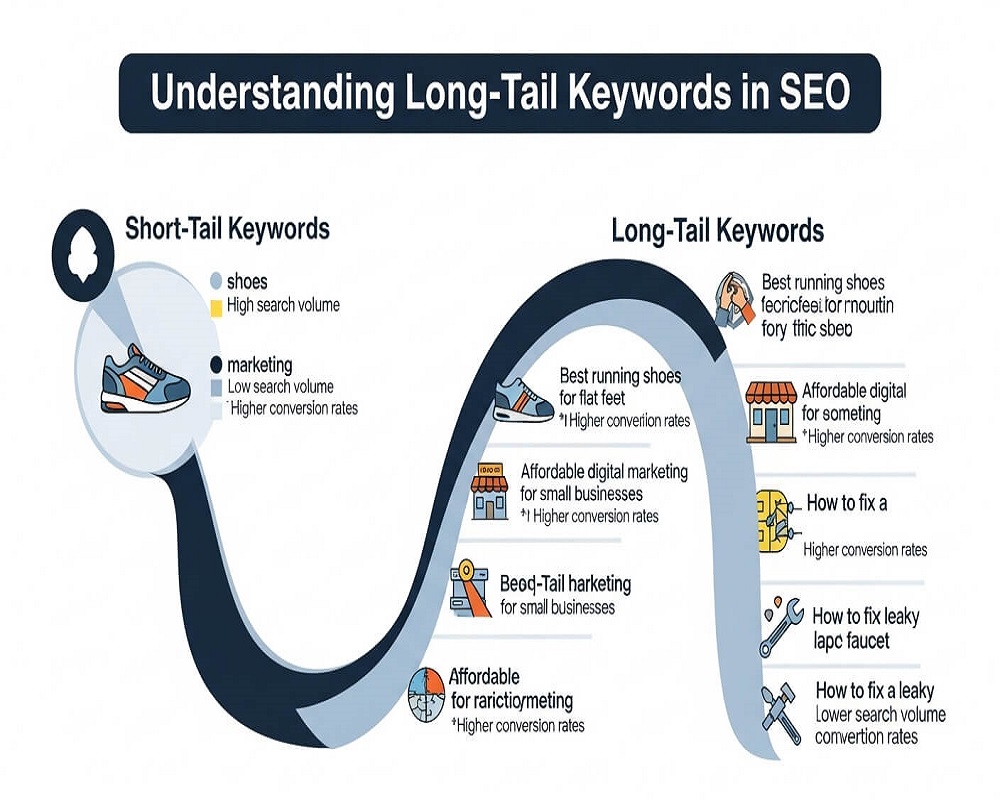
Short answer: A long-tail keyword is a specific search query with low individual search volume, such as “dentist open on Sunday in Gulistan-e-Johar” rather than “dentist”. It is defined by low demand and narrow intent, not by word count. Long-tail keywords are usually easier to rank for and closer to a decision, and together they make up most of the searches people actually type.
This guide is for business owners, bloggers and new SEOs who keep hearing “go after long-tail keywords” and want to know what that means in practice. By the end you will be able to spot a long-tail keyword, find them for your own site with free tools, decide which ones deserve their own page and which belong inside an existing page, and avoid the mistakes I most often see when people try this.
What a long-tail keyword actually is
The name comes from the shape of search demand. If you plot every keyword in a market by monthly searches, a small number of popular terms (“shoes”, “SEO”, “dentist”) sit at the tall head of the curve. After them comes an enormous, thin tail of specific queries that are each searched rarely. Those are long-tail keywords.
The common definition, “three or more words”, is a handy rule of thumb but it is not accurate. Ahrefs points out that defining long-tail keywords by length is a mistake: some one-word terms are barely searched, and some long phrases (think “how to lose weight fast”) have huge volume and brutal competition. What makes a keyword long-tail is low search volume and specific intent. Length usually comes with that, but it is a side effect.
Head, middle and long-tail compared
| Head term | Middle | Long-tail | |
|---|---|---|---|
| Example | running shoes | trail running shoes | trail running shoes for wide feet under 15000 rupees |
| Search volume | High | Moderate | Low, often under 50 a month or “no data” in tools |
| Intent | Vague: research, browse, buy, images? | Narrower | Clear: the searcher knows what they need |
| Who ranks | Big brands, marketplaces, Wikipedia | Established niche sites | Often smaller sites with a page that fits exactly |
| Best page type | Category or pillar page | Sub-category or guide | Product, service, blog post or a section of a page |
Long-tail keyword examples by type
Long-tail keywords are built by adding modifiers to a head term. Seeing the modifier types makes them much easier to find:
- Location: “AC repair Gulshan-e-Iqbal”, “wedding photographer Lahore DHA”, “accountant for small business Manchester”. Essential for local SEO.
- Audience: “accounting software for freelancers in Pakistan”, “SEO for dentists”.
- Problem or symptom: “WordPress site not showing in Google”, “laptop fan loud when charging”.
- Specification: “18 inch ceiling fan with remote”, “size 44 black leather sneakers”.
- Comparison: “Daraz vs Shopify store for small sellers”, “WebP vs AVIF for blog images”.
- Question: “how long does a Google Business Profile verification take”, “can I rank without backlinks”.
- Price and time: “cheap”, “under 5000”, “open now”, “same day”, “2026”.
- Roman Urdu and mixed language: in Pakistan many people search in Roman Urdu or a mix, for example “AC service karachi rate” or “best dentist near me johar”. Tools often show no volume for these, but they appear in Search Console.
Worked example: turning one head term into a long-tail list
Head term: solar panels (huge volume, dominated by manufacturers and marketplaces).
- solar panels for home in Karachi (location, audience)
- 5 kW solar system price in Pakistan (specification, price)
- on-grid vs hybrid solar system for load shedding (comparison, problem)
- how many solar panels to run a 1.5 ton inverter AC (question)
- net metering application process K-Electric (process, local entity)
Each of these has far lower volume than “solar panels”, but each tells you exactly what the searcher wants, and a small installer can realistically rank for them with one strong page each, or with sections on a single in-depth page.
Why long-tail keywords matter more than their volume suggests
Low volume makes long-tail keywords look unimportant in tools. In practice they are where most search actually happens. Ahrefs reports that keywords with fewer than 10 searches a month make up almost 93% of its US keyword database, and Google has said that 15% of the queries it sees each day are new. In other words, a large share of what your customers type is too rare or too new to appear in any keyword tool.
From the audits I run, the benefits show up in four ways:
- Clear intent. “Root canal cost in Karachi” tells you the reader is close to booking. “Teeth” tells you almost nothing. Matching search intent exactly is much easier with specific queries.
- Weaker competition. Big sites rarely build a page for every narrow variation, which leaves room for a smaller site with a precise answer.
- One page ranks for many of them. A good page usually picks up dozens or hundreds of related long-tail queries it never targeted. This is why traffic often beats the tool estimate.
- They fit conversational and AI search. Google says BERT particularly helped with longer, more conversational queries, and the questions people put to AI assistants are long-tail by nature. Pages that answer specific questions clearly are the ones that get quoted, which I cover in my guide to optimising content for AI Overviews.
Check your understanding
Which of these is most likely a long-tail keyword?
- how to lose weight fast
- physiotherapist for frozen shoulder in Gulshan
- insurance
Long-tail is about low volume and specific intent. “How to lose weight fast” is long but heavily searched and very competitive; the physiotherapist query is narrow, local and rarely searched.
A keyword tool shows “0 searches” for a query your customers use. What should you do?
- Ignore it, because nobody searches it
- Create a separate page for it anyway
- Check Search Console and the results page, then cover it on the closest relevant page
Tools miss many real long-tail and Roman Urdu queries. Search Console shows what you already get impressions for, and the results page shows whether Google treats it as its own topic.
“Best CRM for small business” and “top CRM software for small companies” return almost the same results. How many pages do you need?
- One page that covers both
- Two pages, one for each phrasing
- None, they are too competitive
If the results overlap heavily, Google sees one intent. Two pages would compete with each other, which is keyword cannibalisation.
What is the most reliable source of long-tail keywords your site can already rank for?
- A paid keyword tool’s suggestions
- The Queries tab in Google Search Console
- Competitor meta keywords
Search Console shows real queries where Google already shows your pages, including ones with too little volume for any tool.
How to find long-tail keywords (free methods first)
- Google Search Console. Open Performance, then the Queries tab, and sort by impressions. Filter with a regular expression such as
^(how|what|why|can|which|is|does)\bto see question queries, or by word count with^(\S+\s){4,}\S+$for queries of five or more words. Pages sitting in positions 8 to 20 for these queries are the quickest wins; my guide to striking distance keywords shows how to work through them. - Google autocomplete. Type your head term followed by a letter, a question word or “for”, and note the suggestions.
- People also ask and related searches. Open a few questions and new ones load. These are phrasings Google already connects to your topic.
- Forums and communities. Read how people describe the problem on Reddit, Quora, Facebook groups and local forums. Their words are the long-tail queries.
- Your own customers. Sales calls, WhatsApp chats, support tickets and site search logs are full of real phrasings no tool shows.
- Keyword tools. Google Keyword Planner, or a paid tool, with filters for low difficulty and question or modifier terms. AnswerThePublic is useful for question formats; I review it in my post on Answer the Public.
Treat volume numbers on long-tail terms as rough. Tools round, group similar queries and miss local and mixed-language phrasing. The question that matters is whether the query reflects a real need you can answer well. My keyword research guide covers the wider process.
Decide: new page, section or ignore?
This is the step most long-tail advice skips, and it is where I see sites go wrong. Writing a separate page for every variation creates thin, near-duplicate pages that compete with each other. Use this decision table before you write anything:
| What you see | What it means | What to do |
|---|---|---|
| Top results for the long-tail query are the same pages that rank for your head term | Google sees one intent | Cover it as a section or FAQ on the existing page |
| Top results are different, dedicated pages answering exactly this query | Distinct intent | Create a dedicated page |
| Several long-tail queries share the same answer with different wording | Variations of one need | One page; use the clearest phrasing in the title and H1, others naturally in the text |
| The query is about something you do not offer or cannot speak to from experience | Not your audience | Ignore it |
| You already have two pages getting impressions for it | Cannibalisation | Merge or differentiate them |
Map each chosen keyword to one URL in a simple sheet. My guide to keyword mapping explains the template I use, and grouping related pages into topic clusters helps the whole set build authority.
How to use long-tail keywords on the page
- Answer the query near the top. If the query is a question, give the answer in the first paragraph, then the detail.
- Put the main phrasing where it counts: the title tag, H1, URL slug and opening paragraph, written naturally.
- Use related long-tail questions as H2s, H3s or FAQs when the page genuinely answers them.
- Add the specifics the query asks for: prices, sizes, areas, steps, comparisons. Specific queries need specific answers.
- Link between related pages with descriptive anchors so the cluster is clear.
Google’s guidance on helpful content lists producing lots of content on many topics in the hope some of it performs, and using extensive automation to do it, as signs of search-engine-first content. Long-tail targeting done badly looks exactly like that. Done well, it is simply answering your customers’ real questions one by one. If you are building pages at scale, read my guide to programmatic SEO first.
Mistakes I see with long-tail keywords
- A thin page for every variation (“plumber Karachi”, “plumber in Karachi”, “Karachi plumber”), each with the same text.
- Forcing awkward phrases like “best dentist near me Karachi cheap” into sentences word for word.
- Dropping a query because a tool says zero volume, when Search Console shows impressions for it.
- Chasing long-tail terms with no business value, such as informational queries unrelated to what you sell.
- Not measuring the group. Judge long-tail work by total clicks and enquiries to the page, not by the rank of one phrase.
Frequently asked questions
How many words is a long-tail keyword?
Most are three words or more, but word count is not the definition. A long-tail keyword is one with low search volume and specific intent. Some short terms are long-tail and some long phrases are highly competitive head terms.
Are long-tail keywords easier to rank for?
Usually, because fewer sites target each one precisely. They are not automatically easy: if forums, marketplaces or strong brands already answer the query well, you still need a better, more specific page.
What is the difference between short-tail and long-tail keywords?
Short-tail (head) keywords are broad and heavily searched, such as “laptops”. Long-tail keywords are narrow and searched less often, such as “laptop for AutoCAD students under 150000”. Head terms suit category and pillar pages; long-tail terms suit specific pages and sections.
Should I create a separate page for every long-tail keyword?
No. Check whether Google shows different pages for the query. If the results match those of a broader keyword you already target, cover the long-tail query as a section or FAQ on that page.
Do long-tail keywords still matter with AI search?
Yes, arguably more. People ask AI assistants and Google’s AI features long, specific questions. Pages that answer those questions clearly and directly are more likely to be cited and clicked.
Sources
- Ahrefs, “Long-Tail Keywords: What They Are and How to Get Search Traffic From Them” (2021, updated 2026).
- Google, “Understanding searches better than ever before” (2019).
- Google Search Central, “Creating helpful, reliable, people-first content” (accessed 2026).
If you want help building a long-tail plan from your own Search Console data rather than a tool’s guesses, my on-page optimisation service starts there, or you can get in touch with the questions your customers keep asking.